



Heating oil futures trade on the Chicago Mercantile Exchange’s (CME) NYMEX division. Each heating oil contract contains 42,000 barrels of the energy commodity. Refiners process raw crude oil into oil products. Gasoline production favors WTI NYMEX crude oil as the fuel requires lighter and sweeter petroleum with lower sulfur content. Heating oil favors ICE Brent crude oil with slightly higher sulfur content.
WTI crude oil is the North American grade, the pricing benchmark for approximately one-third of the world’s oil. Meanwhile, two-thirds of the world’s producers and consumers utilize the Brent benchmark, which reflects the price of petroleum produced in Europe, Russia, North Africa, and the Middle East. Brent is the petroleum that OPEC, the international oil cartel, influences via its production policy.
OPEC and Russia’s dominance in Brent pricing is why heating oil and distillate prices moved to a record high in 2022 and was near $3.90 per gallon wholesale on October 20.
A bullish path for heating oil and distillates
NYMEX heating oil futures rose to a record high of $5.2217 per gallon wholesale in April 2022. Before 2022, the record peak was at $4.1586 in July 2008.
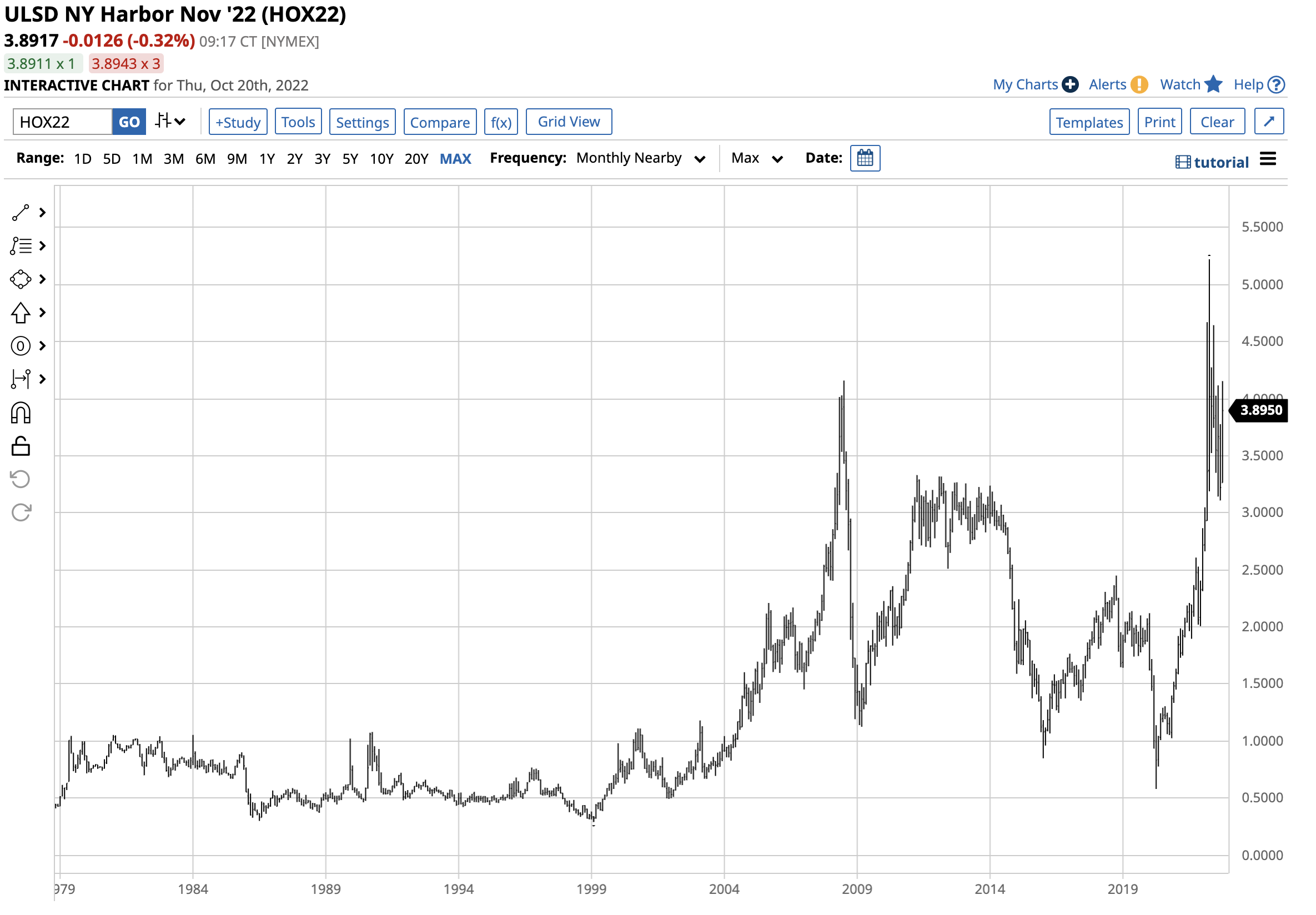
The chart highlights at near $3.90 per gallon, heating oil futures remain at a fourteen-year high.
Seasonality does not matter for heating oil. Despite its seasonal name, it is a proxy for diesel and jet fuels, which like heating oil, are distillate products.
New record highs in distillate crack spreads
Crack spreads are the margins for processing a barrel of crude oil into oil products. On October 18, 2022, distillate crack spreads rose to $88.56 per barrel, an all-time high. Brent petroleum is the primary ingredient in distillates because of its higher sulfur content than WTI petroleum.
The rise in processing spreads has supported distillate prices, underpinning heating oil futures that are near the $4 per gallon wholesale level.
Brent trades at a premium to WTI, supporting heating oil futures
Brent crude oil is the primary ingredient in distillate processing, but it is also the petroleum that is in the crosshairs of the war in Ukraine, OPEC’s control of worldwide oil prices, and the US energy policy that favors a greener path to address climate change that inhibits fossil fuel production and consumption.
The current environment has caused Brent to trade at a higher price than the North American WTI petroleum.
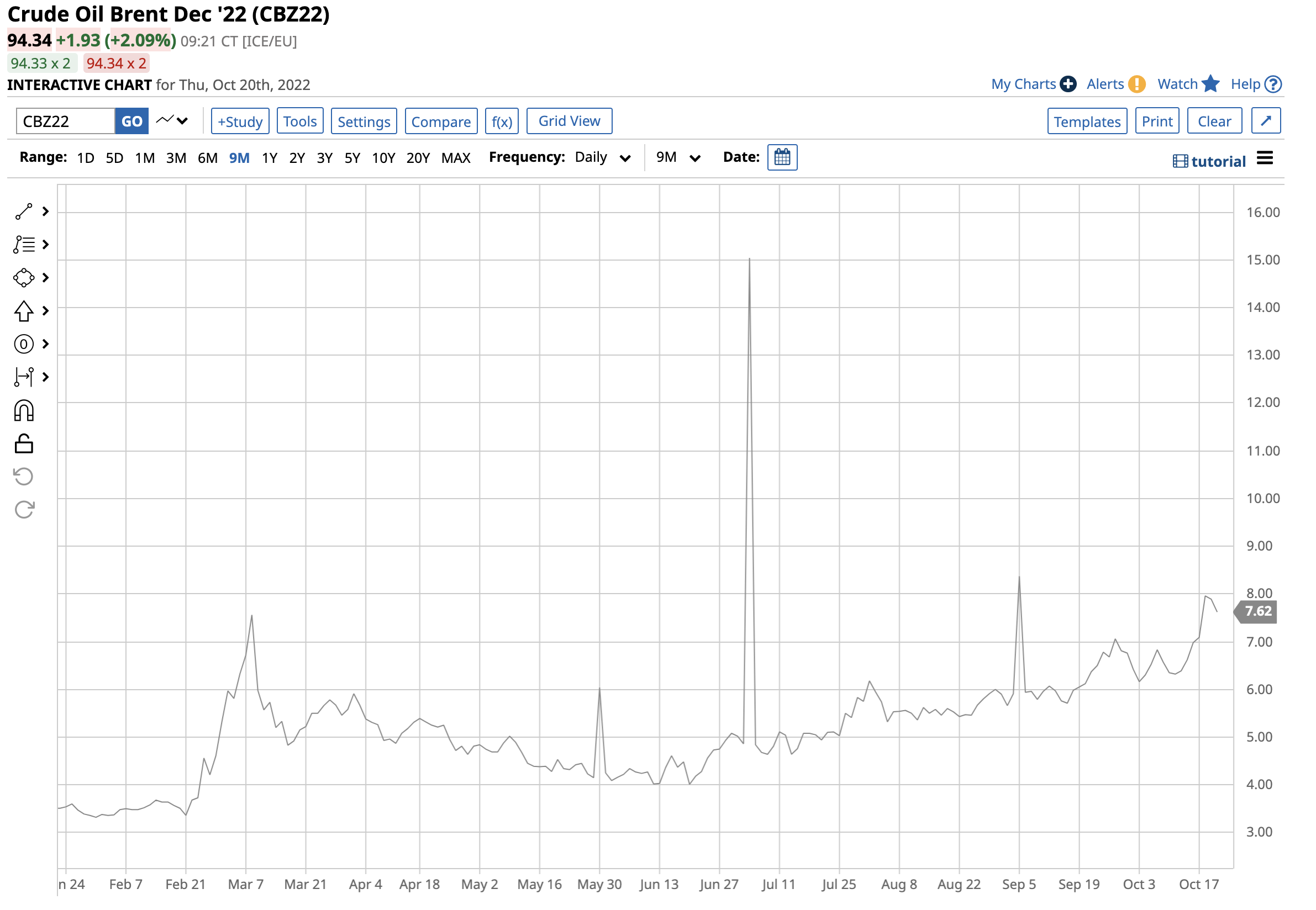
The chart ({CBZ22}-{CLZ22}) shows that Brent crude oil for December delivery was trading at a $7.62 per barrel premium over WTI crude oil for December delivery. The Brent premium contributes to the high price of heating oil and other distillate products.
OPEC is in control
At the most recent meeting of OPEC oil ministers in Vienna, Austria, the cartel agreed to cut output by two million barrels per day. The production decline came as Brent futures fell from $139.13 per barrel, the highest price since 2008, to the $90 level. OPEC said its move was over concerns about economic weakness in China and the US, the world’s leading oil-consuming countries. The cartel cut production despite protests from the US government, which had requested an output increase.
Over the past months, the US has released substantial crude oil from its Strategic Petroleum Reserves to address rising oil and oil product prices. At the end of 2021, the SPR stood at the 594.7-million-barrel level. As of the week ending on October 14, it was 31.9% lower at 405.10 million barrels. The Biden administration had authorized an unprecedented one-million-barrel-per-day release, scheduled through October 2022 and extended it through December 2022.
The bottom line is that the US energy policy, supporting alternative and renewable fuels and inhibiting fossil fuel production and consumption, surrendered control of global oil prices, handing it back to the international oil cartel and its most influential non-member, Russia. Oil production policy is now a function of decisions from Riyadh, Saudi Arabia, and Moscow. The Saudis and Russians are not predisposed to do any favors for the United States in the current geopolitical environment.
Payback for the Saudis and a Russian weapon
The Biden administration does not have a warm and fuzzy relationship with Saudi Arabia. Objections and rhetoric surrounding the murder of a Washington Post journalist pointing blame at the Crown Price soured relations. Moreover, after suffering from low oil prices because of the rise of US shale production, the Saudis are now managing the oil price to produce the optimal level of revenue for themselves and other OPEC members. High oil prices are payback for the deteriorating Saudi-US relationship.
Meanwhile, Russia has become the most influential non-OPEC member since 2016, when Moscow agreed with the cartel to participate in production decisions that support petroleum prices. With high prices fueling US inflation in 2022, Russia’s invasion of Ukraine, and US and NATO support for Ukraine, crude oil and natural gas have become economic weapons for the Russian government. The bottom line is that crude oil prices could rise when the US SPR releases end in November. Meanwhile, heating oil and other distillate prices will continue to be the most sensitive to OPEC production policy and Russia’s desire to use petroleum as a weapon against the US and other “unfriendly” countries supporting Ukraine. Moreover, when China emerges from its COVID-19 lockdowns and the economy rebounds, expect oil and oil product demand to increase, which could send prices back towards a challenge of the 2022 high and, perhaps, the 2008 all-time peak.
Heating oil has been the most sensitive oil product because Brent crude oil is the primary ingredient in distillate refining.
More Energy News from Barchart
- Nat-Gas Prices Fall on Forecasts for Warm U.S. Temps
- Crude Jumps as Weekly EIA Inventories Unexpectedly Decline
- Kimbell Royalty Partner's 11.8% Dividend Yield Looks Sustainable
- Crude Climbs as Weekly EIA Inventories Unexpectedly Fall

/Oracle%20Corp_%20logo%20on%20phone%20and%20stock%20data-by%20Rokas%20Tenys%20via%20Shutterstock.jpg)

/Dominos%20Pizza%20Inc%20storefront%20by-KathyDewar%20via%20iStock.jpg)