




A long straddle is an advanced options strategy used when a trader is seeking to profit from a big move in either direction and / or an increase in implied volatility.
To execute the strategy, a trader would buy a call and a put with the following conditions:
- Both options must use the same underlying stock
- Both options must have the same expiration
- Both options must have the same strike price
Since it involves having to buy both a call and a put, the trader must pay two premiums up-front, which also happens to be the maximum possible loss.
The potential profit is theoretically unlimited, although the trade will lose money each day through time decay if a big move does not occur.
The position means you will start with a net debit and only profit when the underlying stock rises above the upper break-even point or falls below the lower break-even point.
Profits can be made with a smaller price move if the move happens early in the trade.
Let’s take a look at Barchart’s Long Straddle Screener for July 29th. I have added a filer for Market Cap above 40b to remove small capitalization stocks.
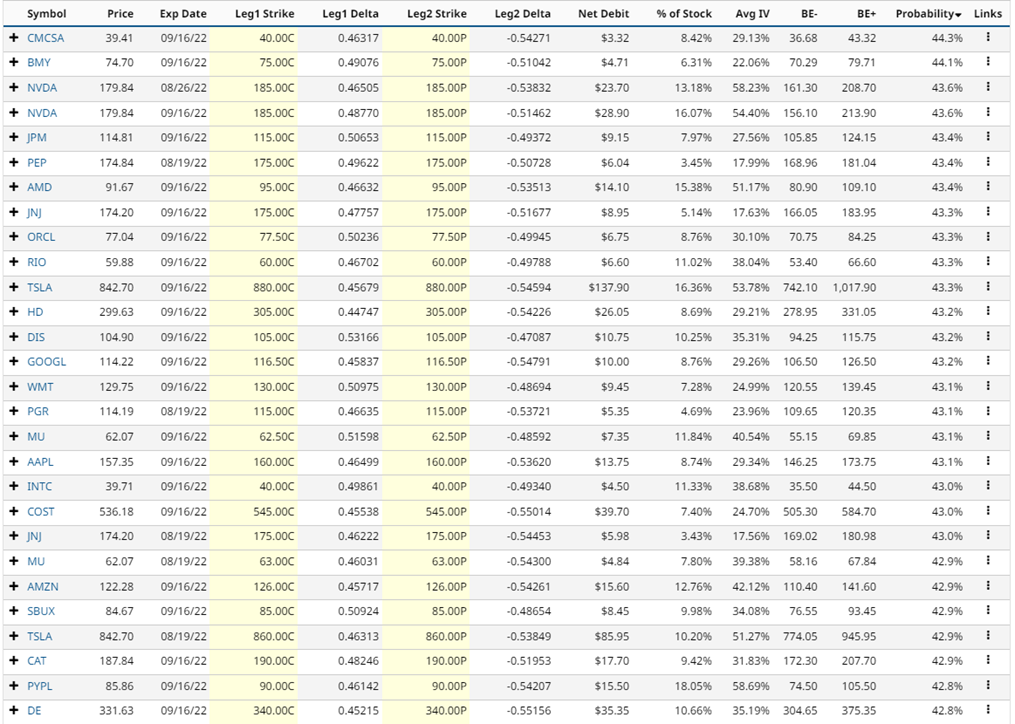
The screener shows some interesting long straddle trades on popular stocks such as NVDA, JPM, AMD, JNJ and TSLA. Let’s walk through a couple of examples.
NVDA Long Straddle Example
Let’s take a look at the third line item – a long straddle on Nvidia.
Using the August 26th expiry, the trade would involve buying the 185 strike call and the 185 strike put. The premium paid for the trade would be $2,370 which is also the maximum loss. The maximum profit is theoretically unlimited. The lower breakeven price is 161.30 and the upper breakeven price is 208.70. The premium paid is equal to 13.18% and the probability of success is estimated at 43.6%.
The Barchart Technical Opinion rating is a 56% Sell with a weakest short term outlook on maintaining the current direction.
Implied volatility is currently 57.39% compared to a twelve-month low of 31.11% and a high of 84.76%.
JPM Long Straddle Example
Let’s take a look at the fifth line item which is on a stock with much lower volatility – JPM.
Using the September 16th expiry, the trade would involve buying the 115 strike call and the 115 strike put. The premium paid for the trade would be $915 which is also the maximum loss. The maximum profit is theoretically unlimited. The lower breakeven price is 105.85 and the upper breakeven price is 124.15. The premium paid is equal to 7.97% which is less than the NVDA example, because JPM implied volatility is 25.90% compared to 57.39% for NVDA. The probability of success is estimated at 43.4%.
The Barchart Technical Opinion rating is an 88% Sell with a weakening short term outlook on maintaining the current direction. Long term indicators fully support a continuation of the trend.
JNJ Long Straddle Example
Let’s take a look at one final straddle, the eighth line item – a long straddle on JNJ.
Once again, using the September 16th expiry, the trade would involve buying the 175 strike call and the 175 strike put. The premium paid for the trade would be $895 which is also the maximum loss. The maximum profit is theoretically unlimited. The lower breakeven price is 166.05 and the upper breakeven price is 183.95. The premium received is equal to 5.14% which is also one of the lower results from the screener. The probability of success is estimated at 43.3%.
The Barchart Technical Opinion rating is an 8% Sell with a weakest short term outlook on maintaining the current direction.
Implied volatility is currently 17.66% compared to a twelve-month low of 25.65% and a high of 12.87%.
Mitigating Risk
Long straddles can lose money fairly quickly if the stock stay flat, and / or if implied volatility drops.
Position sizing is important so that a large loss does not cause more than a 1-2% loss in total portfolio value. Another good rule of thumb is a 20-30% stop loss.
Please remember that options are risky, and investors can lose 100% of their investment. This article is for education purposes only and not a trade recommendation. Remember to always do your own due diligence and consult your financial advisor before making any investment decisions.
*Disclaimer: On the date of publication, Steven Baster did not have (either directly or indirectly) positions in some of the securities mentioned in this article. All information and data in this article is solely for informational purposes. Data as of after-hours, July 28, 2022.
More Stock Market News from Barchart

/Microsoft%20headquarters%20By%20Peter.jpeg)
/Micron%20Technology%20Inc_%20logo%20on%20building-by%20vzphotos%20vis%20iStock.jpg)
/NVIDIA%20Corp%20logo%20outside%20building-by%20BING-JHEN_HONG%20via%20iStock.jpg)
/Amazon%20-%20Image%20by%20bluestork%20via%20Shutterstock.jpg)
/Robot%20arm%20industrial%20automation%20manufacturing%20by%20Eakrin%20via%20Adobe%20Stock.jpeg)