Pan American Airways began a new era of scheduled trans-Atlantic passenger air service on June 28, 1939. Its Dixie Clipper “flying boat” began its inaugural flight along Pan Am’s newly established route between New York and Marseilles, France, via the south Atlantic Ocean.
Almost 5,000 people saw the Dixie Clipper’s initial takeoff from Port Washington, New York. The airplane’s initial flight on the new route began at 1:59 p.m. on June 28, 1939. There were 22 passengers and 12 crew members on board the airplane, which landed at Lisbon, Portugal, on the afternoon of June 29, 1939, after a flight of approximately 27 hours (which included a stop in the Azores). The Dixie Clipper then flew to Marseilles the next day, landing there some 42 hours after leaving New York.
Pan Am’s domination of trans-Atlantic and trans-Pacific civilian passenger flights was halted by the outbreak of World War II. Pan Am’s commercial passenger service using the Boeing B-314 lasted less than three years, and ended after the Japanese attack on Pearl Harbor and other locations in December 1941.


(Image: Pan Am Historical Foundation)
Pan Am overview
Pan American Airways (later Pan American World Airways, and known simply as Pan Am) was the “principal and largest international air carrier and unofficial overseas flag carrier of the United States for much of the 20th century.”
Pan Am was founded in 1927 by two former U.S. Army Air Corps majors. It began by flying scheduled airmail and passenger service between Key West, Florida, and Havana, Cuba. Led during the 1930s by American entrepreneur Juan Trippe, Pan Am bought a fleet of flying boats and its route network was originally centered on Central and South America. With success on those routes, the airline added numerous destinations to new trans-Pacific and trans-Atlantic routes.
Trippe called the airline’s flying boats “clippers” to link Pan Am with the maritime heritage of the world’s great ocean liners.
By the mid-20th century, Pan Am had a near-monopoly on international routes from the United States. A trend-setting airline, It was the first to fly worldwide and pioneered a number of airline industry innovations, including the use of jet-powered aircraft, jumbo jets and computerized reservation systems. Until its end in 1991, Pan Am “epitomized the luxury and glamor of intercontinental travel.”

The Boeing 314
Pan American’s first Clippers were M-130’s, built by the Glenn L. Martin Company. It was an M-130 that was the first “China Clipper,” an aircraft and route that increased Pan Am’s visibility and reputation.
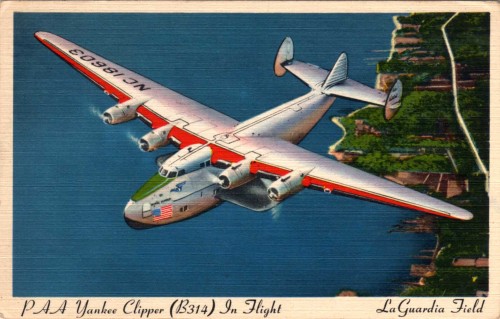
However, when Pam Am requested bids for a new and larger flying boat with unprecedented range, it was the Boeing Airplane Company’s bid that was successful. On July 21, 1936, Pan Am signed a contract with Boeing for six of its flying boats. Also known to the public as Clippers, the aircraft were formally classified as the Boeing Model 314 (B-314).
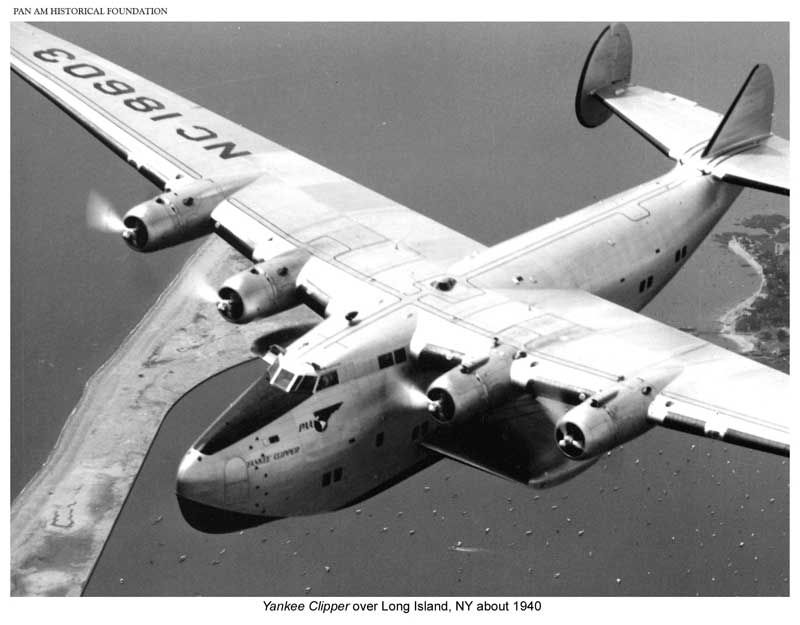
Among the largest aircraft built during the pre-World War II era, the long-range airplanes were manufactured by Boeing between 1938 and 1941. The Boeing 314 had a range of 3,500 miles, enough to cross both the Atlantic and Pacific oceans. Each airplane cost $550,000 (in 1936 dollars – equivalent to more than $115 million today).
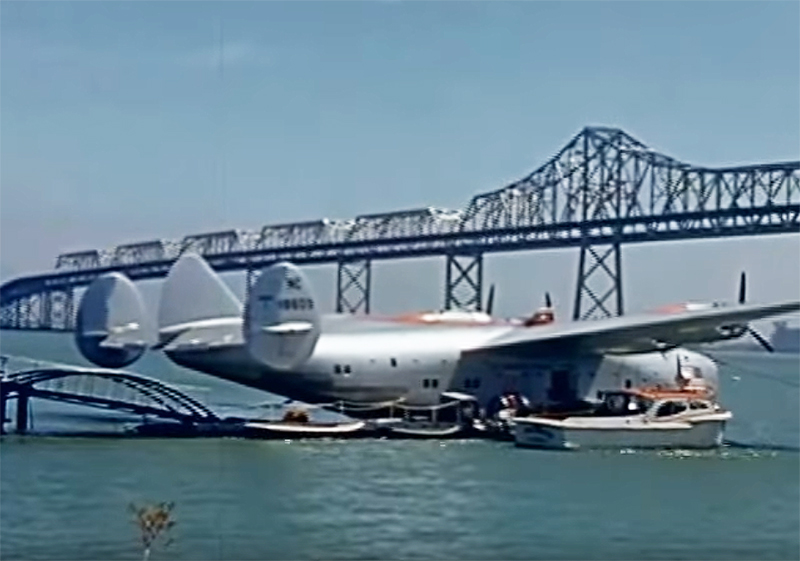
The 314s were assembled at the Boeing manufacturing facility on the Duwamish River in Seattle. Boeing used a “series of heavy ribs and spars to create a robust fuselage and cantilevered wing, eliminating the need for external drag-inducing struts to brace the wings.” In addition, Boeing “incorporated Dornier-style sponsons into the hull structure. The sponsons, broad lateral extensions at the waterline on both sides of the hull, served several purposes: they provided a wide platform to stabilize the craft while floating; they served as a gangway for boarding and exiting; and they possessed intentional shaping to contribute additional aerodynamic lift in flight.”

Pan Am’s Clipper fleet
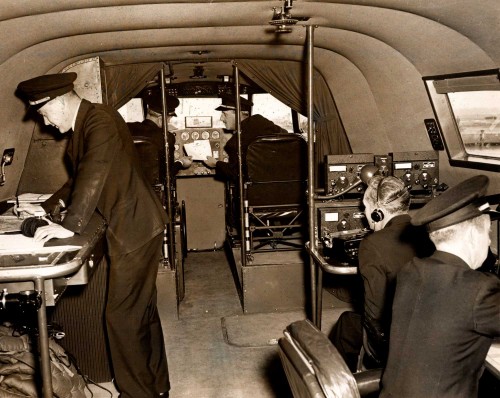
Pan Am’s Clippers were built and designed for “one-class” luxury air travel, which was necessary because of the long duration of transoceanic flights. The aircraft’s seats were easily converted into 36 bunks for overnight accommodation. Men and women were provided with separate dressing rooms, and each Clipper was equipped with a lounge and dining area. Meals were prepared by chefs hired from four-star hotels, and white-coated stewards served the five- and six-course meals on china accompanied by “gleaming silver service.”
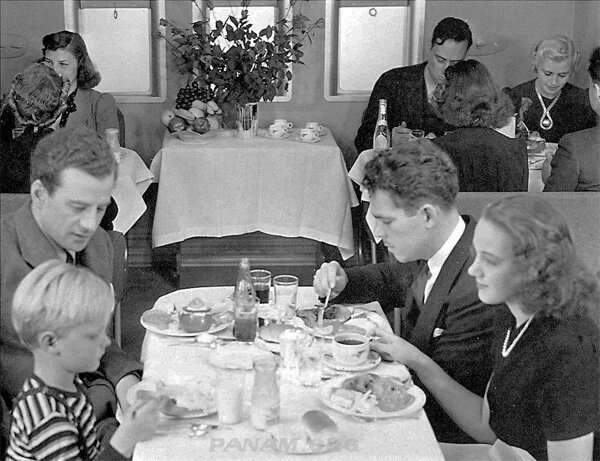
The standard of luxury on Pan Am’s Clippers has rarely been matched on any aircraft since then. They were a form of travel for the rich. A round-trip ticket from New York to England cost $675 (equivalent to more than $13,000 today). Most of the Clippers’ flights were trans-Pacific; a one-way ticket from San Francisco to Hong Kong cost $760 (equivalent to more than $15,000 today). Pan Am’s Boeing 314 Clippers represented the romance of flight.
Passengers and their baggage were weighed, with each passenger allowed up to 77 pounds of free baggage. However, the charge for exceeding the weight allowance was $3.25 per pound (equivalent to more than $63 today). To fly the long-range routes of the Clippers, each B-314 carried nearly 4,250 gallons of gasoline and 300 gallons of oil (to lubricate/operate the airplane’s radial engines).
The Boeing-built Clippers had a cruising speed of 188 miles per hour (although flights carrying the airplane’s maximum gross weight were flown at 155 miles per hour). The Dixie Clipper “weighed nearly 42 tons, had a wingspan of 152 feet, and measured 109 feet in length.”
Another factor that was critical to the Pan Am Clipper fleet’s success was the capabilities of each aircraft’s flight crews. They were “extremely skilled at long-distance, over-water flight operations and navigation.” Only Pan Am’s “very best and most experienced flight crews were assigned Boeing 314 flying boat duty.” Pan Am captains, as well as first and second officers, were very experienced, with thousands of hours of flight time – not just in airplanes per se, but in other seaplanes and flying boats. In addition, Pan Am mandated “rigorous training in dead reckoning, timed turns, judging drift from sea current, celestial navigation, and radio navigation.”
The outbreak of World War II
Because of Pan Am’s success with its first six Boeing 314 aircraft, the airline ordered six improved models that were to be built and delivered in 1941. Pan Am sought to double its service on its Atlantic and Pacific routes. The six additional airplanes had increased engine power, could carry an additional 1,200 gallons of fuel, and had the capacity for 77 daytime passengers. These airplanes were the Boeing 314A.
However, the German invasion of Poland on September 1, 1939, as well as the rapid fall of France in 1940 “caused some doubt about whether the Atlantic service could continue.” The number of passengers flying the trans-Atlantic routes was declining, and if either Spain or Portugal (both neutral countries at the time) were to join the Axis, then Pan Am’s flights to Lisbon would end.
Pan Am’s executive management considered reducing its order with Boeing; instead, in August 1940, it reached an agreement to sell three of the six 314A’s that were being built to the United Kingdom. The British Overseas Airways Corporation (BOAC) intended to use the aircraft to fly non-stop on the airline’s UK-West Africa route, because its existing flying boats could not make the trip without stopping in Lisbon. The aircraft provided a vital transportation and communications link for Britain, but was politically controversial. Prime Minister Winston Churchill later flew on one of the aircraft, which he praised intensely, thereby adding to the Clippers’ reputation during the war.
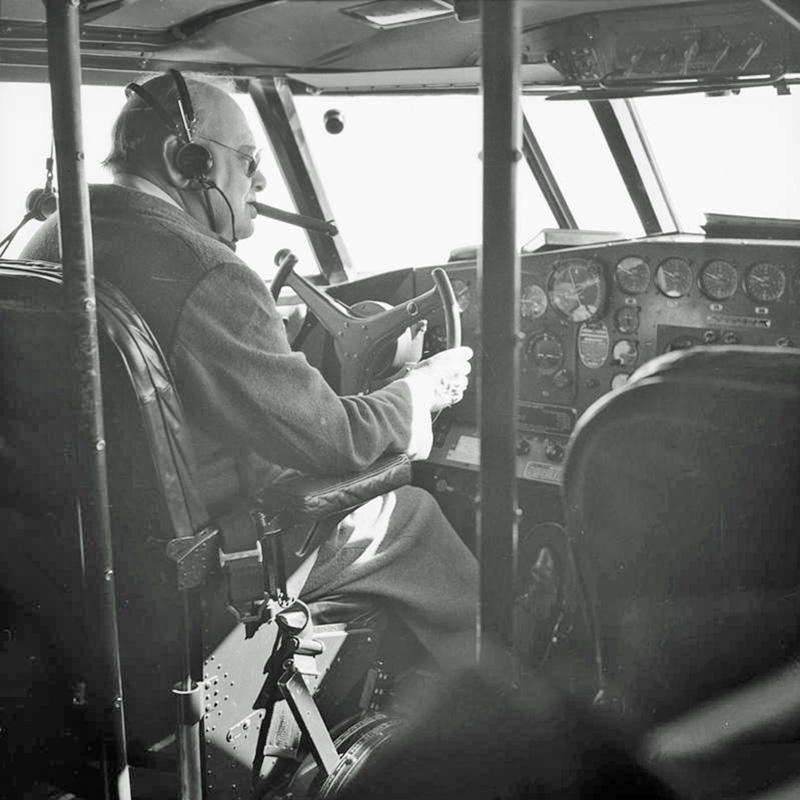
Pan Am’s trans-Atlantic flights to neutral Portugal and Ireland continued throughout World War II (1939-1945). However, military passengers and cargo were given priority, and Pan Am’s service and amenities were more spartan than before the war.
On the other side of the world, the Pacific Clipper was nearing Auckland, New Zealand from San Francisco when the Japanese attacked American and British possessions in the Pacific. Choosing not to risk flying back to Honolulu and being shot down by Japanese fighters, the Clipper was directed by Pan Am to fly west to New York. Beginning on December 8, 1941, at Auckland, the Pacific Clipper covered over 31,500 miles via Surabaya (Indonesia), Karachi (Pakistan), the nation of Bahrain, Khartoum (Sudan) and Leopoldville (in what was then the Belgian Congo). The Pacific Clipper landed at Pan Am’s LaGuardia Field seaplane base on January 6, 1942, nearly a month later.
World War II service
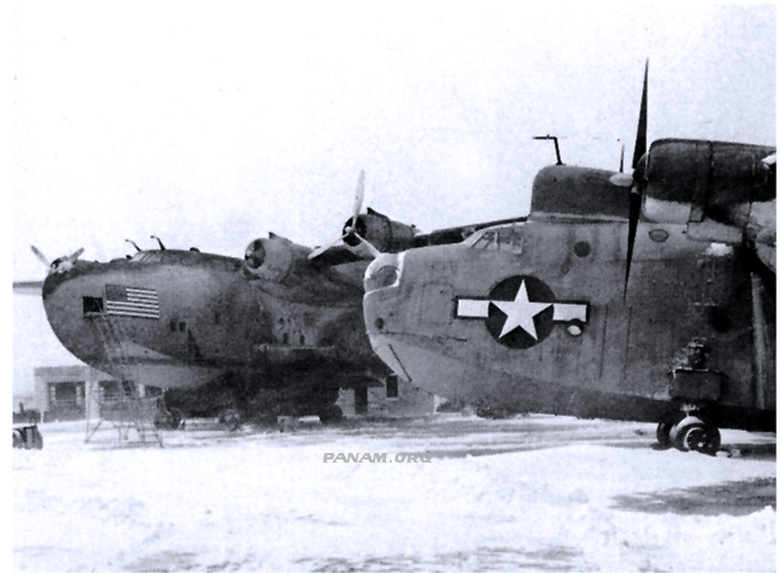
The U.S. military used Pan Am’s Clipper fleet extensively during World War II. Pan Am’s fleet was purchased by the Department of War (U.S. Army) and Department of the Navy and then leased back to Pan Am for a dollar. The airplanes’ markings were changed, but the Clippers continued to be flown by their experienced Pan Am civilian crews. The flying boats were utilized to ferry personnel and equipment to the European and Pacific theaters of war.
American military cargo was carried via Natal, Brazil to Liberia; the cargo was used to supply the British forces at Cairo, Egypt, and even the Russians, via the Persian Corridor. At that time, the Boeing 314 was the only aircraft in the world that could make the 2,150-statute-mile crossing over water.
In February 1942, 40 women were hired by Pan Am to replace its male mechanics at LaGuardia to perform service, repair and overhaul of the Clippers for their service to and from Europe. In 1943, President Franklin D. Roosevelt traveled in what had been the Dixie Clipper with a Pan Am crew to the Casablanca Conference. This marked the first time that a U.S. president flew in an airplane on official business.
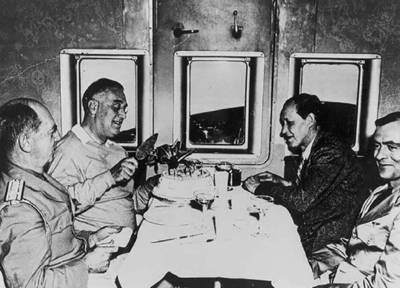
President Roosevelt met with British Prime Minister Churchill in Casablanca, Morocco, from January 14-24, 1943. Although Soviet Premier Joseph Stalin was invited, he did not attend because the Red Army was engaged in a major offensive against the German Army. At the meeting the Allies finalized strategic plans for 1943 against the Axis powers and set forth the policy of “unconditional surrender.”
The post-war fate of the Clippers
Following the end of the war, seven Clippers were returned to Pan Am. However, even before war’s end, the Clipper had become obsolete for several reasons. For example, one of the flying boats’ pre-war advantages had been that they did not require long concrete runways. But during World War II many such runways had been constructed for the heavy bombers used to fight the Germans and Japanese.
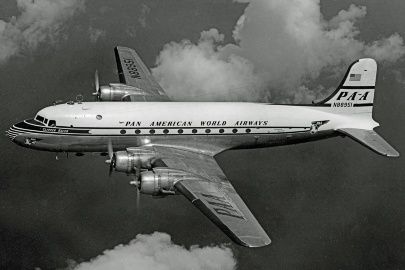
In addition, new long-range aircraft such as the Lockheed Constellation and the Douglas DC-4 were developed and were easily transitioned to commercial use. These new airplanes were relatively easy to fly, and did not require the extensive pilot training programs mandated for seaplane operations.
DurIng 1946 the remaining Pan Am Clippers were removed from scheduled service; the California Clipper was the final Pan Am 314 to be retired. It had accumulated more than one million flight miles. Of the 12 Boeing 314 Clippers built, three were lost to accidents, although only one of those resulted in fatalities – 24 passengers and crew aboard the Yankee Clipper were killed during landing at Cabo Ruivo Seaplane Base, in Lisbon, Portugal, on February 22, 1943.
The seven remaining Clippers were purchased from Pan Am by New World Airways, a start-up airline. The aircraft were parked at San Diego’s Lindbergh Field for several years before all were sold for scrap in 1950. The last of the 12 airplanes – the Anzac (Australia and New Zealand) Clipper was resold and scrapped in late 1951.
Legacy
Flying boats (specifically Pan Am’s Clippers) dominated international commercial airline service from their introduction until the outbreak of World War II. During the war the aircraft were useful to the militaries of the Allies.
Although aerodynamically less efficient than streamlined aircraft, flying boats were able to provide service to any city with a sheltered harbor. This made them “the ideal international airliner at a time when few cities had runways capable of handling large airplanes.”
The flying boat era reached its zenith with the luxurious Boeing B-314 Clipper. Pan American Airways’ fleet of Clippers served trans-Atlantic and trans-Pacific destinations, and made Pan Am one of the most visible airlines in the world.
(Image: clipperflyingboats.com)

/Micron%20Technology%20Inc_%20logo%20on%20building-by%20vzphotos%20vis%20iStock.jpg)

/Amazon%20-%20Image%20by%20bluestork%20via%20Shutterstock.jpg)
/Server%20racks%20by%20dotshock%20via%20Shutterstock.jpg)