Nearby August COMEX gold futures were trading at the $1825 per ounce level on June 24, 2022. Gold is sitting much closer to the low end of its trading range since March as the precious metal digests this year’s move to a new record high and consolidates near the level where it spent most of its time in 2021.
Gold is a hybrid as it is a metal and a financial asset. A significant percentage of annual production satisfies fabrication or jewelry demand. Meanwhile, governments worldwide hold the precious metal as a reserve asset, in the same category as foreign currency reserves. For thousands of years, gold has been money and retains its role as a means of exchange. Gold’s dual role causes price variance to be higher than other currencies but lower than most commodities.
Gold’s price was sitting in nowhere-land in late June 2022, with bullish and bearish factors pulling it in opposite directions.
Higher rates weigh on gold
While the continuous COMEX gold futures contract reached $2072 on March 8, August futures rose to a $2085.20 high.
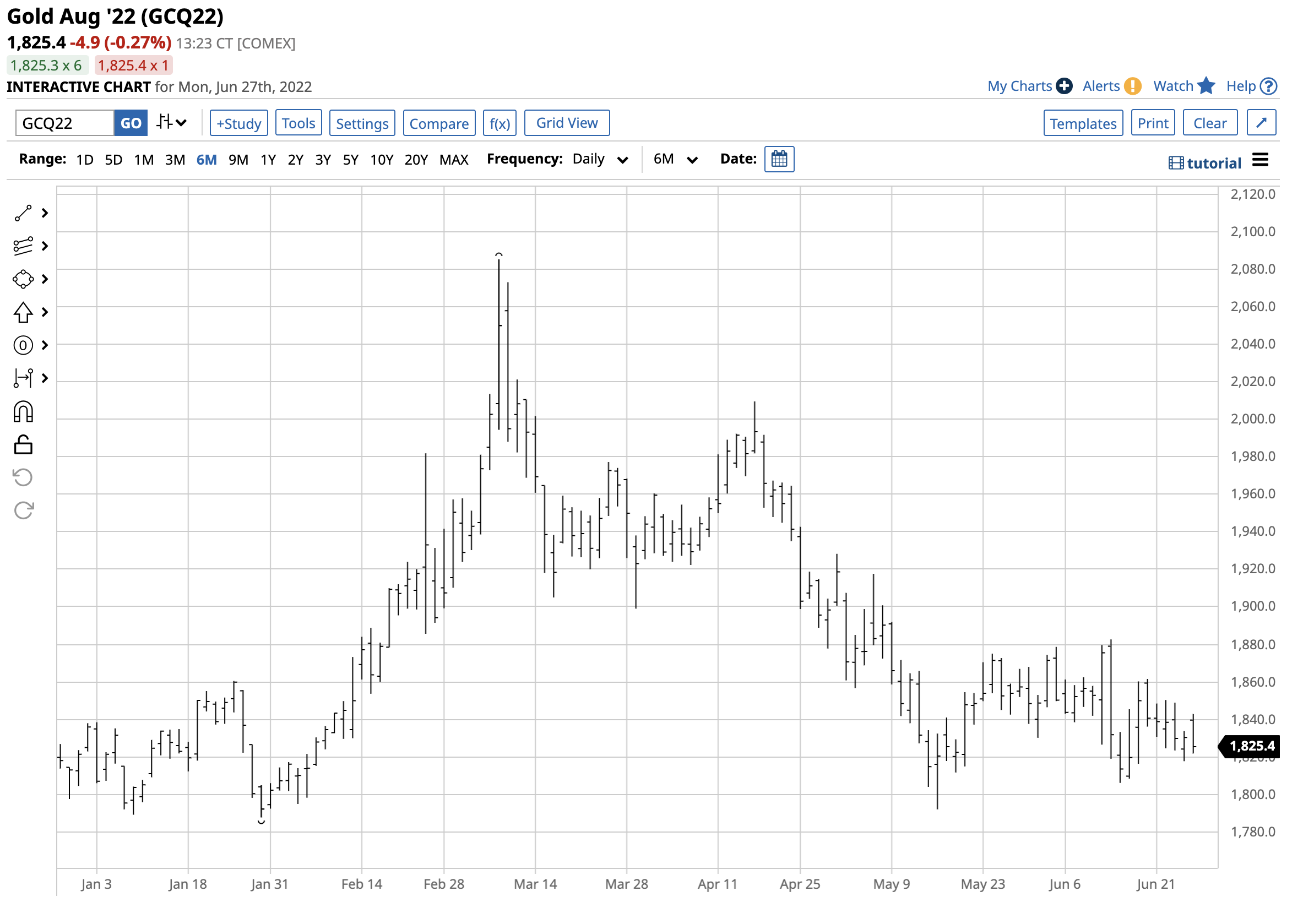
The chart highlights the pattern of lower highs and lower lows, leading to a decline to $1792 on May 16. Gold recovered and traded around an $1850 pivot point through the second half of May and throughout June.
The US Fed increased the Fed Funds Rate by 75 basis points to 1.50% to 1.75% on June 15. At that level, short-term rates remain far behind inflation, running at the highest level since December 1981. CPI was 8.6% higher on a year-on-year basis in May 2022, and even the core inflation measure, excluding food and energy, was four times higher than the top end of the Fed Funds band at 6% higher in May. The US bond market has been falling steadily in 2022.
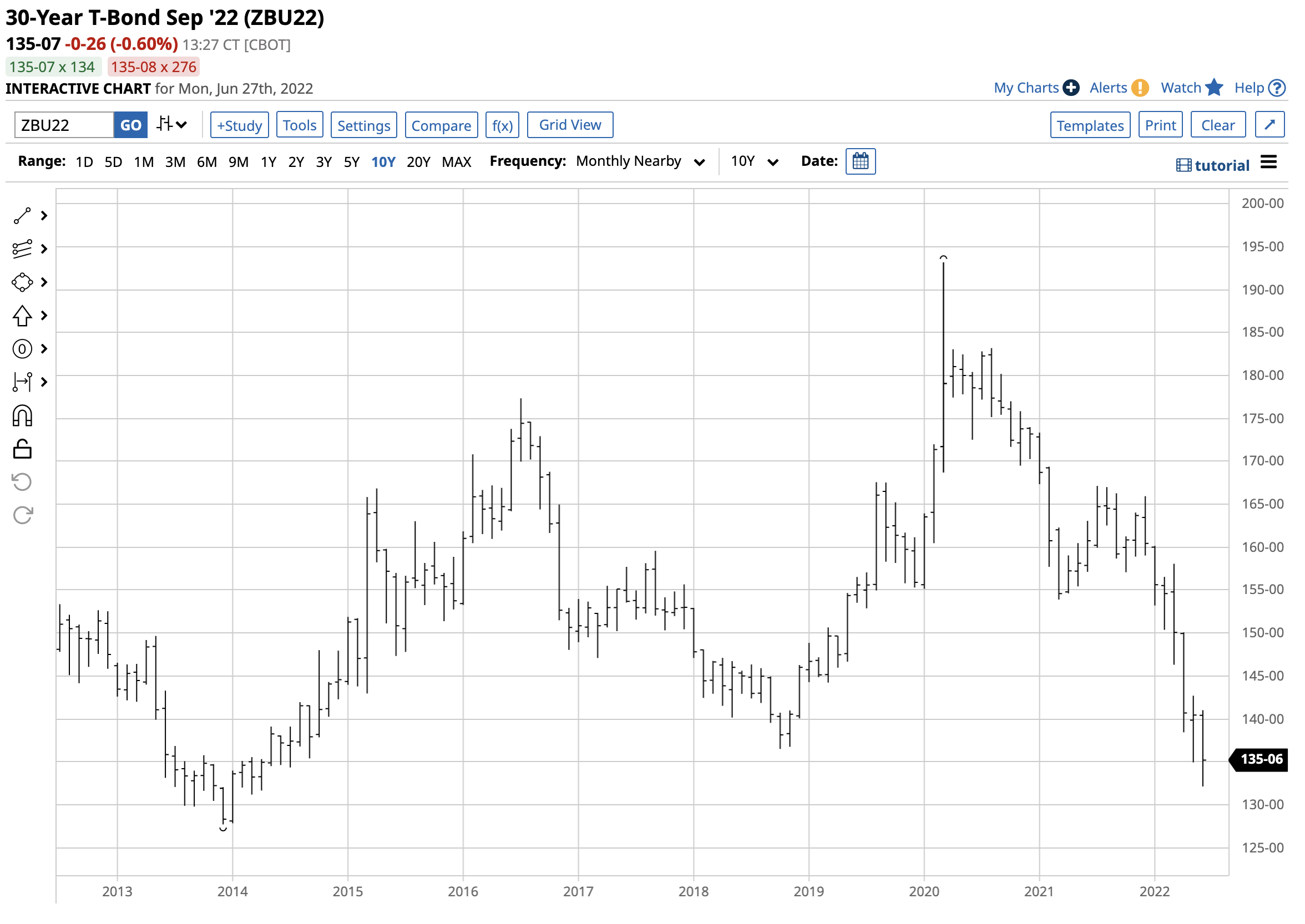
The monthly chart of the US 30-Year Treasury bond futures shows the decline from 160-14 at the end of 2021 to the 135 level on June 24. Rising interest rates increase the cost of carrying long gold positions, and fixed-income instruments compete with gold and other assets for capital. While a rising interest rate environment typically weighs on gold, 2022 is no ordinary year.
Geopolitics supports the precious metal
At the Beijing winter Olympics opening ceremony on February 4, 2022, Chinese President Xi and Russian President Putin shook hands on a massive trade deal and a “no-limits” support agreement. Twenty days later, after the games concluded, Russia invaded Ukraine. Russia has long claimed Ukraine is western Russia, while the US and Europe believe Ukraine is a sovereign country in Eastern Europe. The first major war in Europe since WW II and the Chinese-Russian “no-limits” agreement create tensions and a bifurcation between the world’s nuclear powers. China has not participated in sanctions on Russia, while the US and Europe have not only sanctioned the Russians but continue to provide arms and support to the Ukrainian government.
Meanwhile, Chinese support and Russian aggression could set the stage for China to move towards a forced reunification with Taiwan. The bottom line is the geopolitical landscape has not been this dangerous in decades.
Russia makes a bullish move- Will China Follow?
Russia and China have been leading gold-buying countries over the past years. Aside from absorbing domestic output to build reserves, they have purchased gold bullion in the international gold market. After it invaded Ukraine, Russia faced sanctions and a falling rouble. However, the Russians decided to back 5,000 roubles with one gram of gold, which lifted the Russian currency.
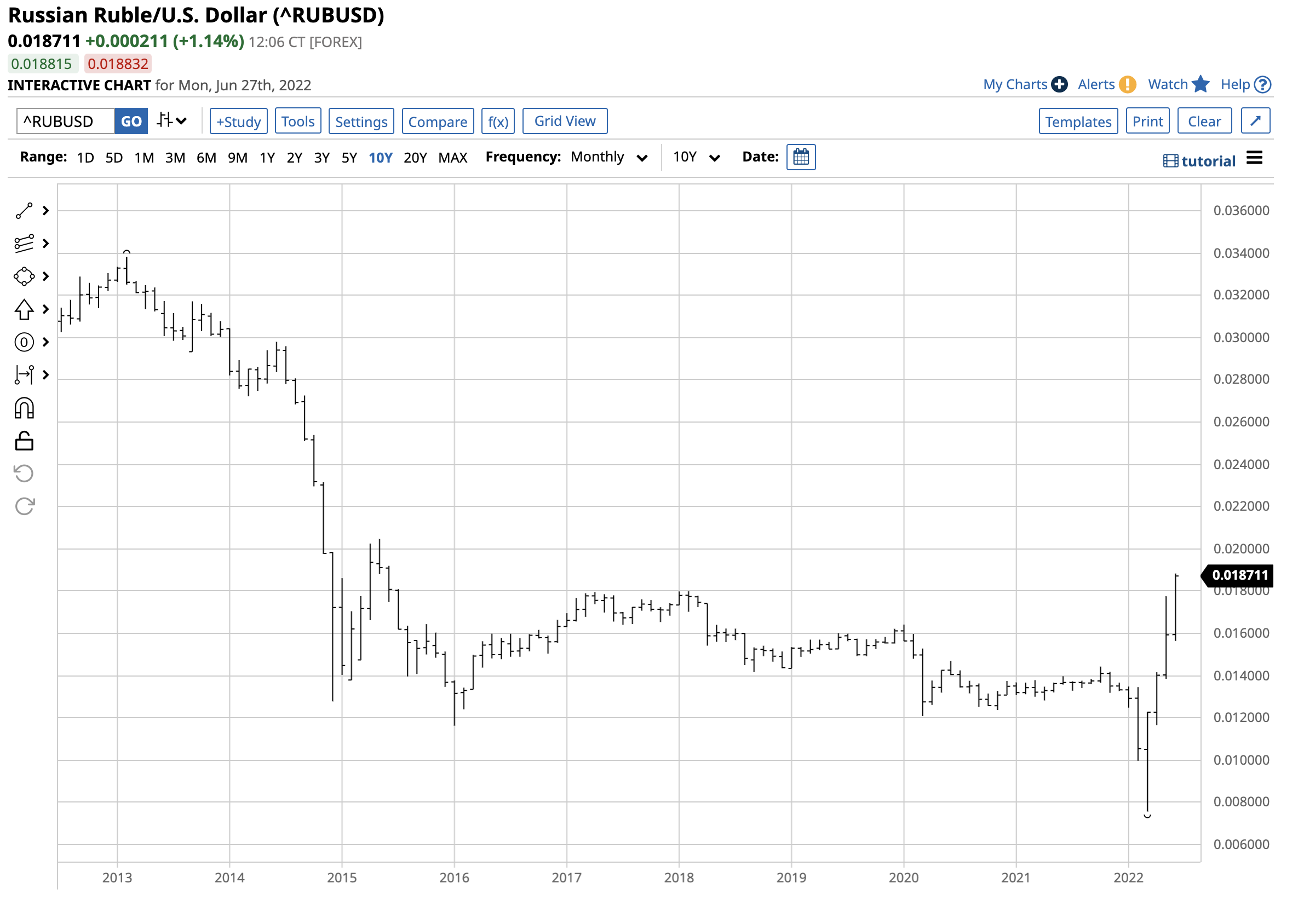
The chart shows the decline in the rouble and the rally that took the Russian currency to the highest level against the US dollar since 2018 at the end of June. Meanwhile, the rise from $0.00757 to over $0.0187 against the US dollar occurred as the dollar index rallied to the highest level in two decades, and the rouble did even better against the euro, British pound, and Japanese yen. The strength in the rouble after the move to return to a gold standard could cause China to follow suit over the coming months or years, propelling gold higher as the metal’s role in the worldwide financial system rises.
Meanwhile, the G-7 banned imports of Russian gold, which is easier said than done as it is challenging to trace the origin of remelted and recast gold bars.
Levels to watch in the gold market
Support on the continuous COMEX gold futures stands at $1787, May and 2022 low.

Below there, technical support is at $1692.60, the August 2021 low, and $1673.70, the bottom from March 2021.
Technical resistance is at the $2072, March 2022 all-time peak.
Continue to buy dips- A successful strategy that keeps on giving
The short-term trend in the gold futures market remains bearish, with the metal making lower highs and lower lows over the past three months.
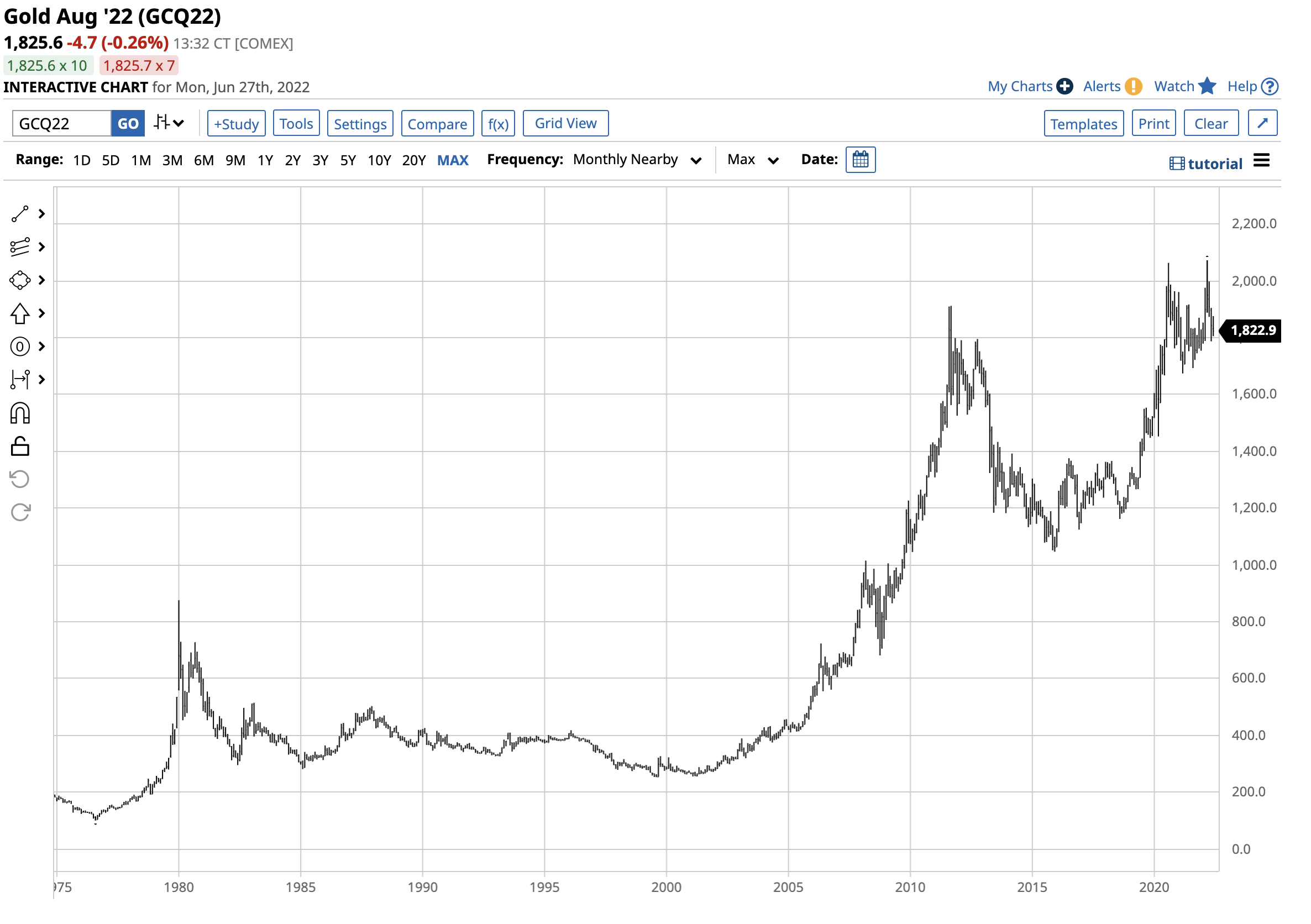
Meanwhile, the long-term trend remains bullish, with gold making higher lows and higher highs over the past twenty-two years. Buying on price weakness and corrections has been optimal in the gold market since 1999, when the price found a bottom and moved over 8.2 times higher at the most recent high.
Gold has long been an inflation barometer, but rising interest rates have been toxic for the precious metal. Therefore, gold remains stuck between the economic condition and hawkish central bank monetary policies, and a declining bond market. However, Russia’s decision to back the rouble with gold and the potential for China to follow their ally could dramatically change gold’s role. Governments continue to hold the precious metal as an integral part of their foreign currency reserves. While Russia and China have added to gold reserves over the past years, many other countries have done the same. If gold returns as an exchangeable backstop for currencies, the upside potential could be explosive. Even if China does not follow its new partner, the trend in gold suggests the odds continue to favor much higher prices over the coming months and years.
More Metals News from Barchart

/Micron%20Technology%20Inc_%20logo%20on%20building-by%20vzphotos%20vis%20iStock.jpg)