




Fear, Debasement, and the Fog of War: What Is Driving GC Right Now?
Gold’s structural bull market continues to be driven by persistent central bank accumulation, currency debasement concerns, and a declining appetite for U.S. Treasuries as a reserve asset. J.P. Morgan projects 2026 central bank demand at approximately 585 tonnes per quarter, while ETF inflows are expected to reach 250 tonnes. Goldman Sachs has raised its year end 2026 gold target to 5400, citing macro policy hedges that remain structurally sticky rather than transient.
The more immediate driver is geopolitical escalation. On February 28, 2026, the United States and Israel launched coordinated strikes on Iranian nuclear and ballistic infrastructure, triggering an Iranian response and disruption to flows through the Strait of Hormuz. Brent crude surged above 126 per barrel, introducing a fresh inflationary impulse through energy markets.
This has created a key tension for gold. While the conflict supports safe haven demand, the resulting inflation shock is keeping the Federal Reserve on hold. At its March 18 meeting, the Fed maintained the federal funds rate at 3.50 to 3.75 percent and held its projection for one rate cut in 2026. Officials also revised inflation expectations higher, with core and headline PCE now projected at 2.7 percent, reinforcing a higher for longer policy stance.
Policy uncertainty has increased further with Jerome Powell’s term set to end in May and former Fed Governor Kevin Warsh nominated as his successor, adding another layer of uncertainty around the path of future rate cuts.
The result is a market caught between two opposing forces. Escalating conflict and energy disruption are structurally supportive for gold, while sticky inflation, elevated yields, and a firm U.S. dollar are acting as headwinds. The broader metals complex has reflected this tension, with silver, platinum, and related assets selling off sharply from their January highs.
At present, gold is most sensitive to two variables. The first is any shift in Federal Reserve communication, particularly around the timing of rate cuts under new leadership. The second is the trajectory of the U.S. Iran conflict, specifically whether disruption in the Strait of Hormuz evolves into a broader growth shock that could force a policy pivot.
What the Market Has Done
- The market has been in an uptrend, consistently respecting the 2025 yearly VWAP, which has acted as a key structural support throughout the broader move higher.
- At the start of 2026, the market made a parabolic move in January, driven by dovish repricing of Federal Reserve expectations following softer inflation data and continued central bank demand, which accelerated momentum driven buying.
- This parabolic condition led to a capitulation phase, where the market experienced a large and volatile selloff in early February as stronger United States economic data pushed yields higher and triggered long liquidation, bringing price down to the 4500 area (Daily level 3).
- Buyers responded at the 4500 area and were able to bid prices steadily higher, rotating back toward all time highs in February as geopolitical risk and intermittent dollar weakness provided support.
- However, buyers failed to revisit all time highs, and sellers responded by stepping down offers toward the 5400 area (Daily level 1).
- Buyers attempted to hold bids at the 5050 area (Daily level 2) and above the 2026 yearly VWAP, but failed to maintain acceptance, resulting in long liquidation and a rotation lower back toward the 4500 to 4600 area (Daily level 3).
What to Expect in the Coming Weeks
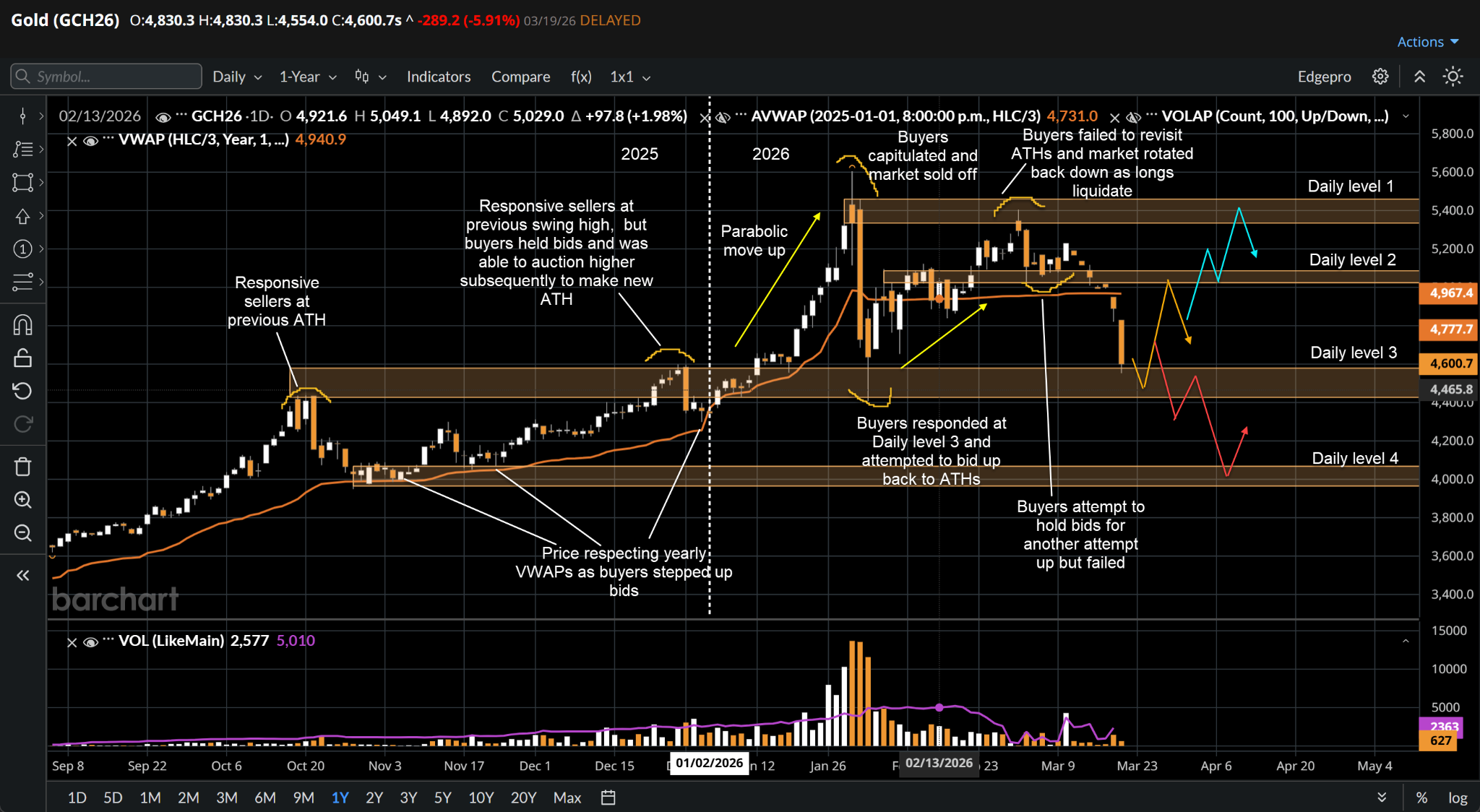
The key level to watch remains the 4500 area (Daily level 3), as it represents a critical inflection point for both structure and sentiment.
Neutral Scenario
- If buyers are able to defend the 4500 area, expect rotation back up toward the 5000 to 5050 area (Daily level 2), where sellers are expected to respond.
- This would likely result in a two way balanced auction between the 5000 and 4500 range as the market digests recent macro developments.
- This scenario would reflect a market that has largely priced in ongoing Middle East tensions without further escalation driving incremental safe haven flows.
Bearish Scenario
- If buyers fail to defend the 4500 area, expect a move lower toward the 4200 area, and possibly to the 4000 area, where buyers are expected to respond.
- This scenario would likely be driven by continued strength in United States economic data and further upside in real yields, reducing the relative attractiveness of gold.
- It could be reinforced if geopolitical tensions stabilize or fail to escalate further, including no additional disruption to key energy infrastructure or shipping routes such as the Strait of Hormuz.
Bullish Scenario
- The first clue that a bullish scenario is in play is if buyers are able to step up bids within the 5000 to 4500 range and establish higher lows.
- If buyers are able to break and accept above the 5000 area (Daily level 2), expect a move up to the 5400 area (Daily level 1), and possibly a continuation toward all time highs.
- This would likely require a shift back toward dovish Federal Reserve expectations or a renewed escalation in geopolitical risk, specifically further disruption to Middle East energy flows or shipping lanes, which could sustain and accelerate safe haven demand.
Conclusion
Gold futures are at a critical juncture where technical structure and macro forces are tightly intertwined. The broader trend remains constructive, but recent price action highlights increasing sensitivity to real yields, Federal Reserve policy expectations, and geopolitical developments.
The 4500 area remains the key battleground. Holding this level would suggest a transition into balance with potential for continuation higher, while failure would signal a deeper corrective phase. Traders should closely monitor how price responds at this level alongside incoming macro data and developments in the Middle East, as these factors will likely dictate the next directional move.
Who is EdgeClear? We are a professional-grade futures brokerage engineered by traders to provide the high-performance architecture and futures trading platform required for serious market participation. We serve as a professional technical partner for traders who prioritize data integrity and objective analysis. Take the next step in your professional evolution and Open an Account today.
Disclaimer:
This article is provided for informational and educational purposes only and does not constitute financial, investment, or trading advice. The analysis presented reflects the author’s market observations and opinions at the time of writing and is not a recommendation to buy or sell any futures contract, security, or financial instrument. Futures trading involves significant risk and is not suitable for all market participants. Losses may exceed initial margin deposits, and market conditions can change rapidly.
Any scenarios, levels, or market expectations discussed are hypothetical in nature and are intended solely to illustrate potential market behavior. They do not represent actual trading results and should not be interpreted as guarantees of future performance. Past performance, market behavior, or historical price action are not indicative of future outcomes.
Readers are solely responsible for their own trading decisions and risk management. Always conduct independent research, consider your financial situation and risk tolerance, and consult with a qualified financial professional, if necessary, before engaging in futures or derivatives trading.

/Nvidia%20logo%20and%20sign%20on%20headquarters%20by%20Michael%20Vi%20via%20Shutterstock.jpg)
/Goldman%20Sachs%20Group%2C%20Inc_%20logo%20sign-by%20Poetra_RH%20via%20Shutterstock.jpg)
/A%20SoFi%20logo%20on%20an%20office%20building%20by%20Tada%20Images%20via%20Shutterstock.jpg)

/AI%20(artificial%20intelligence)/3D%20Graphics%20Concept%20Big%20Data%20Center%20by%20Gorodenkoff%20via%20Shutterstock.jpg)