



Restaurant company Darden (NYSE:DRI) met Wall Street’s revenue expectations in Q1 CY2026, with sales up 5.9% year on year to $3.35 billion. Its non-GAAP profit of $2.95 per share was in line with analysts’ consensus estimates.
Is now the time to buy Darden? Find out by accessing our full research report, it’s free.
Darden (DRI) Q1 CY2026 Highlights:
- Revenue: $3.35 billion vs analyst estimates of $3.33 billion (5.9% year-on-year growth, in line)
- Adjusted EPS: $2.95 vs analyst estimates of $2.94 (in line)
- Management slightly raised its full-year Adjusted EPS guidance to $10.62 at the midpoint
- Operating Margin: 12.1%, down from 13.2% in the same quarter last year
- Free Cash Flow Margin: 13.4%, similar to the same quarter last year
- Locations: 2,196 at quarter end, up from 2,165 in the same quarter last year
- Same-Store Sales rose 4.2% year on year (0.7% in the same quarter last year)
- Market Capitalization: $23.11 billion
Company Overview
Founded in 1968 as Red Lobster, Darden (NYSE:DRI) is a leading American restaurant company that owns and operates a portfolio of popular restaurant brands.
Revenue Growth
A company’s long-term sales performance is one signal of its overall quality. Any business can have short-term success, but a top-tier one grows for years.
With $12.76 billion in revenue over the past 12 months, Darden is one of the most widely recognized restaurant chains and benefits from customer loyalty, a luxury many don’t have. Its scale also gives it negotiating leverage with suppliers, enabling it to source its ingredients at a lower cost. However, its scale is a double-edged sword because there is only so much real estate to build restaurants, placing a ceiling on its growth. To expand meaningfully, Darden likely needs to tweak its prices, start new chains, or enter new markets.
As you can see below, Darden’s sales grew at a mediocre 6.1% compounded annual growth rate over the last seven years, but to its credit, it opened new restaurants and increased sales at existing, established dining locations.
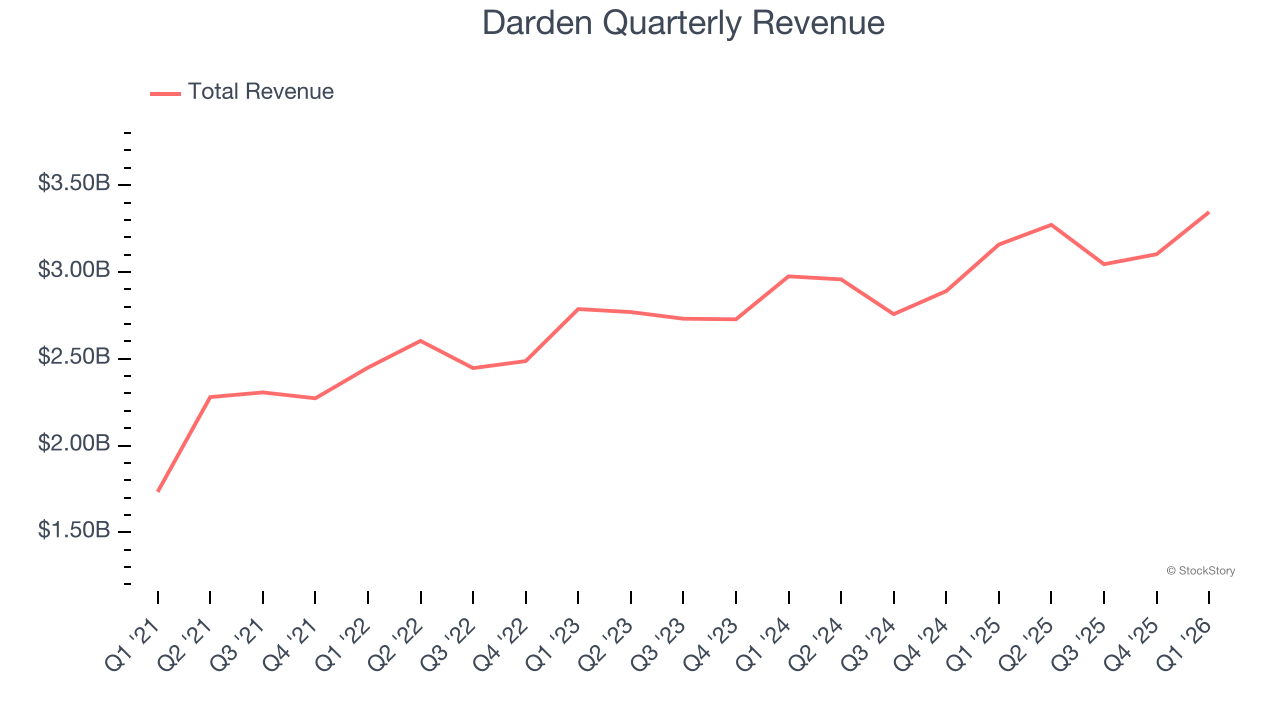
This quarter, Darden grew its revenue by 5.9% year on year, and its $3.35 billion of revenue was in line with Wall Street’s estimates.
Looking ahead, sell-side analysts expect revenue to grow 7.4% over the next 12 months, similar to its seven-year rate. This projection is above the sector average and implies its newer menu offerings will spur better top-line performance.
ALSO WORTH WATCHING: Nvidia’s Quiet Partner. Nvidia’s chips cost a hundred grand. The connectors that make them work cost even more. One company makes them all.
Every AI server needs specialized infrastructure the chip companies don’t make. High-speed cables. Power connectors. Thermal sensors. This 90-year-old company built a monopoly on it. The AI boom just started. This stock is still flying under the radar. Claim The Stock Ticker Here for FREE.
Restaurant Performance
Number of Restaurants
A restaurant chain’s total number of dining locations influences how much it can sell and how quickly revenue can grow.
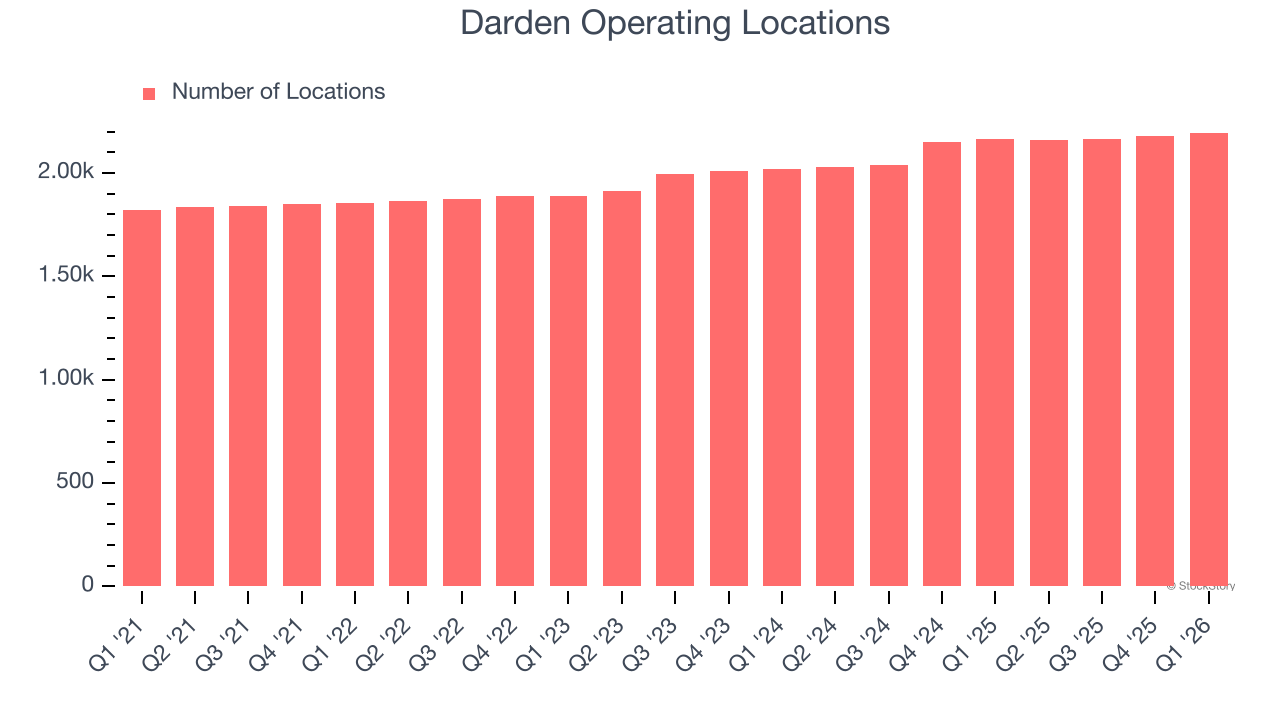
Darden operated 2,196 locations in the latest quarter. It has opened new restaurants at a rapid clip over the last two years, averaging 4.7% annual growth, much faster than the broader restaurant sector.
When a chain opens new restaurants, it usually means it’s investing for growth because there’s healthy demand for its meals and there are markets where its concepts have few or no locations.
Same-Store Sales
A company's restaurant base only paints one part of the picture. When demand is high, it makes sense to open more. But when demand is low, it’s prudent to close some locations and use the money in other ways. Same-store sales provides a deeper understanding of this issue because it measures organic growth at restaurants open for at least a year.
Darden’s demand rose over the last two years and slightly outpaced the industry. On average, the company’s same-store sales have grown by 2.5% per year. This performance suggests its rollout of new restaurants could be beneficial for shareholders. When a chain has demand, more locations should help it reach more customers and boost revenue growth.
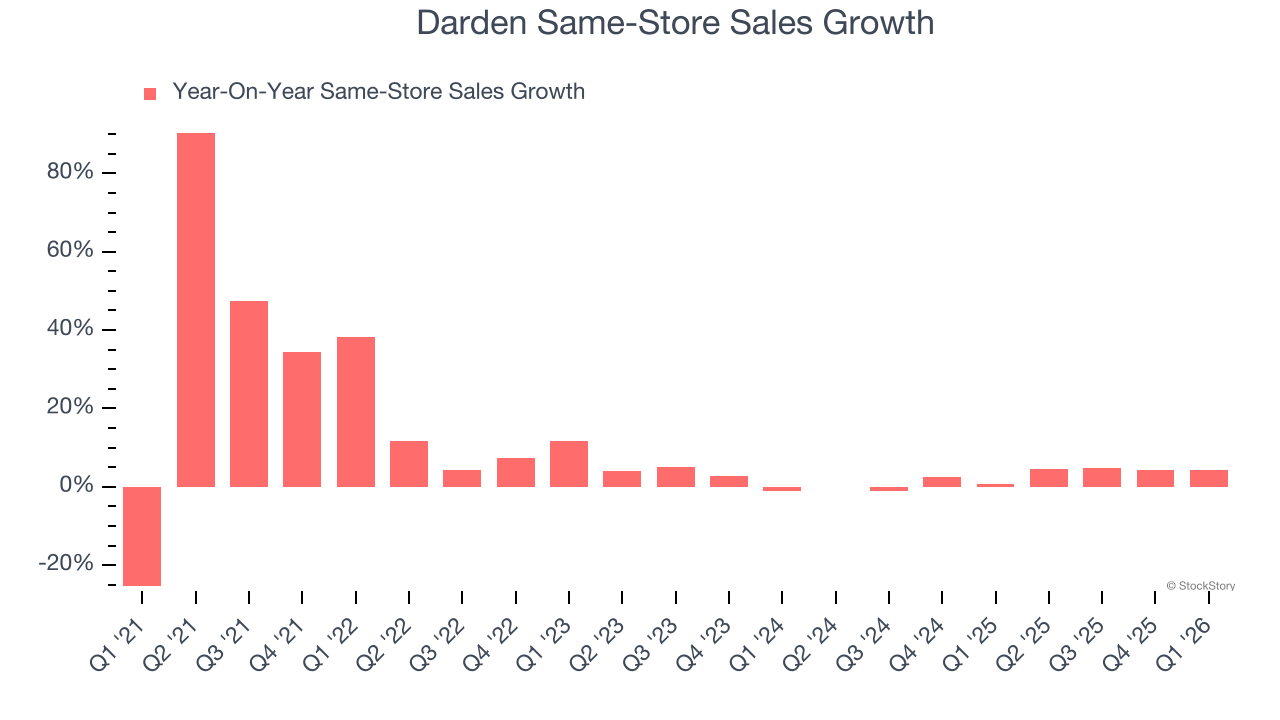
In the latest quarter, Darden’s same-store sales rose 4.2% year on year. This growth was an acceleration from its historical levels, which is always an encouraging sign.
Key Takeaways from Darden’s Q1 Results
There weren't many surprises this quarter, good or bad. Darden met analysts’ same-store sales expectations this quarter, and its revenue and EPS were both in line with Wall Street’s estimates. The stock remained flat at $201.50 immediately after reporting.
So do we think Darden is an attractive buy at the current price? What happened in the latest quarter matters, but not as much as longer-term business quality and valuation, when deciding whether to invest in this stock. We cover that in our actionable full research report which you can read here (it’s free).

/AI%20(artificial%20intelligence)/Ai%20chip%20by%20Quality%20Stock%20Arts%20via%20Shutterstock.jpg)

/A%20hand%20holding%20a%20phone%20with%20the%20Reddit%20logo_%20Mamun_Sheikh%20via%20Shutterstock_.jpg)
/Seagate%20sign%20on%20the%20building%20atits%20operational%20headquarters%20By%20JHVEPhoto.jpeg)
/Apple%20logo%20on%20store%20front%20by%20frantic00%20via%20iStock.jpg)