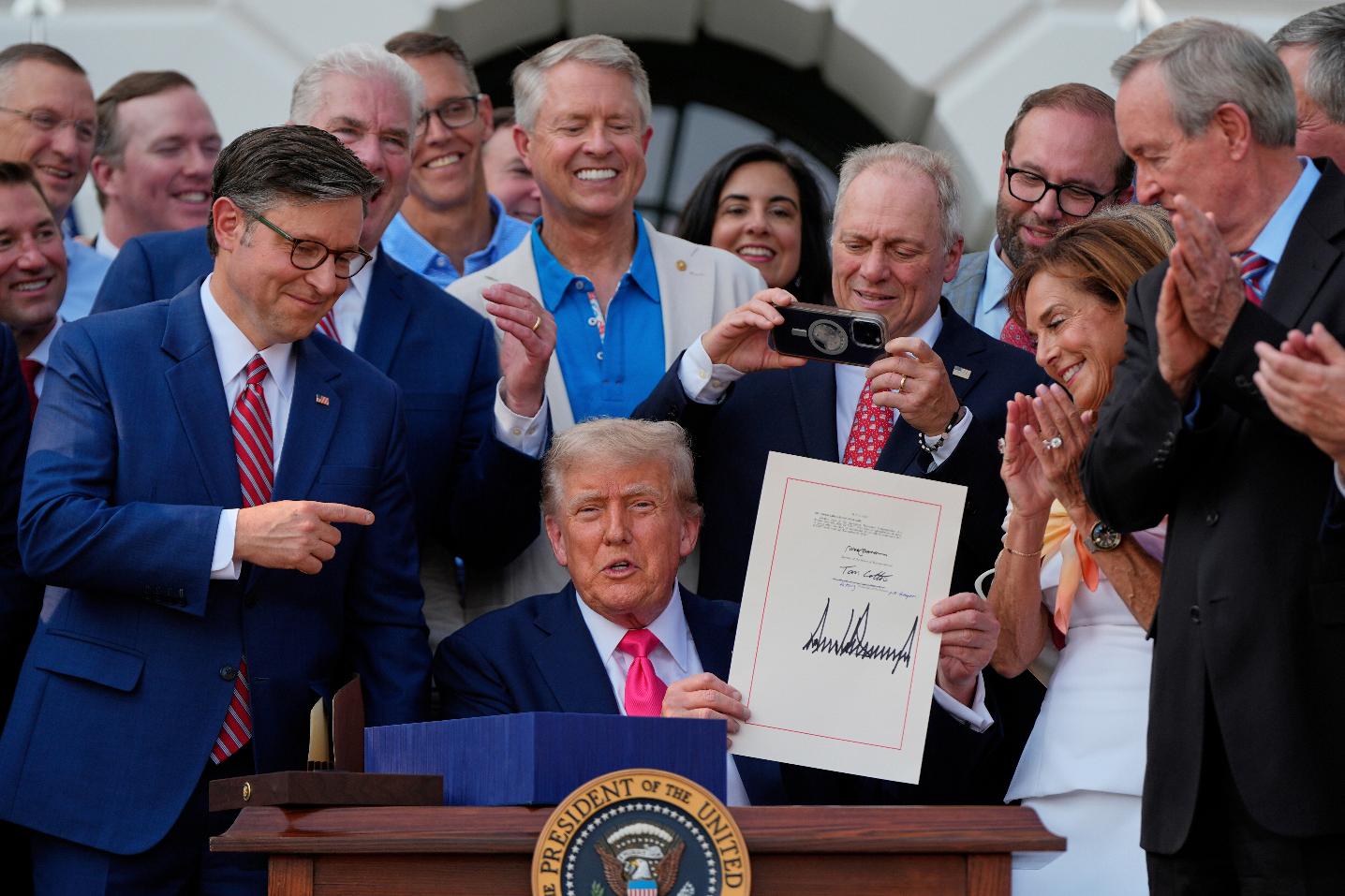
NEW YORK (AP) — Millions more Americans will likely donate to nonprofits following changes in tax laws passed by Congress last summer, but those changes will also likely reduce the overall amount of money given to charity, according to new research.
The report from the Indiana University Lilly Family School of Philanthropy published Tuesday reflects how “top heavy” charitable giving is, meaning the largest donors and corporations have an outsized impact on overall giving trends, said Jon Bergdoll, interim director of data and research partnerships at the school, who also led the research.
New tax deductions available to most tax filers will encourage between 6 and 8.7 million more Americans to donate to nonprofits over time, the researchers found. However, gifts to nonprofits will likely drop around $5.6 billion annually because of new rules that apply to corporations and to the wealthiest people.
Bergdoll cautioned that these impacts won’t take effect immediately. He said other macroeconomic forces are likely to have a much larger impact on the total amount donated to nonprofits in 2026 than the changes in the new law, called the One Big Beautiful Bill.
“Giving I could imagine going in so many different directions this year,” said Bergdoll. “And so this is not saying, ‘Giving will absolutely go down in 2026.’ It just there’s this little extra weight dragging it down.”
A drop in giving by $5.6 billion would represent less than 1% of the $592.50 billion that was given to nonprofits in 2024, according to Giving USA. The Treasury Department did not return a request for comment on the impact of the new tax law on charitable giving.
The main change that will encourage people to donate is a new charitable deduction of up to $1,000 for individuals and $2,000 for married couples that the vast majority of people can claim. It applies to the 87% of people who take the standard deduction and do not itemize their taxes.
Bergdoll said it may take a while for people to learn about the new deduction.
“That behavior will only change based off of households becoming aware,” he said. “And the stakeholders that have the most to gain by those households becoming aware are nonprofits.”
Advocates for nonprofits credited Republican Oklahoma Sen. James Lankford in particular for championing the new charitable deduction. He had previously introduced a bill along with Democrat Sen. Chris Coons, a Democrat, to expand available charitable deductions after changes passed under President Donald Trump’s first administration reduced the number of Americans who could get a tax benefit from giving to nonprofits.
Speaking at a press conference in 2023, Lankford said of that legislation, the Charitable Act, which did not become law, “Currently, our tax code is written in such a way that only the wealthy get any kind of benefit from giving financial aid to nonprofits. We want to spread that out to everybody.”
For wealthy donors, two changes included in the One Big Beautiful Bill are likely to drive down donations. The first is a new, lower cap on the overall deductions that the wealthiest people can claim. Those who itemize their taxes and fall within the highest tax bracket will now be limited to claiming total deductions of 35% of their income, down from 37% previously.
“Because of the nature of giving, because of how much giving is coming from those top marginal income households, this actually has the largest effect of anything we’ve looked at,” Bergdoll said.
A second change applies to everyone who itemizes their taxes, or around 11% of filers, and implements a new floor. Under the new law, these households must give more than 0.5% of their income to nonprofits to claim a tax benefit. If their gifts fall below this threshold, the donor won't get a tax deduction.
The new law also puts a new floor on corporate charitable donations at 1% of their pretax profits. Companies that give less than that now can't take a charitable deduction for those gifts.
The Lilly School research found this change will likely reduce corporate giving by around $1.5 billion annually, but that is less than what they had expected, Bergdoll said.
There is little comprehensive data about the giving of corporations at the company level, he said. But researchers drew on findings from Chief Executives for Corporate Purpose (CECP), which while not representative, indicated that the lion's share of charitable donations come from companies that are giving over the new threshold.
Sheila Bravo, president and CEO, Delaware Alliance for Nonprofit Advancement, which supports and advocates for nonprofits in the state, said the large businesses, like banks, that she talks with did not anticipate their giving would be impacted by the new floor for deductions.
“Here in Delaware, the shifts that we’re seeing in corporate giving are not specific to that tax law as much as there’s other factors that are influencing corporate giving,” Bravo said. Those could include rising costs and uncertainty about the business environment as well as changes within corporations about who directs decisions about charitable giving.
Bergdoll said these projections reflect what they see as the most likely outcome of the tax law changes on charitable giving, but don't represent a precise forecast. However, in all cases they examined, he said overall giving was likely to decline.
“At the very worst of things, we see giving dropping by almost $12 billion,” he said. “And at the lighter end of things, we see giving dropping by about $2.5 billion.”
___
Associated Press coverage of philanthropy and nonprofits receives support through the AP’s collaboration with The Conversation US, with funding from Lilly Endowment Inc. The AP is solely responsible for this content. For all of AP’s philanthropy coverage, visit https://apnews.com/hub/philanthropy.


/Adobe%20Inc%20logo%20on%20computer-by%20DANIEL%20CONSTANTE%20via%20Shutterstock.jpg)
/A%20Palantir%20office%20building%20in%20Tokyo_%20Image%20by%20Hiroshi-Mori-Stock%20via%20Shutterstock_.jpg)
/Micron%20Technology%20Inc_billboard-by%20Poetra_RH%20via%20Shutterstock.jpg)