Costco Wholesale Corporation COST and Target Corporation TGT are two prominent players in the Retail–Discount Stores industry. Costco, which boasts a market capitalization of approximately $419.3 billion, operates a membership-based warehouse model that sells goods at discounted prices. The company manages a network of 933 warehouses globally, including 641 in the United States and Puerto Rico.
Target, meanwhile, has a market capitalization of about $74.1 billion and operates a broad general-merchandise retail model built around affordable pricing, differentiated owned brands and a convenient omnichannel shopping experience. The company ended its latest reported quarter with 2,019 stores, giving it an extensive physical presence across the United States and supporting its store-led digital fulfillment capabilities.
With consumers remaining selective about discretionary spending and retailers competing on value, convenience and differentiated merchandise, the key question for investors is which of these discount retail giants is better positioned to capitalize on evolving shopping habits and deliver stronger returns from here.
The Case for Costco
Costco continues to demonstrate the strength of its membership-driven model, which underpins a stable and recurring revenue base. The company continues to attract shoppers through competitive pricing, high-quality merchandise and a carefully curated product assortment. This value-focused strategy has helped Costco maintain strong customer loyalty and sustain sales growth across markets, even when consumer spending trends are uneven.
Its membership model remains a key competitive advantage. High renewal rates provide a steady stream of recurring fee income, while the growing Executive Membership base supports higher engagement and spending. Executive memberships reached 41.2 million at the end of the third quarter of fiscal 2026, up 9.6% year over year. These members accounted for about 75% of worldwide sales. Growth in this tier is being supported by upgrades from Gold Star members, as well as more new customers choosing Executive Membership at sign-up.
Costco is also strengthening its digital capabilities while preserving the efficiency of its warehouse model. Investments in its mobile app, e-commerce platform, checkout technology and same-day delivery are making shopping more convenient and improving customer engagement. The company is also using personalization and artificial intelligence to improve the shopping experience, while retail media offers another potential avenue for profitable growth.
Expansion provides another long-term growth driver. Costco continues to add warehouses in North America and international markets while relocating some high-volume locations to larger sites with better capacity and additional services. Investments in logistics, manufacturing and technology are also supporting operational efficiency. The company aims for more than 30 openings annually in the coming years. Management sees strong potential in China, Korea and Japan, additional openings in Taiwan, room to grow in Spain and France and continued strength in the U.K. It expects strong international expansion over the next five to 10 years.
The Case for Target
Target’s refreshed strategy is gaining traction, creating a firm base for sustainable sales and earnings growth. The company is sharpening its positioning around the combination of style, design, quality and value while concentrating on merchandising authority, an elevated guest experience, technology and stronger execution. Higher traffic suggests customers are choosing Target more frequently, which management views as one of the healthiest indicators of sustainable growth. Sales momentum has also been broad across channels, merchandise categories, demographics and income groups. Target now expects full-year net sales growth in a range around 5%, one percentage point higher than its previous guidance.
Management is directing resources toward categories that are showing high customer response. Beauty, health and wellness, food, baby and kids, women’s style, home, toys and entertainment have become important areas of focus. Target has repositioned nearly half of its center-store grocery assortment, expanded fresh produce and devoted additional space to growing areas such as snacks, global foods and functional coffee. Its Fun101 transformation is similarly reallocating space toward LEGO, wearable technology, trading cards, collectibles and broader fandom experiences. Exclusive partnerships with Pokemon and LoveShackFancy strengthen Target’s cultural relevance, while the rollout of Target Beauty Studio and further changes across home and apparel provide additional opportunities to deepen merchandising differentiation.
The company’s integrated physical and digital model adds another durable growth avenue. Target’s stores serve as both shopping destinations and fulfillment hubs, supporting faster and more cost-effective delivery. Same-day services continue to gain traction, while ongoing investments in new stores, remodels and supply-chain capabilities should expand the reach and operational efficiency. At the same time, Target is investing in artificial intelligence and personalization to enhance digital discovery, improve merchandising decisions and engage consumers through emerging shopping platforms. Management has also highlighted encouraging growth in traffic originating from external AI platforms, such as OpenAI and Google.
Target is also strengthening its value proposition. The company has lowered prices on more than 10,000 items over the past year and plans further reductions while continuing to introduce trend-right merchandise, owned brands and exclusive offerings. Management is addressing tariff pressure through changes in country of origin, vendor collaboration and assortment adjustments. Target is developing meaningful higher-margin revenue streams. Roundel advertising, Target+ marketplace and Circle 360 memberships are growing rapidly and diversifying earnings beyond traditional merchandise sales. As these businesses scale, they can deepen customer engagement while providing attractive incremental profit streams that complement Target’s core retail operations.
Target retains significant financial and operational flexibility to fund its transformation while returning capital to shareholders. Profitability improved even after excluding tariff-refund benefits, supported by better merchandising performance, healthier gross margins and growth in higher-margin revenue streams. Management expects the full-year operating margin excluding tariff refunds to finish above last year’s adjusted level and raised adjusted earnings per share guidance to $9.90-$10.90. The range includes approximately $1.65 per share of second-quarter tariff refund benefits but excludes any potential future tariff refunds. Excluding the refund benefit, the midpoint of the updated guidance represents a 75-cent increase from the prior guidance range of $7.50-$8.50.
COST vs. TGT: How Do Estimates Stack Up?
The Zacks Consensus Estimate for Costco’s current fiscal-year sales and earnings per share suggests year-over-year growth of 9.7% and 13.5%, respectively. For the next fiscal year, the consensus estimate points to sales growth of 7.8% and earnings growth of 10.2%. Over the past 30 days, the Zacks Consensus Estimate for current-year earnings has remained unchanged at $20.42, while the estimate for the next fiscal year has increased by a penny to $22.51.
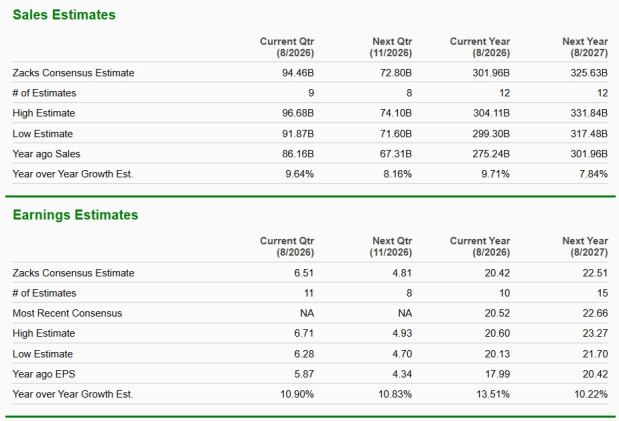
Image Source: Zacks Investment Research
The Zacks Consensus Estimate for Target’s current fiscal-year sales and earnings per share indicates year-over-year growth of 4.6% and 37.7%, respectively. For the next fiscal year, the consensus estimate points to a 2.8% increase in sales but an 11% decline in earnings. Over the past 30 days, the Zacks Consensus Estimate for earnings has risen by $2.08 for the current fiscal year and 40 cents for the next fiscal year to $10.42 and $9.27 per share, respectively.
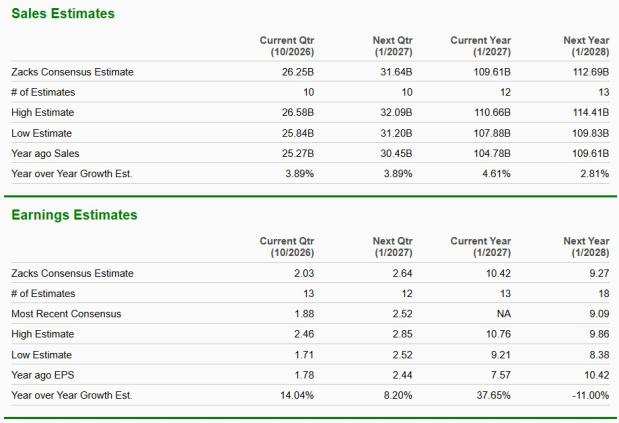
Image Source: Zacks Investment Research
COST vs. TGT: A Look at Past-Year Stock Performance
Despite operating in the same industry, Costco and Target have delivered markedly different stock market performances. Costco shares have gained 9.6% year to date, while Target has significantly outperformed, rallying 66.9% over the same period.
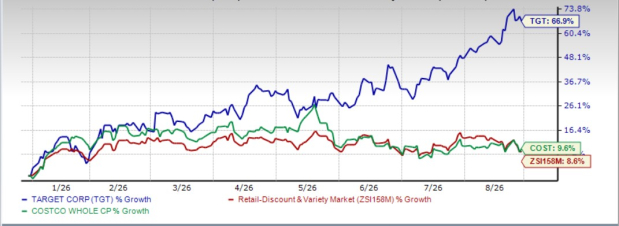
Image Source: Zacks Investment Research
COST vs. TGT: A Peek Into Stock Valuation
Costco currently trades at a forward price-to-earnings (P/E) ratio of 42.00, below its one-year median of 45.56 but still at a notable premium to the industry average of 29.38. In contrast, Target’s forward P/E multiple of 16.73 is above its one-year median of 14.54 but remains well below the industry average, indicating a considerably lower valuation than Costco.
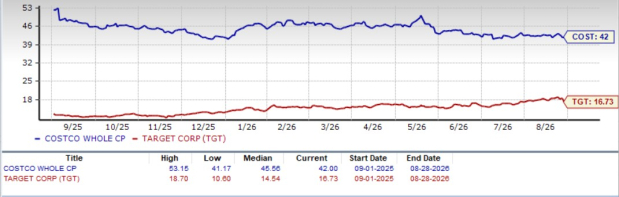
Image Source: Zacks Investment Research
COST vs. TGT: Which Stock Looks More Promising Now?
For investors weighing the two retailers today, Target appears to offer the more compelling proposition. While Costco remains a high-quality business supported by a powerful membership model, strong customer loyalty and a long runway for international expansion, much of that strength is already reflected in its premium valuation. Target, meanwhile, is showing improving operating momentum as its merchandising reset, value initiatives, omnichannel capabilities and higher-margin businesses gain traction. Upward earnings estimate revisions and stronger share price momentum further suggest that investor confidence in the turnaround is building. Given its improving fundamentals, strategic progress and lower valuation, Target currently holds greater promise for investors seeking upside potential.
Costco carries a Zacks Rank #3 (Hold), while Target sports a Zacks Rank #1 (Strong Buy). You can see the complete list of today’s Zacks #1 Rank stocks here.
Zacks' Research Chief Names "Stock Most Likely to Double"
Our team of experts has just released the 5 stocks with the greatest probability of gaining +100% or more in the coming months. Of those 5, Director of Research Sheraz Mian highlights the one stock set to climb highest.
This top pick is a little-known satellite-based communications firm. Space is projected to become a trillion dollar industry, and this company's customer base is growing fast. Analysts have forecasted a major revenue breakout in 2025. Of course, all our elite picks aren't winners but this one could far surpass earlier Zacks' Stocks Set to Double like Hims & Hers Health, which shot up +209%.
Free: See Our Top Stock And 4 Runners UpThis article originally published on Zacks Investment Research (zacks.com).


/A%20Palantir%20office%20building%20in%20Tokyo_%20Image%20by%20Hiroshi-Mori-Stock%20via%20Shutterstock_.jpg)
/Elon%20Musk%2C%20founder%2C%20CEO%2C%20and%20chief%20engineer%20of%20SpaceX%2C%20CEO%20of%20Tesla%20by%20Frederic%20Legrand%20-%20COMEO%20via%20Shutterstock.jpg)
/Microsoft%20sign%20at%20the%20headquarters%20by%20VDB%20Photos%20via%20Shutterstock.jpg)