Dual Edge Research publishes two powerful newsletters that work great individually — and even better together. The Bull Strangle Newsletter focuses on stocks and options, combining stock ownership with premium-selling strategies to generate consistent income and market-beating returns. The Smart Spreads Newsletter specializes in seasonal commodity futures spreads, offering a diversified approach with low correlation to equities. Together, they deliver a complete investment perspective — one focused on income, the other on diversification — all under one simple subscription.
Introduction
Over the past several months, I've spent a considerable amount of time researching one question:
- How far out of the money should a Bull Strangle trader sell the covered call?
The historical analysis produced valuable insights, but after another Monday morning of live trading, I realized the answer is more nuanced than the data alone would suggest. Historical research provides the framework, but the option market ultimately determines the choices available. That realization didn't invalidate the research—it simply highlighted an important distinction between studying historical data and executing real trades.
The historical research consistently showed that strike selection matters. Selling calls too close to the stock price increases the likelihood of assignment and limits upside participation, while wider strikes generally allow investors to capture more of the stock's appreciation. The data also suggested that higher implied volatility often supports selling calls farther out of the money while still collecting attractive option premiums. Those findings remain an important part of the Bull Strangle Strategy and continue to guide my decisions. What changed wasn't the research itself, but my appreciation for how those principles are applied in the real world.
The Option Chain Defines Your Choices
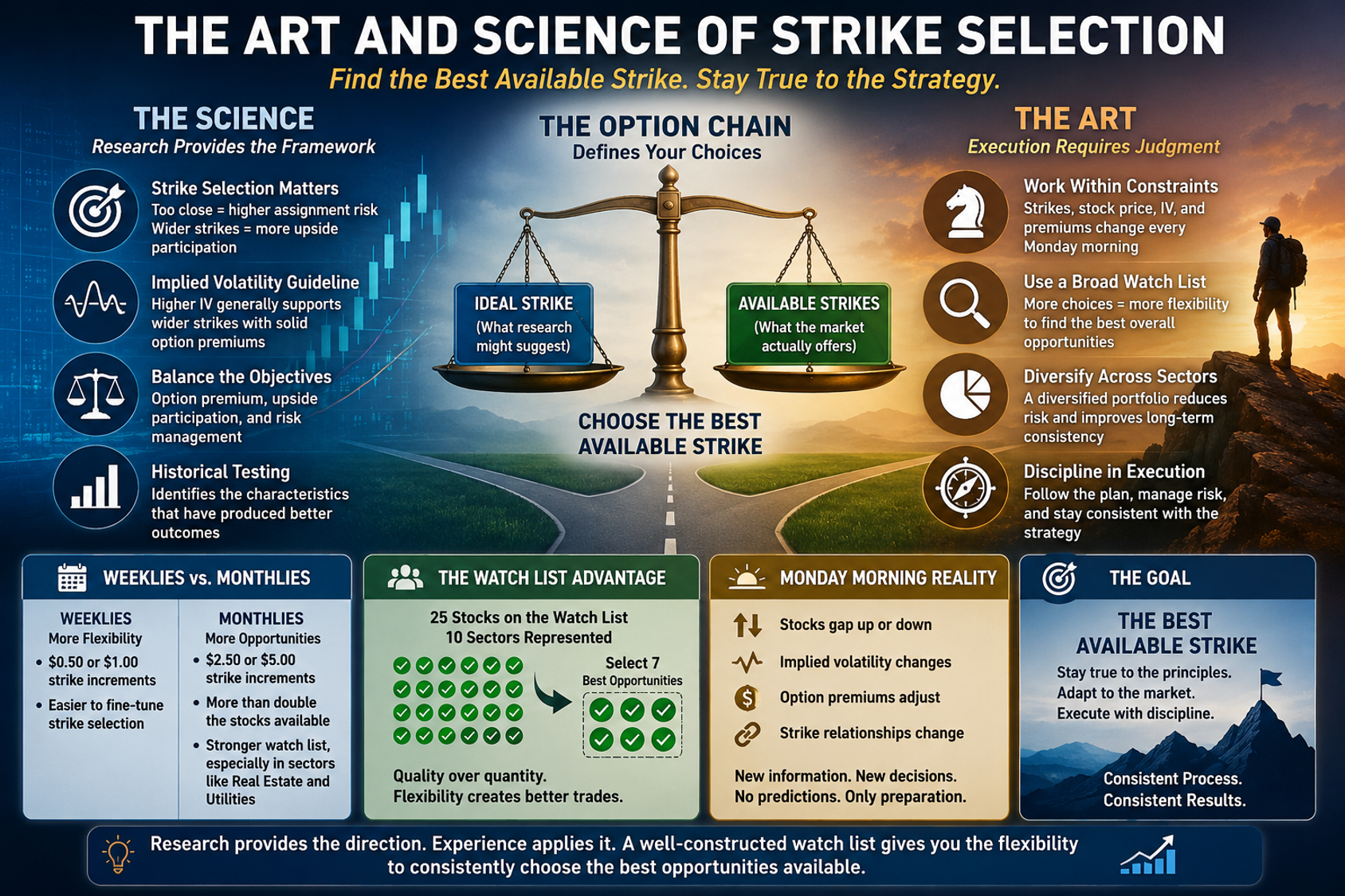
Unlike many investment decisions, option traders don't create the menu—they choose from the menu the exchange provides. Suppose a stock opens Monday morning just above $90. The available monthly call strikes may be $90, $95, and $100, while the available puts are $90, $85, and $80. If historical research suggests that the ideal call strike is somewhere around 4% above the stock price, that strike simply doesn't exist. The practical choices become selling the $95 call or moving all the way to $100. Neither is perfect, but both are reasonable. The decision becomes one of judgment rather than calculation.
Now consider another stock trading near $36. Weekly options might offer strikes every $0.50 or $1.00, allowing the trader to choose a strike much closer to the desired target. The research hasn't changed, but the available choices have. This is where strike selection becomes less about finding the "perfect" percentage above the stock price and more about selecting the best available setup within the constraints of the option chain.
Weekly and Monthly Options Offer Different Levels of Flexibility
The type of expiration also plays a role in the decision-making process. Most Bull Strangle trades are placed using weekly options because they generally provide more flexibility. Many weekly option chains include $0.50 or $1.00 strike increments, allowing traders to position the covered call much closer to their preferred distance above the stock. Monthly options are often different. Higher-priced stocks frequently use $2.50 or $5.00 strike intervals, reducing the precision available when selecting strikes. While that may seem like a disadvantage, the monthly cycle provides another benefit that more than offsets the wider strike spacing.
During monthly expiration weeks, the investable universe expands dramatically because many stocks only offer monthly options. In practice, that more than doubles the number of stocks available for consideration and significantly strengthens the overall watch list. Entire sectors such as Real Estate and Utilities often provide excellent opportunities during the monthly cycle while offering relatively few choices during the weekly expirations. Although the strike spacing occasionally requires a little more judgment, the broader universe of high-quality candidates makes portfolio construction considerably easier.
The Watch List Creates Flexibility
One realization from this week's trading session stood out more than any research project. The Bull Strangle watch list contained twenty-five qualified stocks spanning ten different sectors, yet I only needed to select seven positions. That completely changes the strike selection process. Rather than trying to force every stock into an ideal option structure, I simply looked for the stocks that offered the best overall combination of fundamentals, technical characteristics, diversification, option premiums, and available strikes. One highly ranked stock may have an awkward option chain because of where it opened on Monday morning, while another equally attractive candidate provides much cleaner strike choices. There is no need to force the first trade when numerous other quality opportunities remain.
This flexibility is one of the hidden strengths of maintaining a broad, diversified watch list. The objective isn't to make every stock tradable or to force a trade simply because it ranked highly on Friday. Instead, the watch list is designed to provide enough high-quality candidates that constructing a diversified portfolio with attractive option structures becomes relatively straightforward. The strength of the strategy comes from having choices, not from trying to make every individual stock fit perfectly.
Monday Morning Always Brings New Information
Another practical reality is that the Bull Strangle watch list is created using Friday's closing prices, while the actual trades are entered on Monday morning. Between those two points in time, stocks move. Some gap higher, some gap lower, implied volatility changes, option premiums adjust, and the relationships between available strikes change as well. There is no way to predict exactly where every stock will open on Monday morning, nor should there be. The purpose of the watch list is to identify the highest-quality candidates before emotions enter the process. Monday morning is when the trader combines that preparation with current market conditions and selects the opportunities that offer the best overall setup.
The Best Available Strike
Perhaps the biggest lesson from this research is that strike selection is both a science and an art. The science comes first. Historical testing identifies the characteristics that have historically produced better outcomes and provides objective guidelines for balancing option premium, upside participation, and implied volatility. The art comes during execution. Every Monday, traders work within the constraints of the option chain, the opening stock price, and the opportunities available that day. Rather than searching for a mathematically perfect strike, successful Bull Strangle traders choose the best available strike while remaining faithful to the underlying principles of the strategy.
In the end, that's what real-world options trading looks like. Research provides the direction, experience applies it, and disciplined execution brings the two together. While there may never be a perfect strike for every stock on every Monday morning, a well-constructed watch list gives traders something even more valuable: the flexibility to consistently choose the best opportunities available.
Other Articles in the Series
Part 1 - How the Process Works
Part 2 - From 5,000 Stocks to 20 Candidates
Part 3 - Why We Avoid Earnings
Part 4 - Choosing the Right Option
Want to build a more complete trading toolkit?
The Bull Strangle Newsletter focuses on stocks and options, combining stock ownership with disciplined option-selling techniques designed to generate consistent income while managing risk.
The Smart Spreads Newsletter focuses on seasonal commodity spreads, a historically proven approach that seeks opportunities across agricultural, energy, metal, and financial futures markets.
Each strategy is designed to stand on its own, but together they provide a diversified approach that can perform across a wide range of market environments. For traders looking to deepen their education, The Bull Strangle Strategy and Trading Commodity Spreads are both available on Amazon.
Visit BullStrangle.com to subscribe for just $1 for the first month.
For a video overview of the Bull Strangle Newsletter
For a video overview of the Smart Spreads Newsletter
Darren Carlat
Dual Edge Research
(214) 636-3133
DualEdgeResearch@gmail.com
Disclaimer
This information is for informational purposes only and should not be considered as investment advice. Past performance is not indicative of future results, and all investments carry inherent risk. Consult with a financial advisor before making any investment decisions.


/AI%20(artificial%20intelligence)/Ai%20chip%20by%20Quality%20Stock%20Arts%20via%20Shutterstock.jpg)

/A%20close-up%20of%20the%20Broadcom%20logo%20on%20a%20smartphone%20by%20Timon%20via%20Adobe%20Stock.jpeg)