




Dual Edge Research publishes two powerful newsletters that work great individually — and even better together. The Bull Strangle Newsletter focuses on stocks and options, combining stock ownership with premium-selling strategies to generate consistent income and market-beating returns. The Smart Spreads Newsletter specializes in seasonal commodity futures spreads, offering a diversified approach with low correlation to equities. Together, they deliver a complete investment perspective — one focused on income, the other on diversification — all under one simple subscription.
Introduction - When Higher Premium Doesn't Mean a Better Trade
In the previous articles, we've built a disciplined framework for identifying high-quality stock candidates. We started with approximately 5,000 optionable stocks, systematically narrowed the universe using objective filters, and eliminated companies reporting earnings during the holding period. At this point, we've assembled a diversified watch list of stocks that have historically exhibited the characteristics we're looking for. Now comes the next decision:
- Which option should we actually sell?
Many option traders immediately focus on Delta, probability of expiring worthless, or the amount of premium available. While those factors certainly matter, they are only part of the story. Before evaluating strike prices or premiums, we must first determine whether the option itself can be traded efficiently. The quality of the underlying stock means very little if the option market lacks sufficient liquidity.
For a strategy that is repeated week after week, efficient execution isn't simply a convenience—it is an important component of long-term performance.
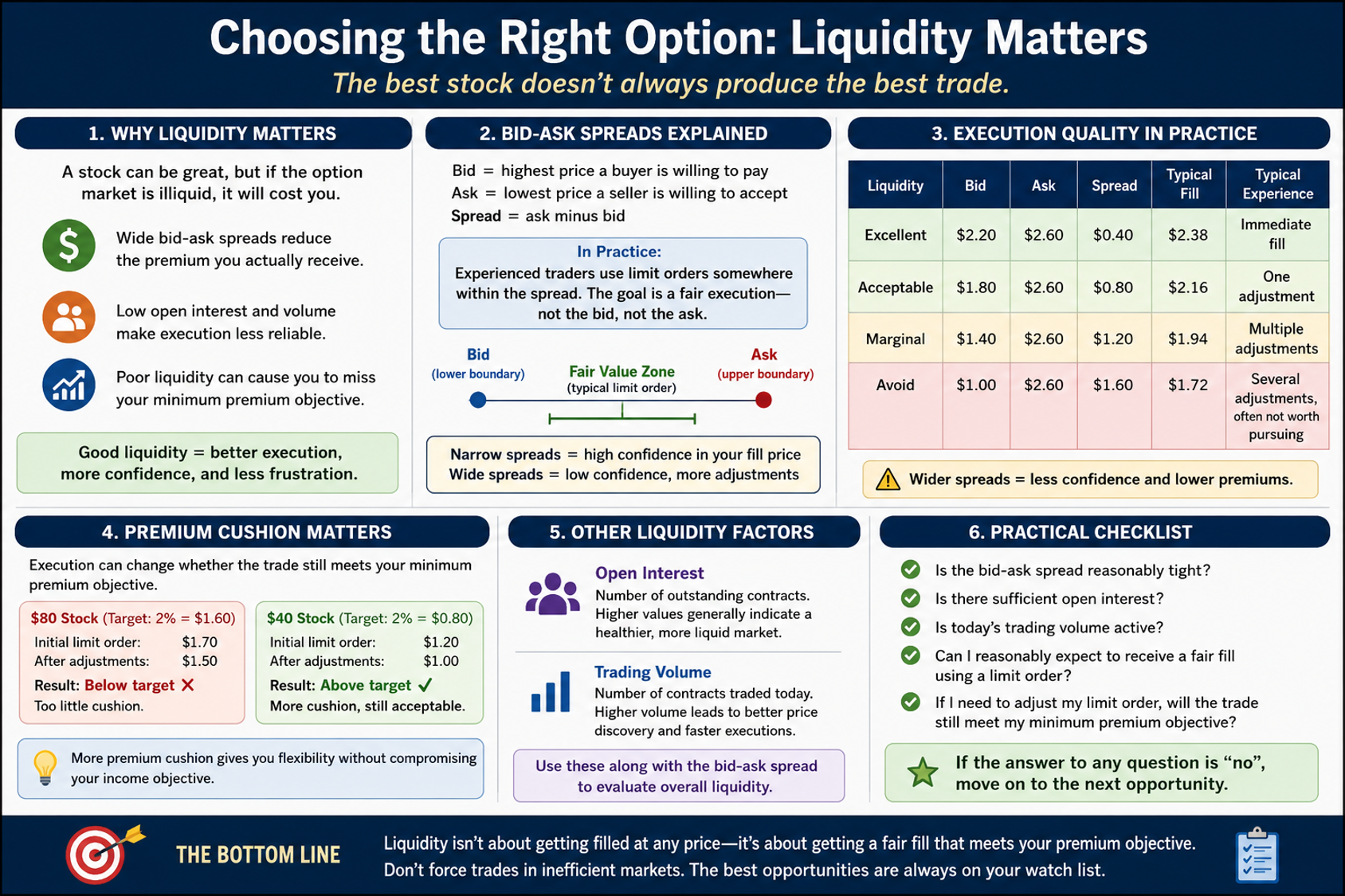
Good Stocks Can Have Poor Option Markets
It's easy to assume that every actively traded stock has an equally active options market, but that simply isn't true. Many companies with millions of shares traded each day have option chains that are surprisingly thin. Others may offer attractive quoted premiums, but those premiums often exist because buyers and sellers struggle to agree on a fair price.
The result is wider bid-ask spreads, lower open interest, and less daily trading volume. None of these characteristics guarantees a poor trade, but together they make it more difficult to consistently execute at favorable prices. Unlike market direction, these costs are largely avoidable. If an option chain appears inefficient, there is almost always another high-quality stock waiting on the watch list. That's why evaluating liquidity comes before selecting a strike price.
Why Bid-Ask Spreads Matter
The bid price is technically the highest price a buyer is currently willing to pay, while the ask price is the lowest price a seller is currently willing to accept. The difference between those two prices is known as the bid-ask spread.
In practice, however, experienced option traders rarely think of the bid and ask as the prices at which they'll actually trade. Instead, they view them as the boundaries of a negotiation. Rather than immediately accepting the bid when selling an option or paying the ask when buying one, most traders enter a limit order somewhere within the spread and allow the market an opportunity to respond.
In a highly liquid option chain, limit orders placed near fair value often fill quickly with little or no adjustment. As liquidity declines, however, execution becomes much less predictable. You may find yourself lowering your asking price several times before attracting a buyer, gradually giving up premium with each adjustment. The wider the bid-ask spread, the less confidence you can have that your initial limit order represents the price you'll ultimately receive.
For that reason, I don't view the bid price as the amount I'm likely to collect. Instead, I view it as the lower boundary of the current market. My objective is to determine whether the option market is efficient enough that I can reasonably expect to receive a fair price somewhere within the spread.
Execution Quality in Practice
The table below illustrates how execution quality typically changes as liquidity deteriorates. The fill prices are representative examples of what an experienced trader might reasonably expect using limit orders under normal market conditions. Actual fills will vary depending on market conditions, volatility, and order flow.
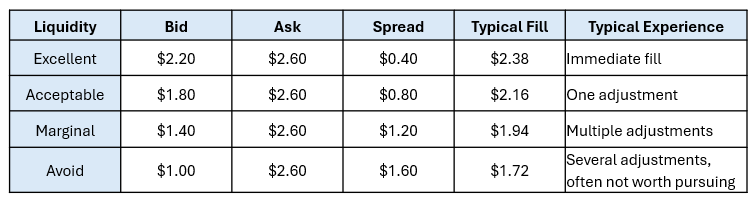
Notice that the objective isn't simply to estimate a typical fill price. It's to understand how confident you can be in actually receiving that price.
With an excellent option market, a limit order placed near fair value will often fill almost immediately. An acceptable market may require only a small adjustment before execution. As liquidity declines, however, the process becomes increasingly uncertain. You may lower your asking price once, then again, and perhaps several more times before receiving a fill. Eventually, you may complete the trade, but with much less confidence that you've received fair value. I've found that if I have to repeatedly lower my asking price just to complete a trade, it's usually a sign that I should have moved on to another opportunity instead. For this reason I always attempt to fill the options first before the stock.
Premium Cushion Matters
Execution quality affects more than just the price you receive—it can determine whether the trade still satisfies your investment criteria.
Suppose your objective is to collect approximately 2% of the stock price in option premium. For an $80 stock, that means collecting roughly $1.60 per share. Imagine your initial limit order is placed at $1.70. If you must lower your asking price several times before receiving a fill at $1.50, you've successfully executed the trade—but you've also fallen below your minimum premium objective. In other words, you compromised one of the very rules that caused you to select the trade in the first place.
Now consider a $40 stock with the same 2% objective. Your minimum premium is only $0.80, yet your initial limit order may be substantially higher than that amount. Even after making several adjustments, the premium may still comfortably exceed your minimum requirement. Although the execution wasn't ideal, the trade continues to satisfy your income objective.
The lesson isn't that lower-priced stocks are always better. Rather, it's that the amount of premium cushion matters. When a trade begins with very little excess premium above your minimum requirement, even modest execution concessions can reduce the trade below an acceptable level. Trades that begin with a larger premium cushion provide greater flexibility without compromising the strategy.
Open Interest and Trading Volume
While the bid-ask spread is often the first statistic I evaluate, it isn't the only measure of liquidity. Two additional statistics deserve close attention: open interest and trading volume.
Open interest measures the number of outstanding option contracts, while trading volume measures how many contracts changed hands during the current trading session. Higher values generally indicate a healthier market with more participants, better price discovery, and faster executions. Neither statistic guarantees a favorable fill, but together with the bid-ask spread they provide an excellent picture of how efficiently an option trades.
The objective isn't to find the busiest option chain in the market. It's simply to avoid markets where poor liquidity makes consistent execution unnecessarily difficult.
A Practical Checklist
When evaluating an option chain, I rarely rely on a single statistic. Instead, I ask a few simple questions:
- Is the bid-ask spread reasonably tight?
- Is there sufficient open interest?
- Is today's trading volume active?
- Can I reasonably expect to receive a fair fill using a limit order?
- If I need to adjust my limit order, will the trade still meet my minimum premium objective?
If the answer to any of those questions is no, I simply move on to the next stock. There is almost always another opportunity waiting.
Throughout this series we've followed the same philosophy: identify the highest-quality opportunities and eliminate unnecessary risk whenever possible. Liquidity is simply another example of that philosophy in action. Rather than forcing trades in inefficient option markets, we move on to the next opportunity. Over hundreds of trades, those seemingly small decisions can have a meaningful impact on both returns and consistency.
Looking Ahead
Once we've identified a liquid option chain, the next question becomes even more important:
- Which strike price should we sell?
Should we simply choose the option with the highest premium? Should we rely on Delta? Or is there a more objective way to balance premium collection with probability of success?
In the next article, we'll examine the process of strike selection and explain why consistently choosing the right strike has historically produced better long-term results than simply chasing the largest available premium.
Other Articles in the Series
Part 1 - How the Process Works
Part 2 - From 5,000 Stocks to 20 Candidates
Part 3 - Why We Avoid Earnings
Want to build a more complete trading toolkit?
The Bull Strangle Newsletter focuses on stocks and options, combining stock ownership with disciplined option-selling techniques designed to generate consistent income while managing risk.
The Smart Spreads Newsletter focuses on seasonal commodity spreads, a historically proven approach that seeks opportunities across agricultural, energy, metal, and financial futures markets.
Each strategy is designed to stand on its own, but together they provide a diversified approach that can perform across a wide range of market environments. For traders looking to deepen their education, The Bull Strangle Strategy and Trading Commodity Spreads are both available on Amazon.
Visit BullStrangle.com to subscribe for just $1 for the first month.
For a video overview of the Bull Strangle Newsletter
For a video overview of the Smart Spreads Newsletter
Darren Carlat
Dual Edge Research
(214) 636-3133
DualEdgeResearch@gmail.com
Disclaimer
This information is for informational purposes only and should not be considered as investment advice. Past performance is not indicative of future results, and all investments carry inherent risk. Consult with a financial advisor before making any investment decisions.


/A%20close-up%20of%20an%20AMD%20office%20by%20gehapromo%20via%20Adobe%20Stock.jpeg)
/Space/Rocket%20launching%20into%20space%20by%20BEST%20BACKGROUNDS%20via%20Shutterstock.jpg)
/Applied%20Materials%20Inc_%20campus%20sign-by%20Sundry%20Photography%20via%20iStock.jpg)
/Micron%20Technology%20Inc_%20logo%20on%20building-by%20vzphotos%20vis%20iStock.jpg)