



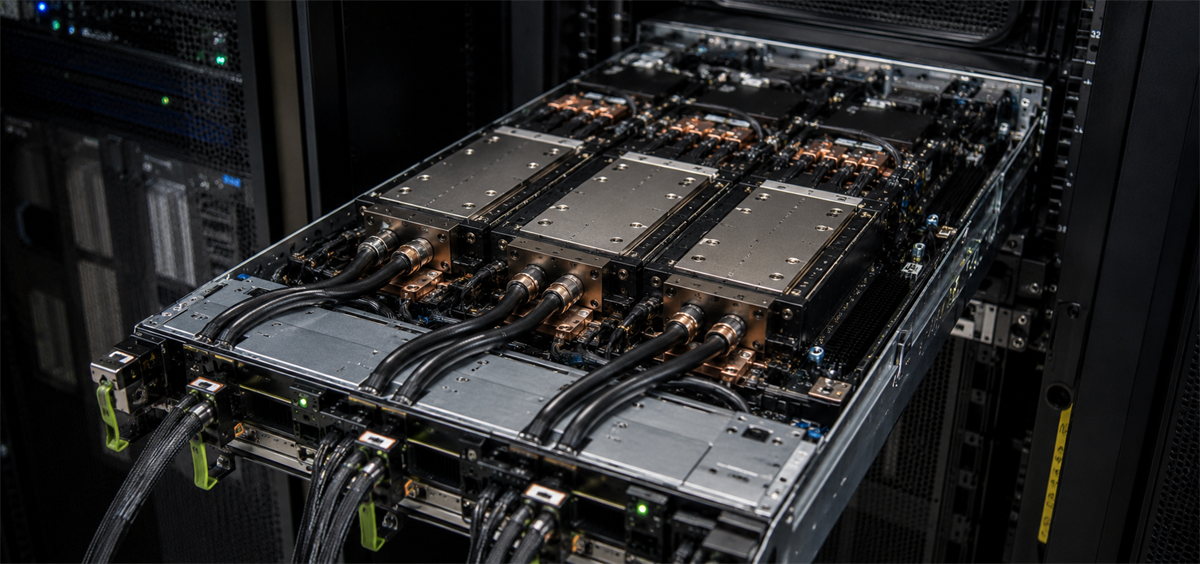
The artificial intelligence (AI) computing sector is fracturing. For years, one hardware architecture dictated the pace of AI advancement. Today, hyperscalers are rewriting that narrative by bringing silicon development in-house. Newly released benchmark results around the Hot Chips 2026 conference reveal that OpenAI’s first-generation application-specific integrated circuit (ASIC), the Jalapeño, outperforms leading commercial systems in specific inference workloads.
This verified silicon achievement signals a shift toward deploying internal, vertically integrated AI hardware. The emergence of credible alternatives in AI inference could become an important turning point for the tech sector. As hyperscalers pivot to defend their margins, investors might weigh the immediate fundamental strength of traditional chipmakers against the commoditization of enterprise AI infrastructure.
A Recipe for Silicon Independence
To grasp the impact of OpenAI's Jalapeño, investors should look at the raw efficiency metrics. Built on a cutting-edge node with specialized memory bandwidth, Jalapeño handles about 1.5x to 1.9x as much work per watt at peak throughput as current-generation hardware like the Blackwell systems. It also achieves significantly lower end-to-end latency while keeping typical power consumption at or below 550 watts during active workloads. In data center economics, power efficiency translates directly to operating leverage.
The most potent threat to the existing ecosystem is not just thermal efficiency, but software independence. OpenAI utilizes its own Gluon kernel programming language to execute these workloads, reducing its dependence on proprietary GPU software such as CUDA for workloads running on its first-party silicon. That gives OpenAI greater control over a part of the software stack that has helped lock developers into traditional graphics processing unit ecosystems for years.
Microsoft (NASDAQ: MSFT) is executing a parallel strategy to mitigate its reliance on third-party GPU manufacturers. The anticipated September unveiling of the Microsoft Maia 300 AI chip could intensify competition in AI inference. Microsoft is reportedly negotiating with Taiwan Semiconductor Manufacturing (NASDAQ: TSM) for capacity to produce more than 300,000 Maia 300 units for delivery in 2027. With an estimated $678 billion backlog and sustained growth in cloud infrastructure, Microsoft is directing substantial capital expenditure toward a self-reliant hardware architecture.
Margins, Multiples, and Hardware
While custom hardware threatens future market share in inference, an objective look at the underlying financials paints a nuanced picture of the AI race. Developing internal silicon requires significant capital expenditure, which directly impacts near-term capital efficiency.
NVIDIA (NASDAQ: NVDA) currently has a return on equity of about 97%, compared to Microsoft’s perfectly respectable but much lower metric of about 32%. As hyperscalers like Microsoft pour billions into fabricating hundreds of thousands of internal silicon units, their margins face near-term compression risks that pure-play designers are currently avoiding.
Valuation multiples further highlight this divergence. NVIDIA trades at a forward price-to-earnings ratio of about 24, alongside a highly attractive price-to-earnings-to-growth ratio of about 0.41. That combination helps explain why investors continue to support its approximately $5.16 trillion market valuation despite growing competitive threats. NVIDIA's first-quarter results for fiscal year 2027 (FY2027) underscore this momentum, with earnings per share of $1.87 and year-over-year revenue growth exceeding 85%.
Conversely, Microsoft trades at a forward price-to-earnings ratio of roughly 25, with a price-to-earnings-to-growth ratio closing in on 1.57.
While Microsoft offers a more diversified software and cloud revenue base, highlighted by its recent earnings per share of $4.74 and an approximate 17.7% revenue expansion, investors are paying a slight premium for that stability relative to its expected growth rate.
Both Microsoft and NVIDIA are returning capital to shareholders to stabilize pricing, with Microsoft authorizing a $60 billion stock buyback program and NVIDIA executing its own $80 billion repurchase plan.
Institutional Bets Shift Toward Custom Compute
Institutional movements often front-run structural shifts, and recent rotations validate confidence in the integrated cloud-and-hardware strategy. Pershing Square recently executed a major rotation, stepping heavily out of legacy search and into Microsoft, thereby making Microsoft its largest AI holding. This signals smart-money belief that Microsoft’s hardware investments and deep enterprise software integration will ultimately drive sustained shareholder value.
On the other side of the trade, NVIDIA continues to benefit from enormous demand for GPU-based AI infrastructure, suggesting that any shift toward custom silicon is likely to unfold gradually rather than disrupt its business overnight.
Institutional filings reveal that NVIDIA holds a roughly $21 billion stake in SpaceX (NASDAQ: SPCX), making it NVIDIA's second-largest holding. The position deepens NVIDIA's financial exposure to another major participant in the broader aerospace and tech ecosystem.
Long-term structural shifts are momentarily taking a backseat to immediate macro headwinds. Options chains and prediction markets have aggressively priced out an earnings miss for NVIDIA's upcoming second-quarter FY2027 report. Elevated institutional expectations create immediate volatility risks. When an equity is priced for absolute perfection, even a slight deceleration in forward guidance could trigger short-term price action, temporarily overshadowing the broader Jalapeño threat. Analysts currently project an upside of approximately 44.8% for NVIDIA compared to a modest 13.9% for Microsoft, highlighting a wide divergence in Wall Street's short-term expectations.
Savoring the AI Hardware Transition
The total addressable market for artificial intelligence compute is expanding at a velocity that can arguably support both merchant silicon giants and proprietary hyperscaler hardware. While the introduction of highly efficient, first-party inference chips signals a meaningful shift in the competitive landscape, it does not spell immediate doom for the incumbents.
Investors might consider analyzing their portfolio weighting to ensure they are not overly exposed to a single failure point in the AI supply chain. Balancing pure-play GPU exposure with mega-cap companies investing heavily in proprietary silicon could provide diversification as the AI hardware market becomes more competitive. Those with a higher risk tolerance might view near-term volatility as an opportunity to reassess exposure to these companies as the hardware transition unfolds, monitoring subsequent quarterly margin reports to confirm capital efficiency.
Where Should You Invest $1,000 Right Now?
Before you make your next trade, you'll want to hear this.
MarketBeat keeps track of Wall Street's top-rated and best performing research analysts and the stocks they recommend to their clients on a daily basis.
Our team has identified the five stocks that top analysts are quietly whispering to their clients to buy now before the broader market catches on... and none of the big name stocks were on the list.
They believe these five stocks are the five best companies for investors to buy now...
The article "OpenAI’s Jalapeño Chip Could Change the AI Hardware Race" first appeared on MarketBeat.



/AI%20(artificial%20intelligence)/Ai%20chip%20by%20Quality%20Stock%20Arts%20via%20Shutterstock.jpg)