




The US economy just shed 23,000 jobs. Yet the news sent stocks up sharply on Friday. How can that be? Because as I can’t stress enough, the stock market is NOT the economy.
Consider my MoneyShow Chart of the Day here. It shows the percentage change in nonfarm payrolls from July 2025 through July 2026 and the total return of the S&P 500 Index ($SPX) during that same period. Talk about a divergence! Payrolls grew just 0.37% while the S&P returned 18.1%.
(To get more articles and podcasts from MoneyShow, subscribe to our Top Pros’ Top Picks newsletter here.)
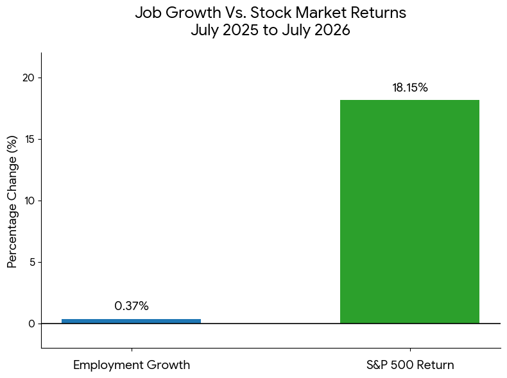
Sources: Bureau of Labor Statistics, S&P Dow Jones Indices
Data dates: 7/31/25 – 7/31/26
In raw terms, the year-over-year job change came to 591,000. That’s okay, but not terrific.
We had five months during that stretch where the economy shed jobs, too. Plus, that 0.37% growth rate is a notable slowdown from the post-pandemic recovery gains of 1.5% to 2%.
And YET...the S&P surged more than 1,150 points during those 12 months. What about the longer term? The S&P returned 26.2% in 2023...25% in 2024...and 17.8% in 2025. It was recently up 13.3% for 2026 on a total return basis. Those numbers all handily top the long-term average.
Zooming in on the short-term, how can stocks rally on news the economy shed workers? Because it lowers the chance of a Federal Reserve interest rate hike. Reducing the fear of tighter money makes investors willing to pay more for stocks. Bonds and precious metals, too.
All this underscores why you have to check your emotions at the door as an investor or trader. Bad news on Main Street isn’t necessarily bad news on Wall Street. Sometimes it’s "good" news. If you want to stay on the right side of the markets, you can’t forget that!

/NVIDIA%20Corp%20video%20chip-by%20Antonio%20Bordunovi%20via%20iStock.jpg)

/An%20Intel%20sign%20out%20front%20of%20a%20corporate%20office%20by%20wolterke%20via%20Adobe%20Stock.jpeg)
/A%20close-up%20of%20an%20AMD%20office%20by%20gehapromo%20via%20Adobe%20Stock.jpeg)