


Financial services company Pathward Financial (NASDAQ:CASH) fell short of the markets revenue expectations in Q4 CY2025, with sales flat year on year at $173.1 million. Its GAAP profit of $1.57 per share was 13.8% above analysts’ consensus estimates.
Is now the time to buy Pathward Financial? Find out by accessing our full research report, it’s free.
Pathward Financial (CASH) Q4 CY2025 Highlights:
- Net Interest Income: $119.3 million vs analyst estimates of $125.9 million (2.8% year-on-year growth, 5.2% miss)
- Net Interest Margin: 7% vs analyst estimates of 7.4% (46 basis point miss)
- Revenue: $173.1 million vs analyst estimates of $185.8 million (flat year on year, 6.8% miss)
- EPS (GAAP): $1.57 vs analyst estimates of $1.38 (13.8% beat)
- Tangible Book Value per Share: $24.54 vs analyst estimates of $24.90 (27.5% year-on-year growth, 1.4% miss)
- Market Capitalization: $1.71 billion
CEO Brett Pharr said, "We started the fiscal year in a position of strength. Overall, we are pleased with the financial results achieved in the quarter, which were marked by solid growth in our core business including growing interest income in commercial finance with a lower provision, increasing core card and deposit fee income, and flat expenses. Our strategy continues to drive strong results, and we are seeing positive outcomes driven by what we accomplished in fiscal 2025. We look forward to delivering on our fiscal 2026 goals which we believe will set us up for sustainable growth in the future. "
Company Overview
Formerly known as Meta Financial until its 2022 rebranding, Pathward Financial (NASDAQ:CASH) provides banking-as-a-service solutions and commercial finance products, enabling partners to offer financial services like prepaid cards, payment processing, and lending options.
Sales Growth
Two primary revenue streams drive bank earnings. While net interest income, which is earned by charging higher rates on loans than paid on deposits, forms the foundation, fee-based services across banking, credit, wealth management, and trading operations provide additional income. Luckily, Pathward Financial’s revenue grew at a decent 11.5% compounded annual growth rate over the last five years. Its growth was slightly above the average banking company and shows its offerings resonate with customers.
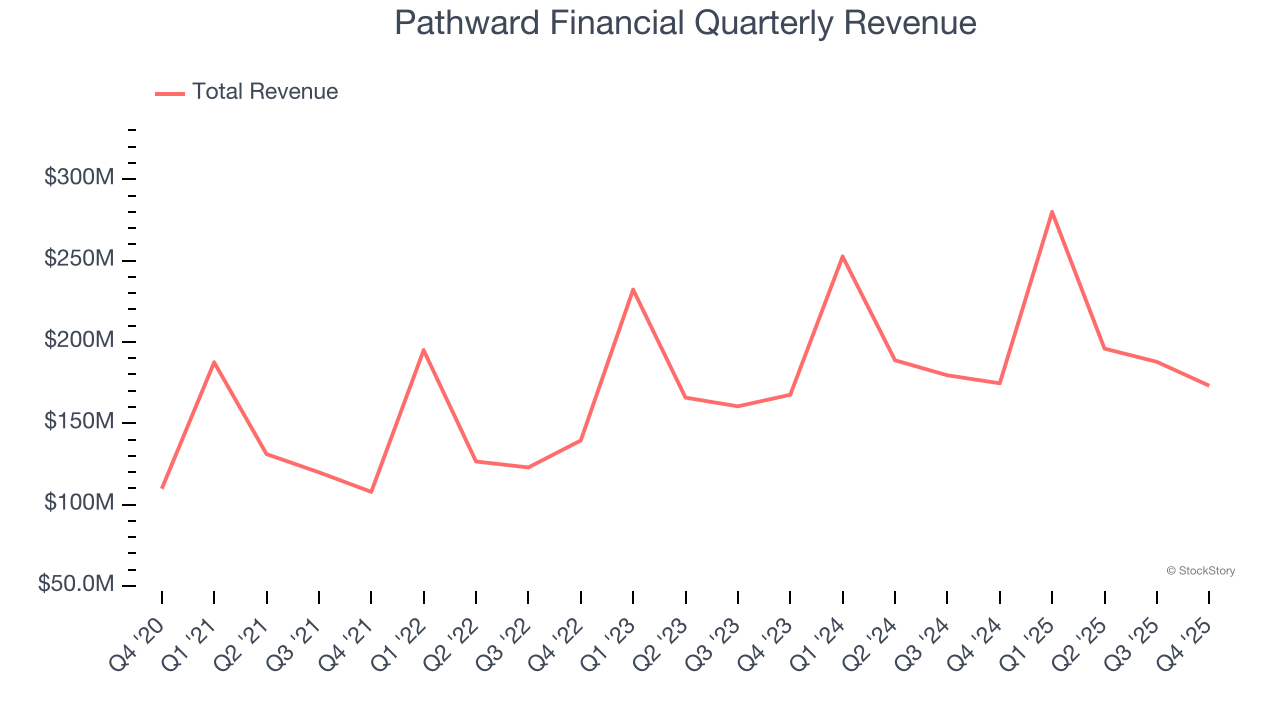
We at StockStory place the most emphasis on long-term growth, but within financials, a half-decade historical view may miss recent interest rate changes, market returns, and industry trends. Pathward Financial’s recent performance shows its demand has slowed as its annualized revenue growth of 7.4% over the last two years was below its five-year trend. 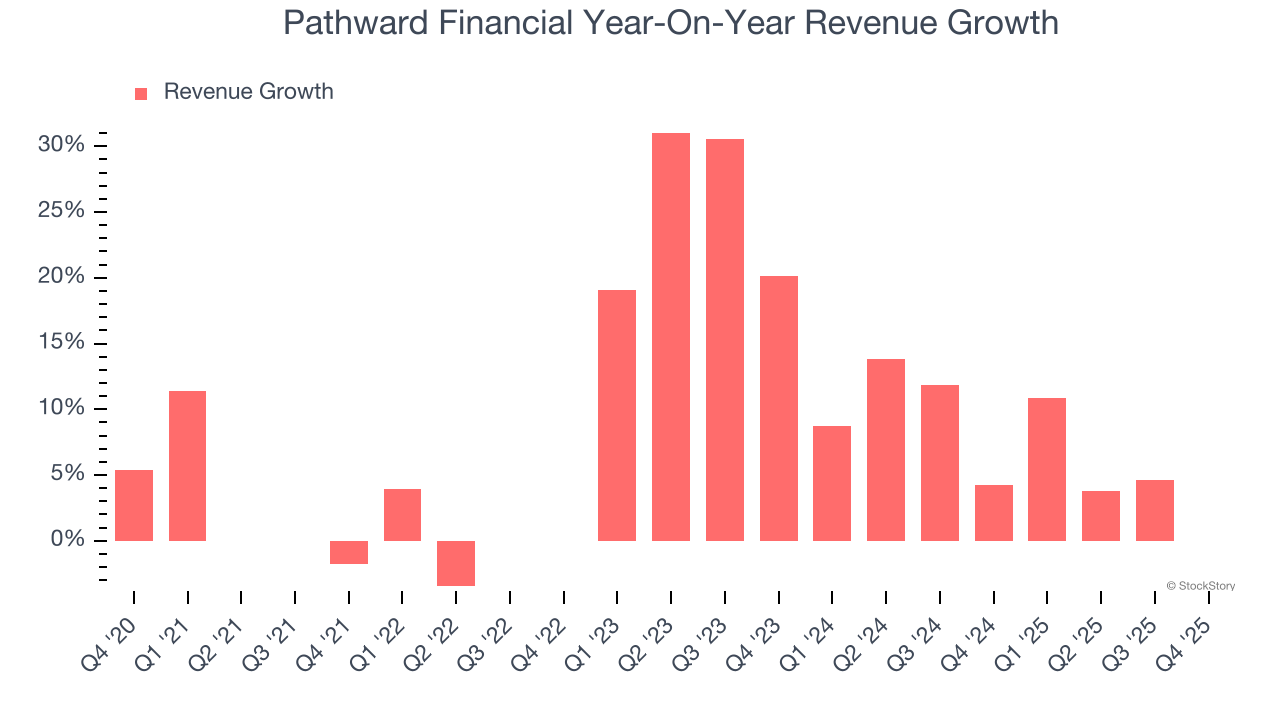 Note: Quarters not shown were determined to be outliers, impacted by outsized investment gains/losses that are not indicative of the recurring fundamentals of the business.
This quarter, Pathward Financial missed Wall Street’s estimates and reported a rather uninspiring 0.9% year-on-year revenue decline, generating $173.1 million of revenue.
Net interest income made up 57.8% of the company’s total revenue during the last five years, meaning Pathward Financial’s growth drivers strike a balance between lending and non-lending activities.
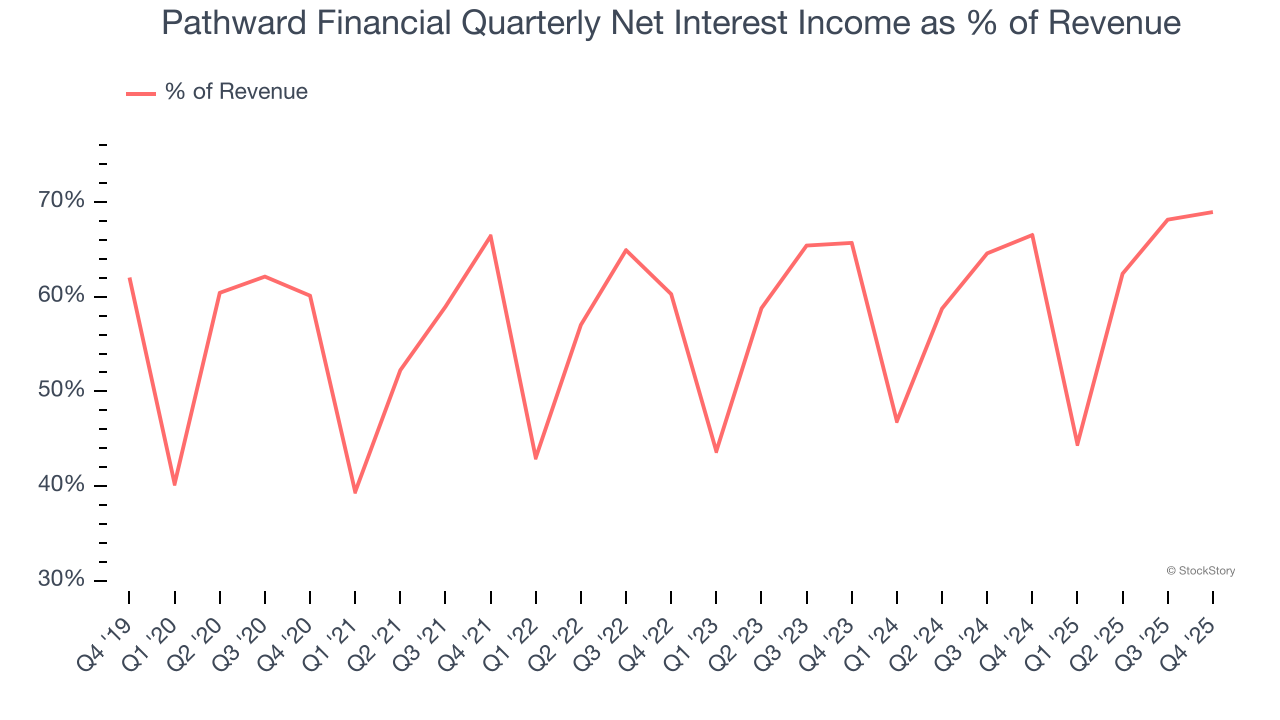
While banks generate revenue from multiple sources, investors view net interest income as the cornerstone - its predictable, recurring characteristics stand in sharp contrast to the volatility of non-interest income.
While Wall Street chases Nvidia at all-time highs, an under-the-radar semiconductor supplier is dominating a critical AI component these giants can’t build without. Click here to access our free report one of our favorites growth stories.
Tangible Book Value Per Share (TBVPS)
Banks operate as balance sheet businesses, with profits generated through borrowing and lending activities. Valuations reflect this reality, emphasizing balance sheet strength and long-term book value compounding ability.
This explains why tangible book value per share (TBVPS) stands as the premier banking metric. TBVPS strips away questionable intangible assets, revealing concrete per-share net worth that investors can trust. EPS can become murky due to acquisition impacts or accounting flexibility around loan provisions, and TBVPS resists financial engineering manipulation.
Pathward Financial’s TBVPS grew at an incredible 11.6% annual clip over the last five years. TBVPS growth has also accelerated recently, growing by 26.2% annually over the last two years from $15.41 to $24.54 per share.
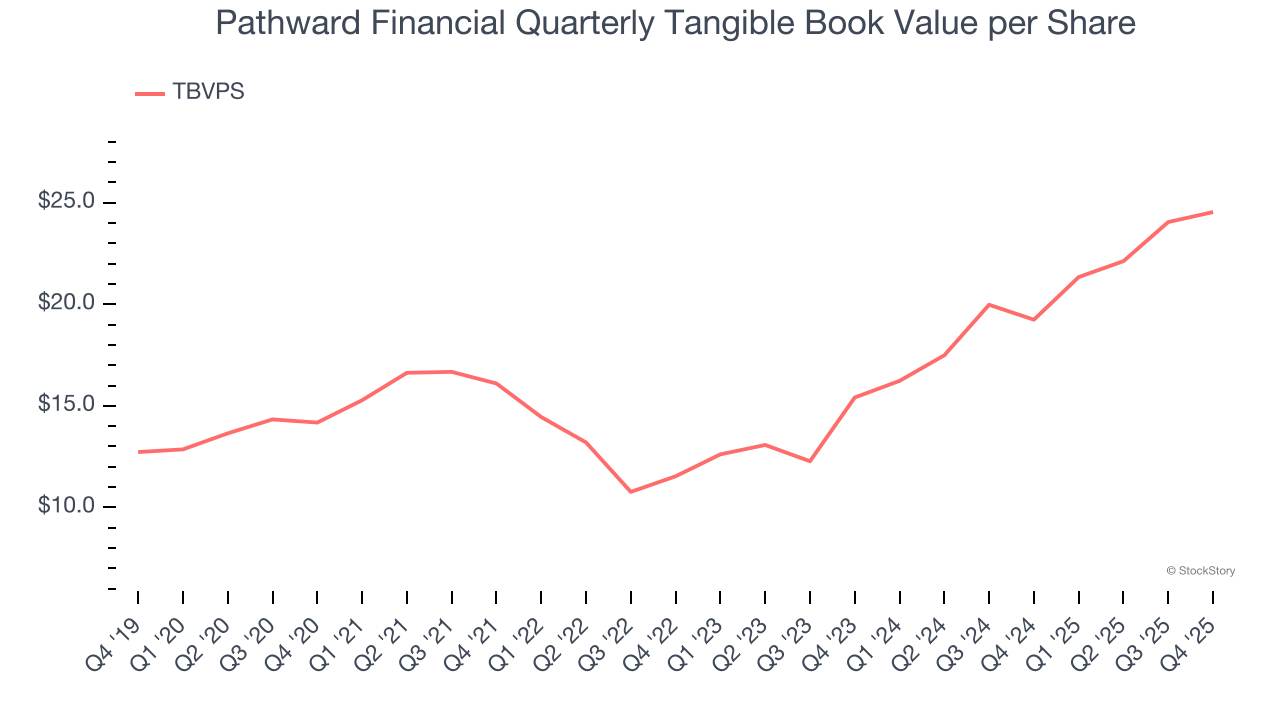
Over the next 12 months, Consensus estimates call for Pathward Financial’s TBVPS to grow by 23.1% to $30.20, elite growth rate.
Key Takeaways from Pathward Financial’s Q4 Results
It was good to see Pathward Financial beat analysts’ EPS expectations this quarter. On the other hand, its revenue missed and its net interest income fell short of Wall Street’s estimates. Overall, this was a weaker quarter. The stock remained flat at $79.90 immediately following the results.
So do we think Pathward Financial is an attractive buy at the current price? We think that the latest quarter is only one piece of the longer-term business quality puzzle. Quality, when combined with valuation, can help determine if the stock is a buy. We cover that in our actionable full research report which you can read here (it’s free).


/AI%20(artificial%20intelligence)/AI%20software%20engineering%20by%20Tapati%20Rinchumrus%20via%20Shutterstock.jpg)
/Broadcom%20Inc%20logo%20on%20phone%20and%20site-by%20Majahid%20Mottakin%20via%20Shutterstock.jpg)

/Micron%20Technology%20Inc_%20logo%20on%20building-by%20vzphotos%20vis%20iStock.jpg)