

AppLovin Corporation’s APP recent performance highlights one defining advantage: the scalability of its advertising technology. The company’s strong third-quarter results demonstrated that growth is no longer solely dependent on volume, but also on efficiency. Rising revenues alongside elevated EBITDA margins indicate that incremental advertiser spend is translating directly into profitability, a key signal of operating leverage.
Axon and Self-Service: Fueling Spend Expansion
At the core of this scalability is AppLovin’s Axon engine, which optimizes ad performance using advanced automation. Combined with the company’s expanding self-service platform, advertisers can now deploy campaigns faster, test formats more efficiently, and scale budgets with greater confidence. This ease of execution is driving higher wallet share from existing customers while attracting new advertisers seeking measurable returns.
Importantly, AppLovin’s advertising tools are no longer confined to gaming. The same performance-driven infrastructure is gaining traction in e-commerce advertising, widening the addressable market significantly. As more non-gaming advertisers adopt the platform, revenue diversification improves while margin stability remains intact.
Management’s outlook reinforces this thesis. Expectations for sustained high double-digit growth alongside consistently strong EBITDA margins suggest confidence that the ad engine can scale without sacrificing efficiency. In short, AppLovin’s growth story is less about cyclical demand and more about a structurally powerful monetization platform.
How AppLovin Compares With Key U.S. Peers
The Trade Desk TTD operates a demand-side platform focused on programmatic advertising, with strength in data-driven targeting. While The Trade Desk benefits from premium brand exposure, its margin profile is more sensitive to advertising cycles than AppLovin. The Trade Desk emphasizes reach and transparency, whereas AppLovin emphasizes performance. As a result, The Trade Desk competes more on scale than efficiency.
Unity Software U also intersects with advertising through its real-time 3D and monetization tools. However, Unity Software’s ad business is closely tied to developer ecosystems and remains more volatile. Unlike AppLovin, Unity Software is still balancing growth with profitability, making AppLovin’s margin stability a key differentiator among these peers.
APP’s Price Performance, Valuation and Estimates
The stock has gained 83% over the past year compared with the industry’s 15% growth.
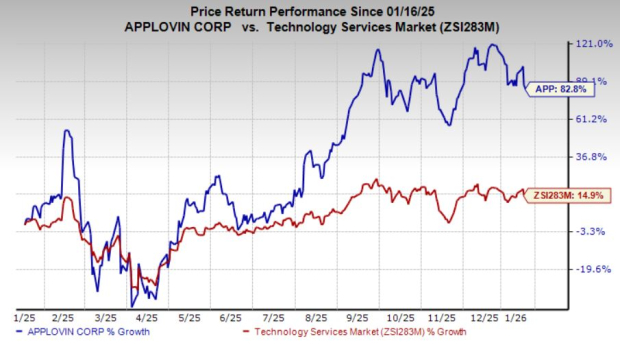 Image Source: Zacks Investment Research
From a valuation standpoint, APP trades at a forward price-to-earnings ratio of 40, which is well abovethe industry average of 26. It carries a Value Score of D.
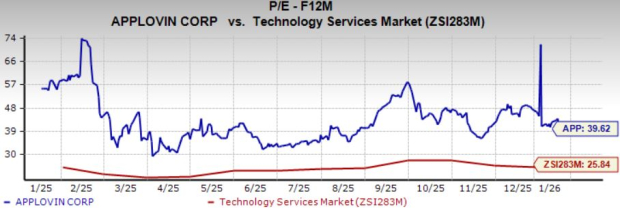 Image Source: Zacks Investment Research
The Zacks Consensus Estimate for APP’s 2025 earnings has remained unchanged over the past 30 days.

Image Source: Zacks Investment Research
APP currently carries a Zacks Rank #3 (Hold). You can see the complete list of today’s Zacks #1 (Strong Buy) Rank stocks here.
Quantum Computing Stocks Set To Soar
Artificial intelligence has already reshaped the investment landscape, and its convergence with quantum computing could lead to the most significant wealth-building opportunities of our time.
Today, you have a chance to position your portfolio at the forefront of this technological revolution. In our urgent special report, Beyond AI: The Quantum Leap in Computing Power, you'll discover the little-known stocks we believe will win the quantum computing race and deliver massive gains to early investors.
Access the Report Free Now >>Want the latest recommendations from Zacks Investment Research? Today, you can download 7 Best Stocks for the Next 30 Days. Click to get this free report
AppLovin Corporation (APP): Free Stock Analysis Report
The Trade Desk (TTD): Free Stock Analysis Report
Unity Software Inc. (U): Free Stock Analysis Report
This article originally published on Zacks Investment Research (zacks.com).



/Nvidia%20logo%20and%20sign%20on%20headquarters%20by%20Michael%20Vi%20via%20Shutterstock.jpg)
/Micron%20Technology%20Inc_%20logo%20on%20building-by%20vzphotos%20vis%20iStock.jpg)