


Dual Edge Research publishes two powerful newsletters that work great individually — and even better together. The Bull Strangle Newsletter focuses on stocks and options, combining stock ownership with premium-selling strategies to generate consistent income and market-beating returns. The Smart Spreads Newsletter specializes in seasonal commodity futures spreads, offering a diversified approach with low correlation to equities. Together, they deliver a complete investment perspective — one focused on income, the other on diversification — all under one simple subscription.
Introduction
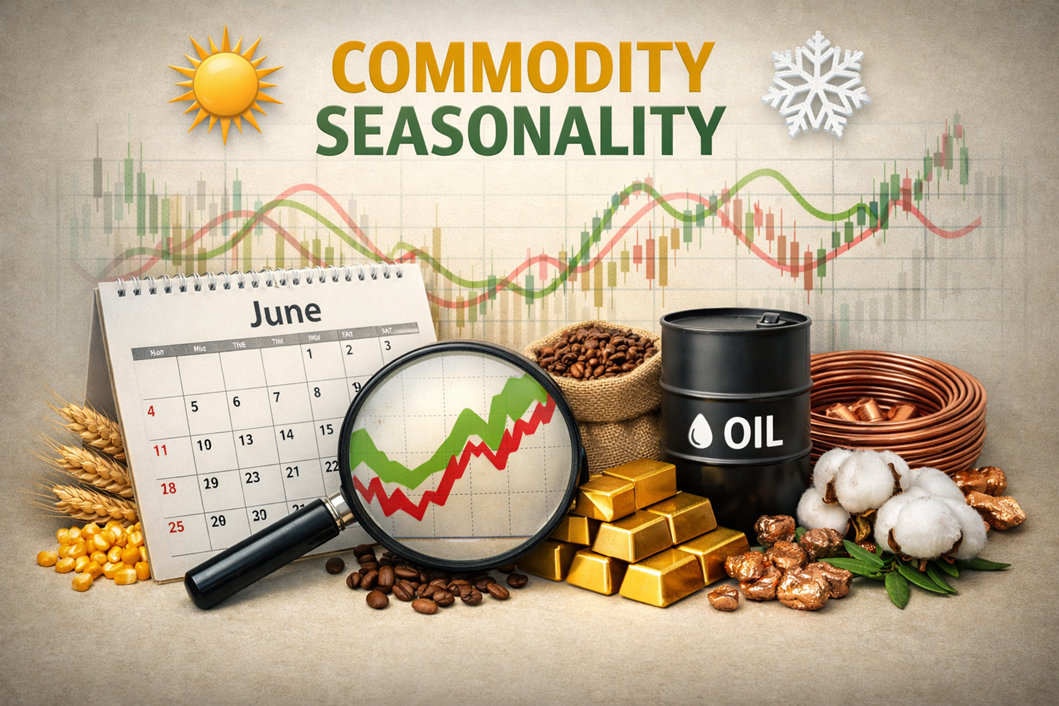
Commodity markets are influenced by forces that rarely appear in equity trading: planting and harvest cycles, weather patterns, inventory flows, transportation constraints, and industrial demand rhythms. While short-term price movements can look chaotic, many commodities exhibit remarkably consistent seasonal tendencies when viewed across long time horizons. For traders looking to reduce noise and improve probability, long-term seasonal analysis—especially when applied to commodity spread trading—can offer a powerful edge.
Why Seasonality Matters in Commodities
Seasonality reflects recurring, structural behaviors rather than one-off events. In agricultural markets, production cycles dictate when supply tightens or loosens. In energy, demand ebbs and flows with weather and consumption patterns. In metals, industrial usage and inventory cycles often repeat with surprising regularity. Unlike equities, where company-specific news can overwhelm historical tendencies, commodities are more directly tied to physical constraints. This makes seasonal behavior more persistent—provided it is studied over a sufficiently long dataset.
Why 15 Years Is a Meaningful Benchmark
Short seasonal studies can be misleading. A 3- or 5-year window may be dominated by unusual weather, geopolitical shocks, or macro distortions. Expanding the lens to 15 years helps smooth those anomalies and highlights patterns that have survived multiple economic cycles, bull and bear markets, and changing policy regimes. A longer dataset allows traders to answer critical questions:
- Does the pattern repeat often, or only occasionally?
- Are returns clustered around a specific calendar window?
- How severe are drawdowns when the pattern fails?
- Is the edge persistent across different volatility regimes?
Fifteen years is often long enough to filter out coincidence and focus on structural tendencies.
Why Seasonal Data Pairs Well With Spread Trading
Seasonal analysis becomes especially powerful when applied to calendar spreads, where one futures contract is traded against another in the same commodity (for example, buying a deferred month and selling a nearby month). Because spreads focus on relative pricing, they tend to be:
- Less sensitive to broad market direction
- More influenced by supply-and-demand shifts between contract months
- Lower in outright volatility than flat futures positions
Seasonal forces often express themselves more cleanly in spreads than in outright prices. Inventory draws, storage costs, and delivery pressures frequently impact nearby and deferred contracts differently—creating repeatable relative moves even when the headline price remains choppy.
Separating Signal From Noise
Not every seasonal pattern is tradable. Robust analysis looks beyond average returns and focuses on:
- Win rate: How often does the spread move in the expected direction?
- Average return vs. worst drawdown: Is the reward worth the risk?
- Timing consistency: Does the move occur within a tight entry window?
- Duration sensitivity: Does holding longer improve or degrade outcomes?
High-quality seasonal spreads typically show not just positive averages, but a tight distribution of outcomes and limited tail risk.
Seasonality Is a Framework, Not a Forecast
Even strong seasonal tendencies can fail in any given year. Weather surprises, policy changes, or supply disruptions can override historical norms. That’s why seasonality works best as a probability filter, not a prediction tool. Traders who use seasonal data effectively combine it with:
- Risk limits per market
- Predefined entry and exit windows
- Portfolio-level diversification across commodities and sectors
- Discipline to skip trades that don’t meet statistical thresholds
Used this way, seasonality becomes a decision-making framework rather than a rigid rule.
Bringing It All Together
Fifteen-year seasonal analysis helps traders focus on what has consistently mattered in commodity markets rather than what happens to be moving today. When combined with spread structures, it can uncover opportunities that are driven by repeatable economic forces instead of short-term speculation. For traders interested in applying this long-horizon, data-driven approach in practice, the Smart Spreads newsletter focuses on identifying and tracking high-probability commodity spreads using extended seasonal datasets and historical testing. In addition to seasonality, the newsletter incorporates a broad set of technical and fundamental indicators—such as Commitment of Traders, Relative Strength and Positioning, Carry Yield, Relative Strength, Hedge Fund Position Estimates, CTA Momentum, and market context—to provide an additional filtering layer, helping ensure that seasonal opportunities align with current market dynamics before capital is committed.
More Information
Now you can get two powerful newsletters — for one simple price!
- For stocks and options, the Bull Strangle Newsletter shows you how to combine stock ownership with dual option selling — a disciplined strategy that has consistently outperformed the S&P 500.
- For commodity futures, the Smart Spreads Newsletter focuses on seasonal commodity spreads — a proven, low-correlation approach that thrives in all types of markets.
Each newsletter is designed to deliver consistent income on its own — but when used together, they create a complete, diversified trading approach that works in any market environment.
Visit BullStrangle.com to subscribe for just $1 for the first month.
For a video overview of the Bull Strangle Newsletter
For a video overview of the Smart Spreads Newsletter
Darren Carlat
Dual Edge Research
(214) 636-3133
DualEdgeResearch@gamil.com
Disclaimer
This information is for informational purposes only and should not be considered as investment advice. Past performance is not indicative of future results, and all investments carry inherent risk. Consult with a financial advisor before making any investment decisions.


/Alphabet%20(Google)%20Image%20by%20Markus%20Mainka%20via%20Shutterstock.jpg)

/Alphabet%20Inc_%20and%20Google%20logos%20by%20IgorGolovinov%20via%20Shutterstock.jpg)
/AI%20(artificial%20intelligence)/AI%20technology%20-%20by%20Wanan%20Yossingkum%20via%20iStock.jpg)