




China Demand and Midwest Weather Keep the Grain Complex on Edge
Soybean sentiment has turned choppier over the past two weeks. An initial bout of strength faded into a pullback below twelve dollars a bushel, with prices later slipping toward a four-week low as favorable rain forecasts across the Midwest eased concerns built up during a stretch of hot, dry conditions. The move followed a USDA crop progress report that lowered the national good to excellent rating to 63% from 66%, a 4-percentage point weekly drop described as the largest such decline in twenty years, which briefly lent support before rainfall expectations capped the bounce.
China remains the single most closely watched variable. Following the Trump and Xi summit in South Korea in late October 2025 and their follow up meeting in May 2026, China committed to purchasing at least 25 million metric tons of US soybeans annually through 2028, alongside roughly 17 billion dollars of other agricultural goods each year over the same period. Renewed Chinese buying of new crop US soybeans helped push futures to contract highs on July 24, and traders continue tracking weekly export sales for confirmation that purchases are tracking toward that commitment. At the same time, China's state reserve agency Sinograin has signaled plans to auction roughly 500,000 metric tons of previously imported soybeans, its largest such sale since January, a move framed as freeing storage ahead of new US arrivals rather than weakening demand. Adding to the supply pressure, Brazil is on pace to export a record 115.4 million metric tons of soybeans in 2026, underscoring how much of the recent softness reflects abundant global availability rather than any demand shock. The July WASDE report added a modestly bullish undertone, with the USDA projecting a 2026/27 season average farm price of 11.40 dollars per bushel, the highest since the 2023/24 marketing year, as ending stocks came in slightly below pre report expectations.
What the Market Has Done
- The market has been in a constructive uptrend, with buyers stepping up bids as seen by the rising trendline and a pattern of higher highs.
- From April to May, buyers stepped up bids to 1157-2 (Daily level 4) in an attempt to continue higher, but were unable to get above the previous high from March at 1237-5, an area that sits in the vicinity of resistance carried over from 2024 (Daily level 3).
- Instead, the market dipped below 1157-2 for a liquidity check and found buying liquidity, resulting in prices rotating higher to probe slightly above the previous swing high to 1249-5 (Daily level 3), where responsive sellers are still holding offers.
- Recently, the market has rotated down from that level to 1187-4 (Minor level 1), where buyers are apparently attempting to defend the level.
What to Expect in the Coming Weeks
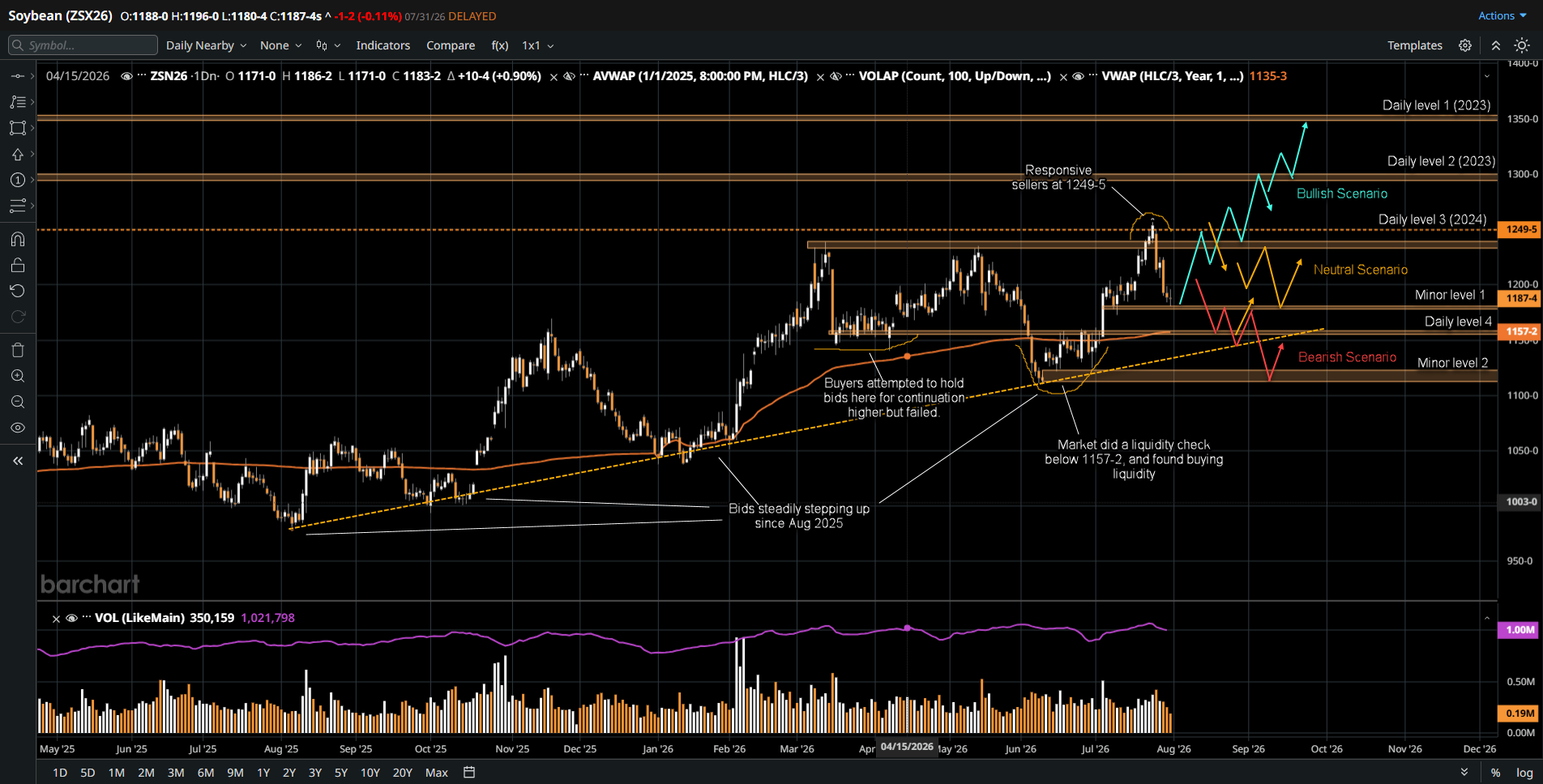
The key levels to watch are 1187-4 (Minor level 1) and 1157-2 (Daily level 4).
Bullish Scenario:
- If buyers are able to hold up at 1187-4, expect a move back up toward 1249-5 (Daily level 3), where responsive sellers are likely to be encountered again.
- If buyers step up bids further and are able to break and accept above 1249-5, expect a move up to 1300 (Daily level 2), a resistance level carried over from 2023, and possibly toward 1350 (Daily level 1), another resistance level from 2023.
- A possible trigger for this scenario would be confirmation that Chinese state buyers are accelerating purchases toward the 25 million metric ton annual commitment, or a renewed bout of Midwest heat and dryness during the pod filling stage that prompts the USDA to cut yield estimates.
Bearish Scenario:
- If buyers are not able to defend 1187-4, expect price to move down to 1157-2 (Daily level 4), which is confluent with the rising trendline, with some responsive buyers expected at that level.
- If that support fails to hold, expect a move down to 1115 (Minor level 2).
- A possible trigger for this scenario would be confirmation that Brazil's record 2026 export pace is displacing US cargoes in key markets, or fresh evidence, such as the Sinograin auction of imported stock, that China's near term purchasing needs are being met without meaningful new US commitments.
Neutral Scenario:
- A possible two way rotational auction between 1249-5 (Daily level 3) and 1187-4 (Minor level 1) could develop as the market works to establish value higher, after price has tested both edges of the range and failed back into it.
- A possible condition supportive for this scenario would be a WASDE report or crop progress update that lands close to trade expectations, leaving neither the weather narrative nor the Chinese demand narrative with a clear enough edge to push the market decisively in either direction.
Conclusion
Soybean futures remain technically constructive on a broader time frame, with the market having built a pattern of higher highs and higher lows, yet the current test of 1187-4 and the proximity of 1157-2 below it mean the next several sessions could determine whether the uptrend extends or whether a deeper correction is needed to attract fresh buying interest. Fundamentally, the picture is similarly balanced, as record Brazilian export volumes and an improved Midwest weather outlook offset the support coming from China's renewed purchases of new crop US soybeans and its standing commitment to buy at least 25 million metric tons annually through 2028. With crop progress ratings, weekly export sales, and the pace of Chinese buying all likely to move the market in the coming weeks, watching closely price action at 1187-4 should confirm which of these forces is currently in control. Where do you see soybean futures heading from here, and which of these levels are you watching most closely?
We provide the infrastructure you need to quantify your discipline and ensure every decision is backed by the confidence of seeing exactly what drives your performance. Start trading with the clarity you deserve. Open an Account today.
Disclaimer:
This article is provided for informational and educational purposes only and does not constitute financial, investment, or trading advice. The analysis presented reflects the author’s market observations and opinions at the time of writing and is not a recommendation to buy or sell any futures contract, security, or financial instrument. Futures trading involves significant risk and is not suitable for all market participants. Losses may exceed initial margin deposits, and market conditions can change rapidly.
Any scenarios, levels, or market expectations discussed are hypothetical in nature and are intended solely to illustrate potential market behavior. They do not represent actual trading results and should not be interpreted as guarantees of future performance. Past performance, market behavior, or historical price action are not indicative of future outcomes.
Readers are solely responsible for their own trading decisions and risk management. Always conduct independent research, consider your financial situation and risk tolerance, and consult with a qualified financial professional, if necessary, before engaging in futures or derivatives trading.

/A%20Palantir%20office%20building%20in%20Tokyo_%20Image%20by%20Hiroshi-Mori-Stock%20via%20Shutterstock_.jpg)
/A%20hand%20holding%20a%20phone%20with%20the%20Reddit%20logo_%20Mamun_Sheikh%20via%20Shutterstock_.jpg)
/BlackRock's%20global%20headquarters%20By%20Tada%20Images.jpeg)
/The%20CoreWeave%20logo%20displayed%20on%20a%20smartphone%20screen_%20Image%20by%20Robert%20Way%20via%20Shutterstock_.jpg)
/Apple%20logo%20on%20store%20front%20by%20frantic00%20via%20iStock.jpg)