



/A%20photo%20of%20a%20corporate%20Qualcomm%20sign%20by%20JHVEPhoto%20via%20Adobe%20Stock.jpeg)
Qualcomm's (QCOM) fiscal third-quarter 2026 results highlighted the challenges facing the company, with weak revenue, contracting margins, and little evidence of near-term business momentum. The short-term challenges have weighed heavily on investor sentiment, sending the stock down nearly 44% from its recent high.
Although Qualcomm's core CDMA Technologies (QCT) business faces challenges, the company's long-term growth story extends well beyond handsets. Expanding opportunities in higher-growth markets, particularly data centers, could become a meaningful earnings driver over the coming years, providing a compelling foundation for the bullish investment thesis despite the near-term headwinds.
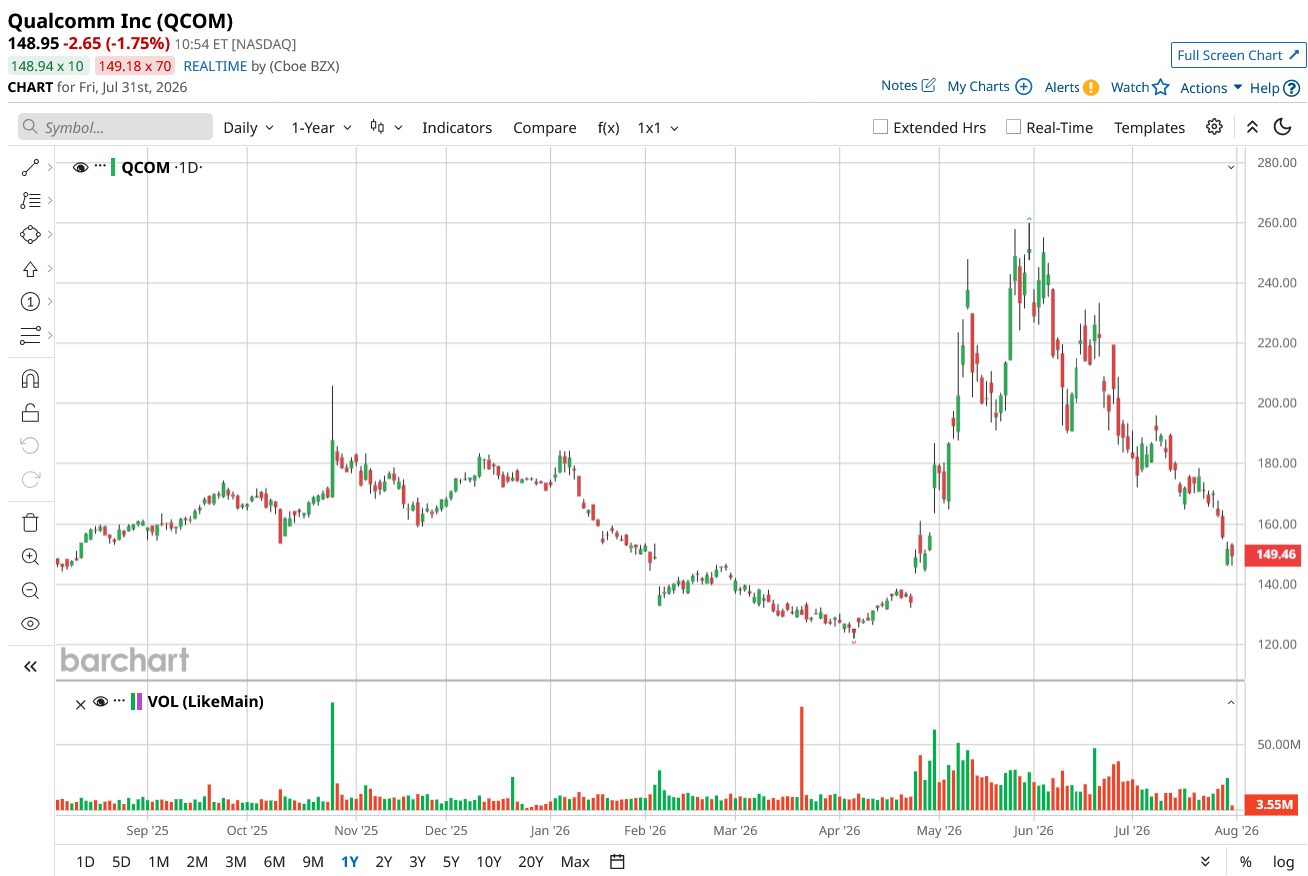
Qualcomm’s Q3 Disappoints
Qualcomm reported third-quarter fiscal 2026 revenue of $9.9 billion, down 4% year-over-year (YoY). The CDMA Technologies (QCT) segment generated $8.5 billion in revenue, down 5%, primarily due to a 20% decline in handset revenue.
The weakness reflects challenges across the Android smartphone ecosystem. Strong demand for AI infrastructure and high-bandwidth memory has diverted memory supply toward data center customers, raising component costs for smartphone manufacturers. As a result, several Android OEMs, particularly in China, lowered production. Lower smartphone shipments directly weighed on Qualcomm's handset business during the quarter.
Margins also came under pressure. Beyond weaker smartphone demand, semiconductor companies are facing higher costs across wafer fabrication, advanced packaging, assembly, memory, and other key materials. These inflationary pressures reduced profitability despite Qualcomm's efforts to manage expenses.
The impact was evident on the bottom line. Its adjusted EPS came in at $2.21, down roughly 20% from the same period last year.
Apple Exposure Adds Another Near-Term Risk
Qualcomm’s management also highlighted another challenge that could pressure near-term results.
Due to ongoing supply constraints, Qualcomm now expects the decline in Apple (AAPL)-related revenue to accelerate beginning in the fiscal fourth quarter. The company indicated that its share in Apple's upcoming iPhone launch will be materially below its earlier expectation of roughly 20%, creating an additional headwind for the QCT business.
Qualcomm's Next Growth Engine Is Taking Shape
Qualcomm's near-term outlook remains constrained by softness in smartphones, but the company's long-term growth story looks compelling. Its diversification strategy is gaining momentum, reducing reliance on handsets, and creating multiple new revenue streams.
The handset business is also showing early signs of recovery. Management said QCT handset revenue from Chinese OEMs likely bottomed in the third fiscal quarter and expects double-digit sequential growth in the fourth quarter. Over time, the emergence of agentic AI smartphones could trigger a new upgrade cycle that supports premium Snapdragon adoption.
The biggest opportunity, however, lies beyond smartphones. Qualcomm now expects more than $40 billion in non-handset QCT revenue by fiscal 2029, up from its previous guidance of $22 billion. The forecast includes over $24 billion from Automotive and IoT and more than $15 billion from Data Center, indicating that the company's diversification strategy is gaining ground.
The data center business is progressing rapidly. Qualcomm plans to expand its portfolio with connectivity products in fiscal 2026, custom silicon and AI accelerators in 2027, and server-class CPUs in 2028. Its first two custom silicon programs have already entered wafer production. They are expected to begin generating revenue in the December quarter, marking the start of what management expects to become long-term customer relationships. For fiscal 2027, Qualcomm forecasts Data Center revenue growth to $5 billion.
Automotive is another major growth driver. The segment generated a record $1.6 billion in revenue last quarter, up 61% YoY, driven by rising demand for advanced vehicle computing and increasing semiconductor content per vehicle.
By fiscal 2027, Qualcomm expects non-handset businesses to account for more than half of QCT revenue, rising to roughly two-thirds by fiscal 2029. In addition, an eventual recovery in Android shipments to China and AI-driven device upgrades positions Qualcomm to deliver a stronger and more diversified growth trajectory over the rest of the decade.
The Takeaway for QCOM Stock
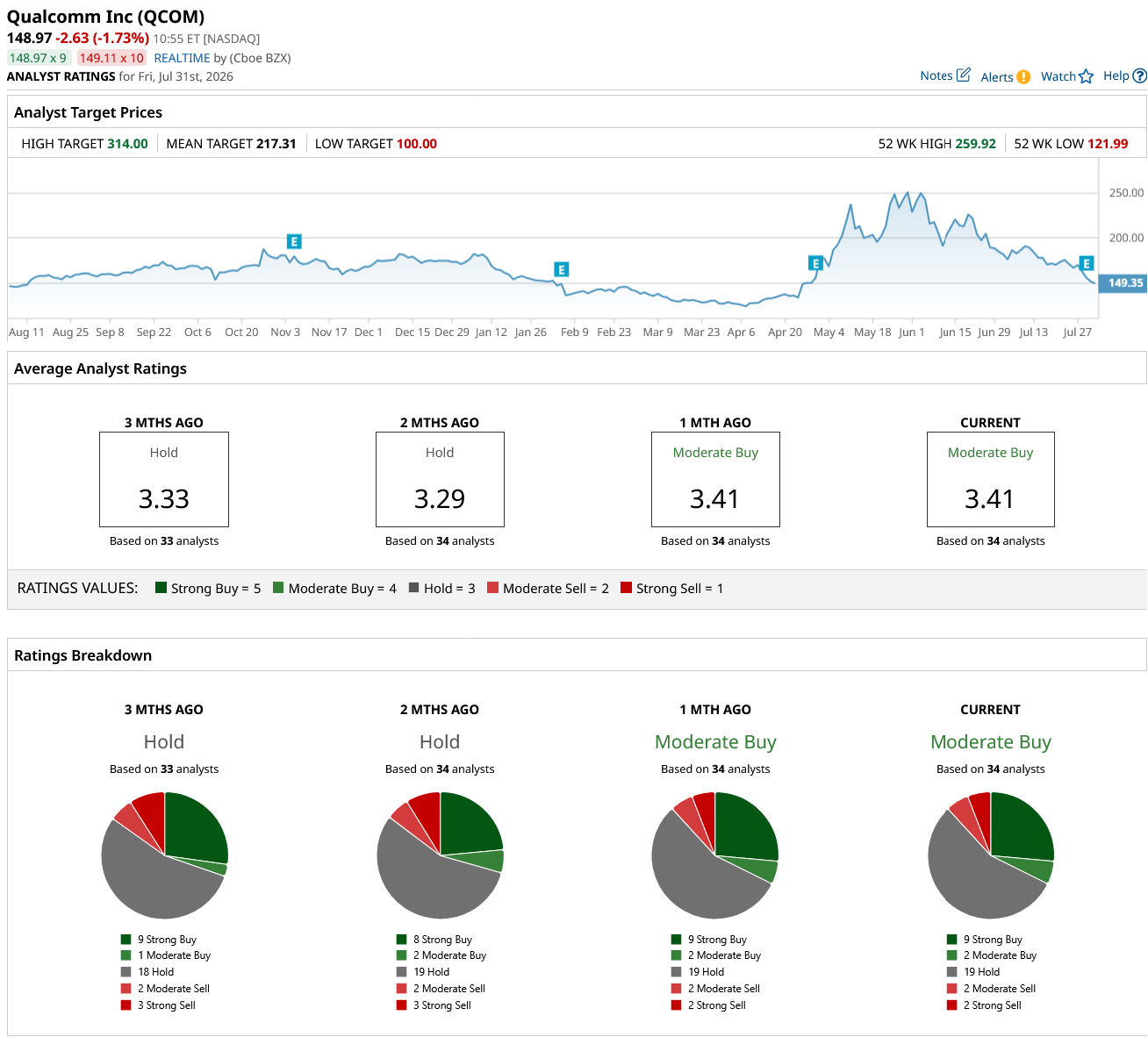
Qualcomm's near-term outlook remains challenging as lower handset revenue and cost pressure will continue to weigh on financial performance. Thus, analysts remain cautiously optimistic and maintain a “Moderate Buy” consensus rating.
However, the company's aggressive expansion into data centers, automotive, and IoT is steadily reshaping its growth profile and reducing its dependence on the handset market.
Overall, Qualcomm's expanding presence in higher-growth markets provides a solid path to a sharp recovery in its share price.
On the date of publication, Amit Singh did not have (either directly or indirectly) positions in any of the securities mentioned in this article. All information and data in this article is solely for informational purposes. For more information please view the Barchart Disclosure Policy here.




/AI%20(artificial%20intelligence)/Ai%20chip%20by%20Quality%20Stock%20Arts%20via%20Shutterstock.jpg)
/Seagate%20sign%20on%20the%20building%20atits%20operational%20headquarters%20By%20JHVEPhoto.jpeg)