



Consumer products behemoth Procter & Gamble (NYSE:PG) missed Wall Street’s revenue expectations in Q2 CY2026 as sales only rose 1.5% year on year to $21.2 billion. Its non-GAAP profit of $1.43 per share was 1.6% above analysts’ consensus estimates.
Is now the time to buy Procter & Gamble? Find out by accessing our full research report, it’s free.
Procter & Gamble (PG) Q2 CY2026 Highlights:
- Revenue: $21.2 billion vs analyst estimates of $21.38 billion (1.5% year-on-year growth, 0.8% miss)
- Adjusted EPS: $1.43 vs analyst estimates of $1.41 (1.6% beat)
- Adjusted EPS guidance for the upcoming financial year 2027 is $7 at the midpoint, missing analyst estimates by 0.8%
- Operating Margin: 18.6%, down from 25.1% in the same quarter last year
- Free Cash Flow Margin: 19.4%, similar to the same quarter last year
- Organic Revenue was flat year on year
- Market Capitalization: $346.7 billion
“Fiscal 2026 was a year of foundation building while continuing to grow sales and profit and return high levels of cash to shareowners despite a very challenging geopolitical and economic environment,” said Shailesh Jejurikar, President and Chief Executive Officer.
Company Overview
Founded by candle maker William Procter and soap maker James Gamble, Procter & Gamble (NYSE:PG) is a consumer products behemoth whose product portfolio spans everything from facial tissues to laundry detergent to feminine care to men’s grooming.
Revenue Growth
A company’s long-term sales performance is one signal of its overall quality. Any business can put up a good quarter or two, but the best consistently grow over the long haul.
With $87.03 billion in revenue over the past 12 months, Procter & Gamble is one of the most widely recognized consumer staples companies. Its influence over consumers gives it negotiating leverage with distributors, enabling it to pick and choose where it sells its products (a luxury many don’t have). However, its scale is a double-edged sword because it’s harder to find incremental growth when your existing brands have penetrated most of the market. For Procter & Gamble to boost its sales, it likely needs to adjust its prices, launch new offerings, or lean into foreign markets.
As you can see below, Procter & Gamble’s 2% annualized revenue growth over the last three years was sluggish, but to its credit, consumers bought more of its products.
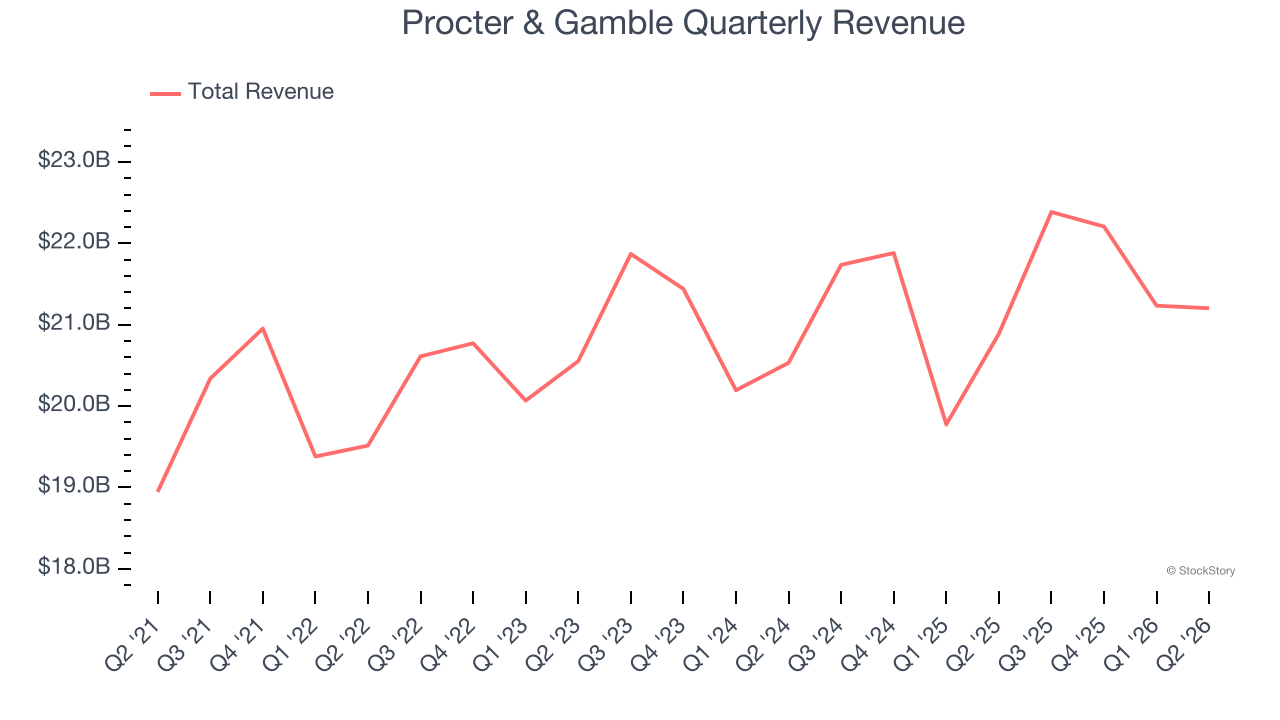
This quarter, Procter & Gamble’s revenue grew by 1.5% year on year to $21.2 billion, falling short of Wall Street’s estimates.
Looking ahead, sell-side analysts expect revenue to grow 2.8% over the next 12 months, similar to its three-year rate. This projection is underwhelming and suggests its newer products will not lead to better top-line performance yet.
WHILE YOU’RE HERE: The Next Palantir? One satellite company captures images of every point on Earth. Every single day. The Pentagon wants it. Hedge funds are using it to beat earnings. You’ve probably never heard of it.
This is what the early days of Palantir looked like before it became a giant. Same playbook. Different technology. If you missed Palantir, you need to see this. Claim The Stock Ticker for Free HERE.
Organic Revenue Growth
When analyzing revenue growth, we care most about organic revenue growth. This metric captures a business’s performance excluding one-time events such as mergers, acquisitions, and divestitures as well as foreign currency fluctuations.
The demand for Procter & Gamble’s products has been stable over the last eight quarters but fell behind the broader sector. On average, the company has posted feeble year-on-year organic revenue growth of 1.5%. 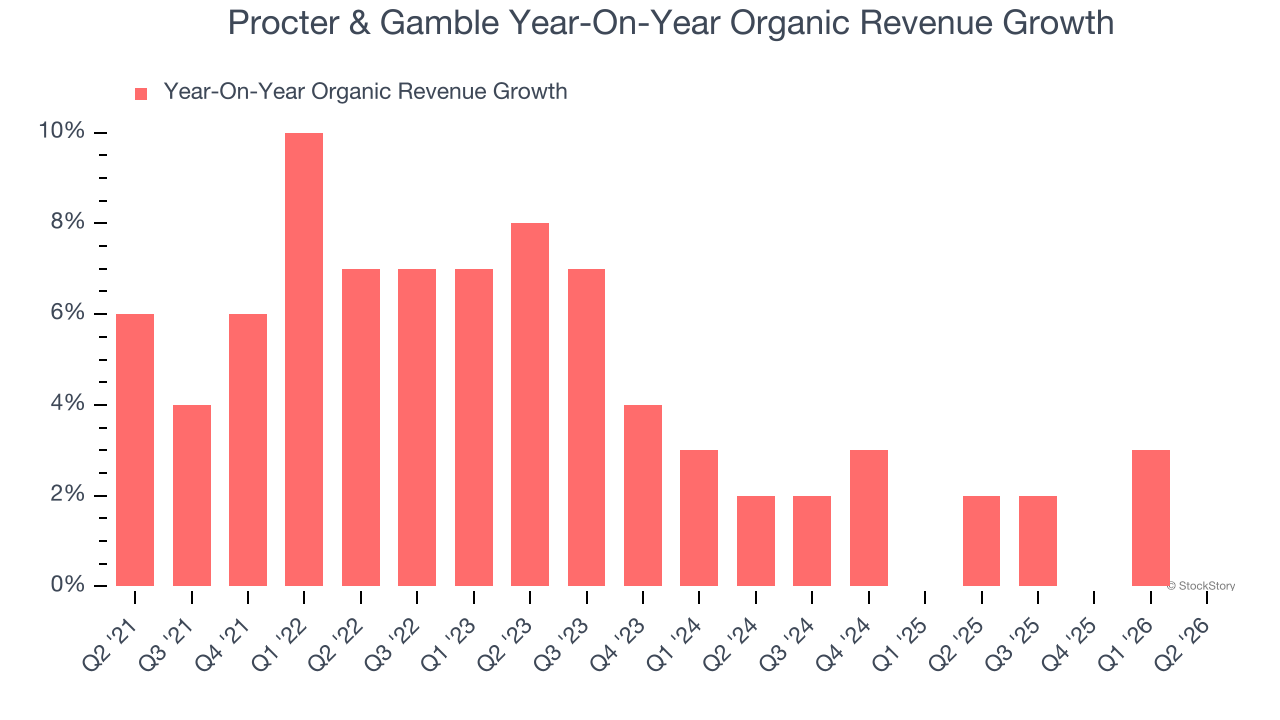
In the latest quarter, Procter & Gamble’s year on year organic sales were flat. This was a meaningful deceleration from its historical levels. We’ll be watching closely to see if Procter & Gamble can reaccelerate growth.
Key Takeaways from Procter & Gamble’s Q2 Results
We struggled to find many positives in these results. Revenue missed slightly on flat organic growth, and EPS guidance came in a bit below expectations. Overall, this was a softer quarter. The stock traded down 3.3% to $143.90 immediately following the results.
Big picture, is Procter & Gamble a buy here and now? What happened in the latest quarter matters, but not as much as longer-term business quality and valuation, when deciding whether to invest in this stock. We cover that in our actionable full research report which you can read here (it’s free).

/An%20Intel%20sign%20out%20front%20of%20a%20corporate%20office%20by%20wolterke%20via%20Adobe%20Stock.jpeg)

/Microsoft%20headquarters%20By%20Peter.jpeg)
/A%20close-up%20of%20the%20Broadcom%20logo%20on%20a%20smartphone%20by%20Timon%20via%20Adobe%20Stock.jpeg)
/Chipset%20held%20over%20rush%20hour%20traffic%20by%20Jae%20Young%20Ju%20via%20iStock.jpg)