




Dual Edge Research publishes two powerful newsletters that work great individually — and even better together. The Bull Strangle Newsletter focuses on stocks and options, combining stock ownership with premium-selling strategies to generate consistent income and market-beating returns. The Smart Spreads Newsletter specializes in seasonal commodity futures spreads, offering a diversified approach with low correlation to equities. Together, they deliver a complete investment perspective — one focused on income, the other on diversification — all under one simple subscription.
Introduction
One of the objectives of the Bull Strangle stock ranking system is to identify characteristics that have historically improved the probability of success. Some metrics require extensive research and analysis. Others are surprisingly straightforward. Stock price and implied volatility fall into the second category. Neither metric is particularly complex, yet both have demonstrated a measurable relationship with historical performance. While neither should ever be used in isolation, they provide valuable information when evaluating potential Bull Strangle candidates.
Stock Price: Not Too High, Not Too Low
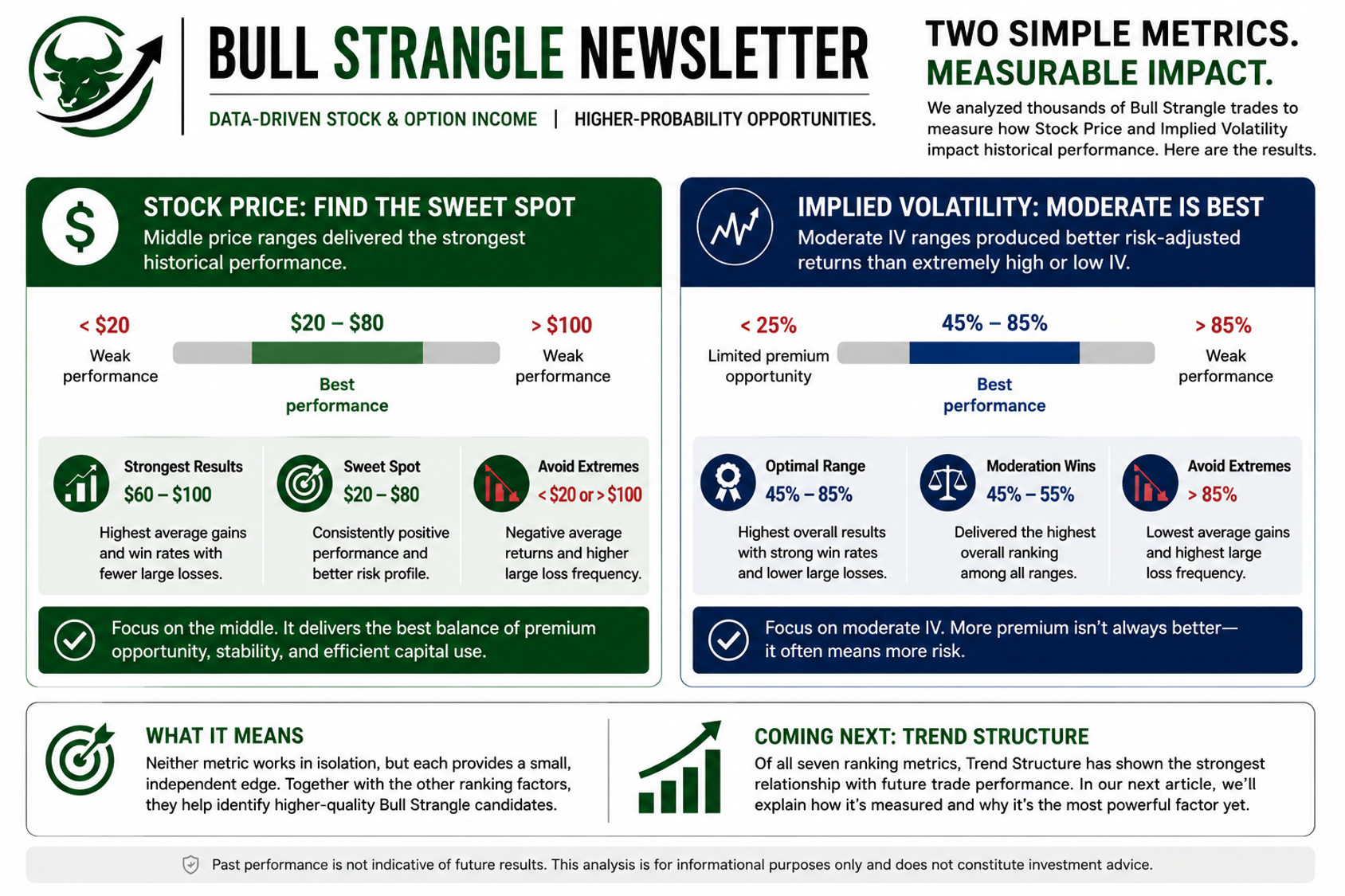
At first glance, the stock price may seem like an arbitrary consideration. After all, a company's share price says little about the quality of the business itself. For an options strategy, however, price matters. Lower-priced stocks often experience larger percentage price swings and can have wider option spreads. Higher-priced stocks require significantly more capital, reducing diversification across the portfolio. Our historical testing revealed a noticeable difference across price ranges. The strongest results came from stocks trading between $60 and $100, with the $80-$100 group producing the highest average gain (+3.5%), highest win rate (57.6%), and relatively few large losses. By comparison, stocks below $20 and above $100 produced negative average returns and substantially weaker win rates.
The takeaway isn't that expensive stocks should always be avoided or that every stock under $80 is attractive. Rather, history suggests that certain price ranges have consistently offered a more favorable balance between premium opportunity and overall trade quality.
Implied Volatility: More Isn't Always Better
Most option traders naturally gravitate toward high implied volatility. Higher implied volatility generally means larger option premiums. That sounds attractive—but our research suggests there's an important trade-off. Extremely high implied volatility often reflects increased uncertainty, which can lead to larger price swings and more challenging trades. Interestingly, the strongest historical performance came from moderate implied volatility rather than the highest readings. Stocks with implied volatility between 45% and 55% generated the highest overall ranking score, while the 65%-85% range also performed well. At the other extreme, stocks with implied volatility above 85% produced the weakest results, including the lowest average returns and the highest frequency of large losses. The message is clear: collecting more premiums is not always synonymous with achieving better performance.
Every Metric Adds One Piece of the Puzzle
Neither stock price nor implied volatility determines whether a stock belongs on the watch list. Instead, each contributes one piece of a much larger evaluation process. The Bull Strangle stock ranking system combines these straightforward measurements with additional factors, including institutional ownership, market capitalization, trend structure, Price/ATR, and implied volatility relative to historical volatility. Each metric provides a small independent edge. Together, they create a disciplined, objective process for identifying higher-quality candidates. No single metric consistently predicts success. But when multiple historically favorable characteristics align, the odds begin to shift in your favor.
Looking Ahead
Stock price and implied volatility are relatively straightforward metrics, yet our historical testing shows they still contribute meaningful information to the overall stock selection process. Like the other ranking factors we've discussed throughout this series, each provides a small, independent edge. Together, they form a more disciplined and objective approach to identifying higher-quality Bull Strangle candidates.
One metric, however, has consistently stood above the rest during our research. Trend Structure. Across thousands of historical observations, Trend Structure has demonstrated the strongest relationship with future trade performance of any metric we've evaluated. Its influence on average returns, win rates, and the avoidance of large losses has exceeded that of any other ranking factor. In my next article, I'll explain how Trend Structure is measured, why it has proven to be such a powerful indicator, and why it has become one of the most heavily weighted components of the Bull Strangle stock ranking system.
Want to build a more complete trading toolkit?
The Bull Strangle Newsletter focuses on stocks and options, combining stock ownership with disciplined option-selling techniques designed to generate consistent income while managing risk.
The Smart Spreads Newsletter focuses on seasonal commodity spreads, a historically proven approach that seeks opportunities across agricultural, energy, metal, and financial futures markets.
Each strategy is designed to stand on its own, but together they provide a diversified approach that can perform across a wide range of market environments. For traders looking to deepen their education, The Bull Strangle Strategy and Trading Commodity Spreads are both available on Amazon.
Visit BullStrangle.com to subscribe for just $1 for the first month.
For a video overview of the Bull Strangle Newsletter
For a video overview of the Smart Spreads Newsletter
Darren Carlat
Dual Edge Research
(214) 636-3133
DualEdgeResearch@gamil.com
Disclaimer
This information is for informational purposes only and should not be considered as investment advice. Past performance is not indicative of future results, and all investments carry inherent risk. Consult with a financial advisor before making any investment decisions.

/Micron%20Technology%20Inc_%20logo%20on%20building-by%20vzphotos%20vis%20iStock.jpg)


/AI%20(artificial%20intelligence)/AI%20engineer%20working%20on%20laptop%20by%20ART%20STOCK%20CREATIVE%20via%20Shutterstock.jpg)
/A%20corporate%20office%20for%20IBM%20by%20HJBC%20via%20Adobe%20Stock.jpeg)