Global markets are experiencing unprecedented turbulence following President Trump's sweeping tariff announcements, and the technology sector has been particularly hard hit due to supply chain concerns. The "Magnificent Seven" tech stocks collectively lost more than $1.8 trillion in market value since the “Liberation Day” tariff announcement.
Investor Anxiety Spikes
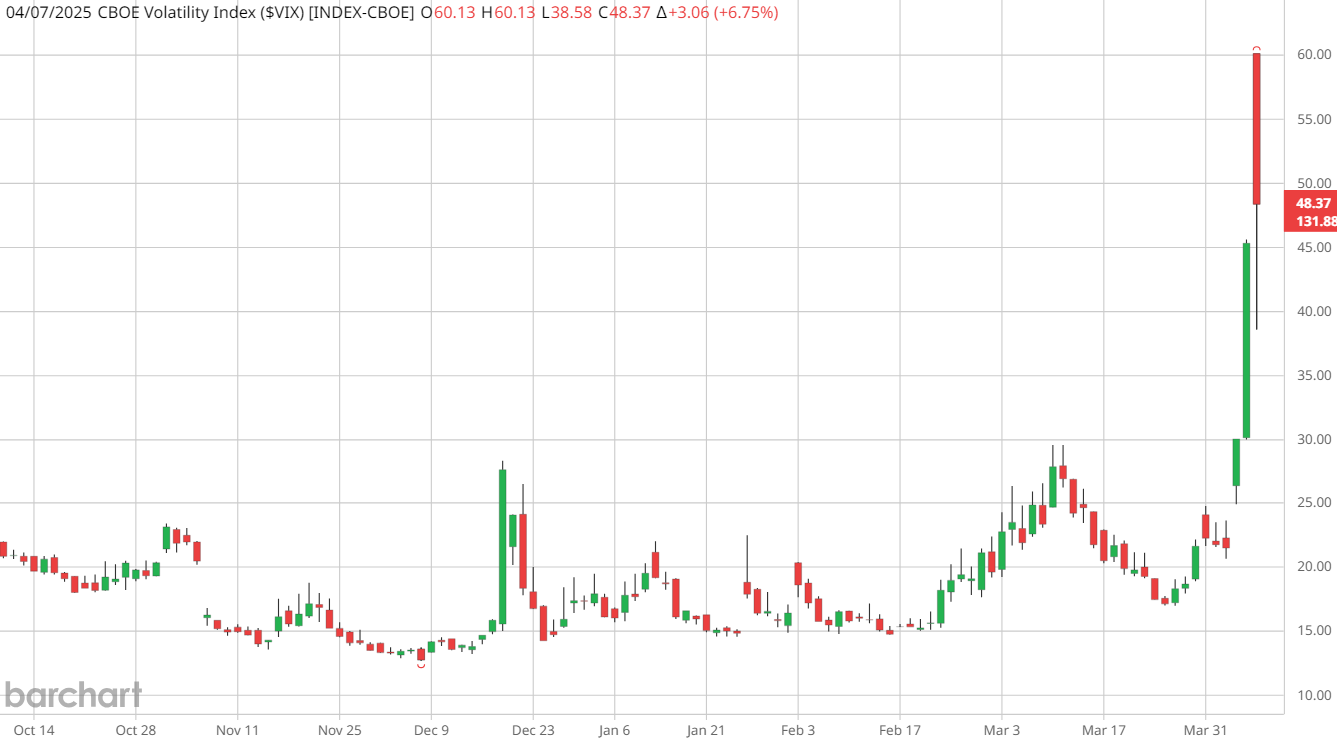
The Cboe Volatility Index ($VIX) - also known as the “fear index” - surged above 60 out of the gate today, reflecting heightened investor anxiety as business leaders and former Trump allies publicly criticize the tariffs. The VIX pared its gains by the close, ending Monday below the round 50 level.
More broadly, market sentiment has deteriorated significantly, with the latest AAII Investor Sentiment Survey showing only 21.8% of individual investors maintaining bullish positions while 61.9% have turned bearish.
Despite the market turmoil, Trump maintains his stance that "sometimes you have to take medicine to fix something," while most economists expect significant price increases across consumer goods and supply chain disruptions if the tariffs remain in place. Major financial institutions have dramatically increased their recession probability forecasts, with JPMorgan raising its odds to 60% and Goldman Sachs to 45%.
Chip Stocks, AAPL Slammed By Supply Chain Worries
The semiconductor industry faces severe pressure as countries like Taiwan and China have been targeted for particularly steep tariffs, with the White House threatening to hike duties on China north of 100% today. That has caused significant declines in major global players like Taiwan Semiconductor Manufacturing Co. (TSM) and SK Hynix, while U.S. chip makers Nvidia (NVDA) and Intel (INTC) have also seen their shares decline.
Apple has also been swept up in concerns about its reliance on China for iPhones. In a note to clients, Needham cautioned that a 28% decline in earnings per share is “NOT the worst case,” as the brokerage considers a partial or total ban of Apple products in China to be a possible bartering chip in the ongoing trade war.
The Wall Street Journal today reports that Apple is making temporary adjustments to its supply chain to produce more iPhones in India as it monitors the longer-term impact of tariffs on its relationship with China.
Is There Safety in Cybersecurity Stocks?
In a note to investors this morning, Wedbush analysts led by Dan Ives wrote, “Cybersecurity names such as Palo Alto, Zscaler, Crowdstrike, Checkpoint (CHKP), [and] CyberArk (CYBR) will be defensive names where investors could rotate from semis to software to hunker down during this Category 5 storm and likely outperform other subsets of tech.”
However, investors seeking shelter from market turbulence should bear in mind that Ives is comparing cybersecurity to “other subsets of tech” here. While cybersecurity services are increasingly essential for businesses, making them somewhat recession-resistant, the stocks themselves demonstrate high beta characteristics with substantial price movements both up and down.
In other words, based on the performance data of major cybersecurity stocks like Palo Alto Networks (PANW) and CrowdStrike (CRWD), cybersecurity stocks do not exhibit typical characteristics of defensive stocks, which traditionally show more stability during market downturns. So while these names might be relatively insulated from an economic downturn if companies are forced to cut costs, that doesn’t necessarily make them a safe haven from market turmoil in the short term.
This article was generated with the support of AI and reviewed by an editor. On the date of publication, the editor had a position in: AAPL , NVDA . All information and data in this article is solely for informational purposes. For more information please view the Barchart Disclosure Policy here.

/Cybersecurity%20by%20AIBooth%20via%20Shutterstock.jpg)