
Dual Edge Research publishes two powerful newsletters that work great individually — and even better together. The Bull Strangle Newsletter focuses on stocks and options, combining stock ownership with premium-selling strategies to generate consistent income and market-beating returns. The Smart Spreads Newsletter specializes in seasonal commodity futures spreads, offering a diversified approach with low correlation to equities. Together, they deliver a complete investment perspective — one focused on income, the other on diversification — all under one simple subscription.
Introduction
In my previous article, I introduced the historical research behind this series—more than 31,000 filtered commodity spread trades spanning dozens of commodity markets over multiple years. Rather than relying on a handful of examples, the conclusions throughout this series are drawn from a large historical database. That research has already shown that carry is an important characteristic when evaluating commodity spreads. Carry helps identify markets where the forward curve provides a structural advantage. But once you've identified thousands of potential opportunities, another question becomes even more important:
Which trades deserve your capital?
To answer that question, I evaluate every spread using three behavioral characteristics:
- Direction – Should the spread historically be bought or sold?
- Leg Configuration – How should the spread be constructed?
- Structural Volatility – How does the underlying volatility environment influence the trade?
This article focuses on the first of those characteristics: Direction. In future articles, we'll explore Pace and Dispersion and show how they can further improve trade selection.
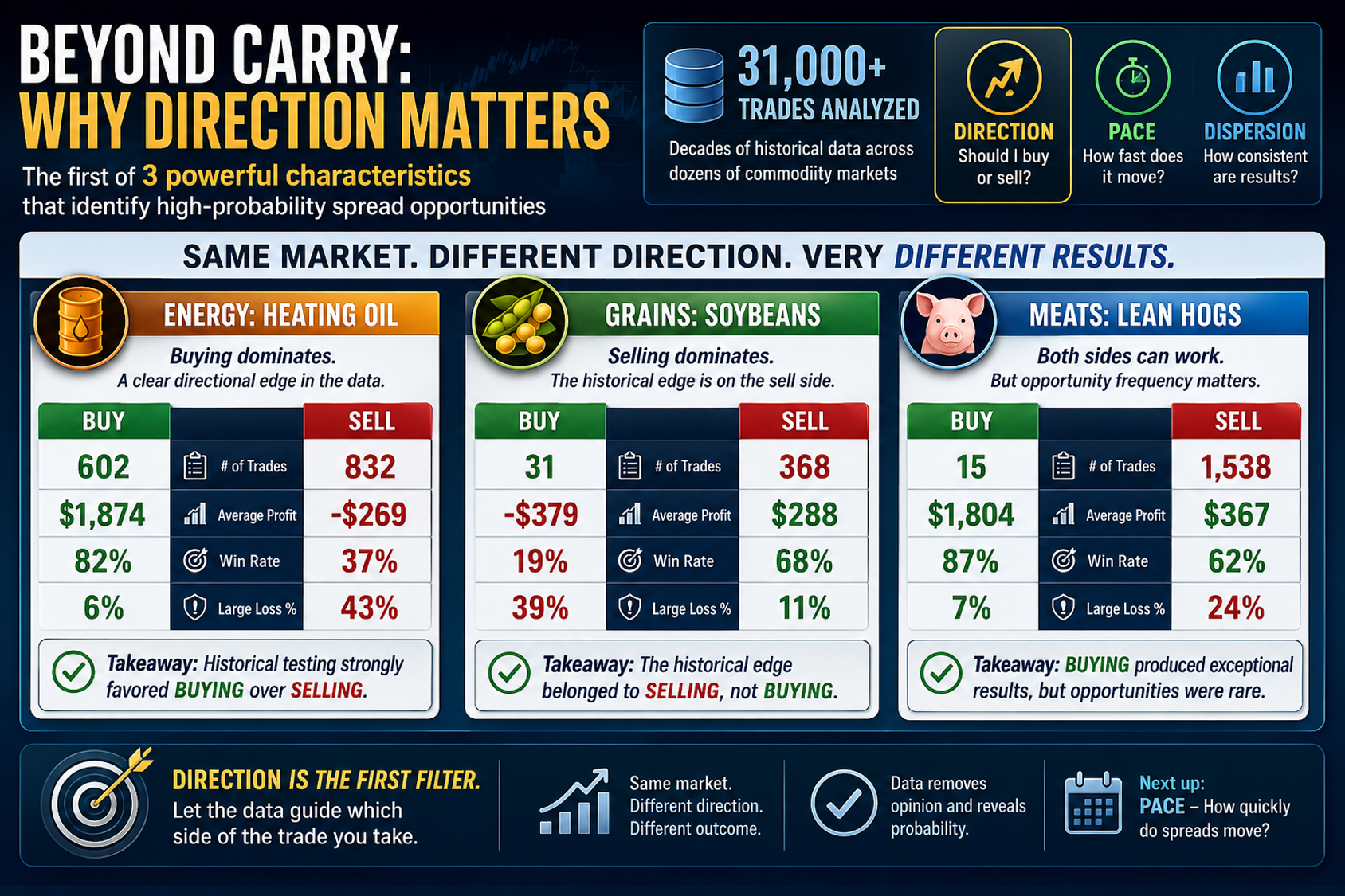
Buying and Selling Are Not Mirror Images
Many traders naturally assume that if a seasonal spread is attractive from one direction, the opposite side should produce the opposite result. My research suggests otherwise. Storage costs, commercial hedging, seasonal demand, weather, transportation, and production cycles influence commodity spreads. Those forces often create persistent biases that favor one direction over the other. Instead of assuming both directions are equally attractive, historical testing lets the data decide. The following examples illustrate how dramatically direction can influence performance.
Energy Example: Heating Oil
Heating Oil produced one of the clearest directional differences in the entire database.
| Direction | Trades | Avg. Profit | Win Rate | Large Loss |
| Buy | 602 | $1,874 | 82% | 6% |
| Sell | 832 | -$269 | 37% | 43% |
The difference is striking. Simply changing from selling to buying transformed Heating Oil from a historically unprofitable strategy into one with a strong historical edge. The market didn't change. The trade structure didn't change. Only the direction changed.
Grain Example: Soybeans
Soybeans tell the opposite story.
| Direction | Trades | Avg. Profit | Win Rate | Large Loss |
| Buy | 31 | -$379 | 19% | 39% |
| Sell | 368 | $288 | 68% | 11% |
Here, the historical evidence clearly favored selling rather than buying. A trader relying only on seasonal intuition might reasonably consider either direction. Historical testing, however, shows a meaningful difference in long-term performance. This is exactly why direction should be evaluated before placing a trade.
Meat Example: Lean Hogs
Lean Hogs provide an important reminder that context matters.
| Direction | Trades | Avg. Profit | Win Rate | Large Loss |
| Buy | 15 | $1,804 | 87% | 7% |
| Sell | 1,538 | $367 | 62% | 24% |
At first glance, buying appears dramatically better. However, there is one important difference. The historical database identified only 15 qualifying buy opportunities, compared with more than 1,500 sell opportunities. Those buy opportunities were exceptional when they occurred, but they occurred very infrequently. Selling Lean Hog spreads generated a smaller historical edge, yet provided a much larger and more consistent stream of opportunities. Both observations are valuable. One direction may offer higher-quality trades, while the other offers far greater frequency. Understanding both characteristics helps traders develop realistic expectations.
Let the Data Decide
One of the biggest advantages of systematic historical research is that it removes opinion from the decision-making process. Rather than asking, "Should I buy or sell this spread?" the better question becomes:
- "What has historically worked best?"
Sometimes the answer is buying. Sometimes it's selling. Occasionally, both directions perform poorly, and the best decision is to pass altogether. The objective isn't to prove that buying or selling is superior. The objective is to identify the direction that has historically provided the highest probability of success.
Looking Ahead
Direction is only the first step in understanding how commodity spreads behave. Two spreads may both have an attractive historical directional bias, yet one may reach its objective in a matter of days, while the other develops gradually over several weeks. In the next article, we'll explore Pace—how quickly commodity spreads tend to move—and why understanding the speed of a trade can be just as important as identifying the correct direction.
Want to build a more complete trading toolkit?
The Bull Strangle Newsletter focuses on stocks and options, combining stock ownership with disciplined option-selling techniques designed to generate consistent income while managing risk.
The Smart Spreads Newsletter focuses on seasonal commodity spreads, a historically proven approach that seeks opportunities across agricultural, energy, metal, and financial futures markets.
Each strategy is designed to stand on its own, but together they provide a diversified approach that can perform across a wide range of market environments. For traders looking to deepen their education, The Bull Strangle Strategy and Trading Commodity Spreads, both available on Amazon.
Visit BullStrangle.com to subscribe for just $1 for the first month.
For a video overview of the Bull Strangle Newsletter
For a video overview of the Smart Spreads Newsletter
Darren Carlat
Dual Edge Research
(214) 636-3133
DualEdgeResearch@gamil.com
Disclaimer
This information is for informational purposes only and should not be considered as investment advice. Past performance is not indicative of future results, and all investments carry inherent risk. Consult with a financial advisor before making any investment decisions.

/A%20close-up%20of%20an%20AMD%20office%20by%20gehapromo%20via%20Adobe%20Stock.jpeg)

/Applied%20Materials%20Inc_%20campus%20sign-by%20Sundry%20Photography%20via%20iStock.jpg)