



Aerospace and defense company Raytheon (NYSE:RTX) reported Q2 CY2024 results beating Wall Street analysts' expectations, with revenue up 7.7% year on year to $19.72 billion. The company expects the full year's revenue to be around $79.13 billion, in line with analysts' estimates. It made a non-GAAP profit of $1.41 per share, improving from its profit of $0.90 per share in the same quarter last year.
Is now the time to buy RTX? Find out by accessing our full research report, it's free.
RTX (RTX) Q2 CY2024 Highlights:
- Revenue: $19.72 billion vs analyst estimates of $19.28 billion (2.3% beat)
- EPS (non-GAAP): $1.41 vs analyst estimates of $1.30 (8.6% beat)
- The company raised its revenue and EPS guidance for the full year (both above expectations)
- Gross Margin (GAAP): 18.2%, down from 20.7% in the same quarter last year
- Free Cash Flow of $2.20 billion is up from -$125 million in the previous quarter
- Organic Revenue rose 10% year on year (13.1% in the same quarter last year)
- Market Capitalization: $139.1 billion
"RTX delivered strong operational performance in the second quarter, with 10 percent organic sales* growth, adjusted margin* expansion across all three segments and $2.2 billion in free cash flow*," said RTX President and CEO Chris Calio.
Originally focused on refrigeration technology, Raytheon (NSYE:RTX) provides a a variety of products and services to the aerospace and defense industries.
Defense Contractors
Defense contractors typically require technical expertise and government clearance. Companies in this sector can also enjoy long-term contracts with government bodies, leading to more predictable revenues. Combined, these factors create high barriers to entry and can lead to limited competition. Lately, geopolitical tensions–whether it be Russia’s invasion of Ukraine or China’s aggression towards Taiwan–highlight the need for defense spending. On the other hand, demand for these products can ebb and flow with defense budgets and even who is president, as different administrations can have vastly different ideas of how to allocate federal funds.
Sales Growth
Reviewing a company's long-term performance can reveal insights into its business quality. Any business can have short-term success, but a top-tier one tends to sustain growth for years. Unfortunately, RTX's 4.9% annualized revenue growth over the last five years was sluggish. This shows it failed to expand in any major way and is a rough starting point for our analysis. 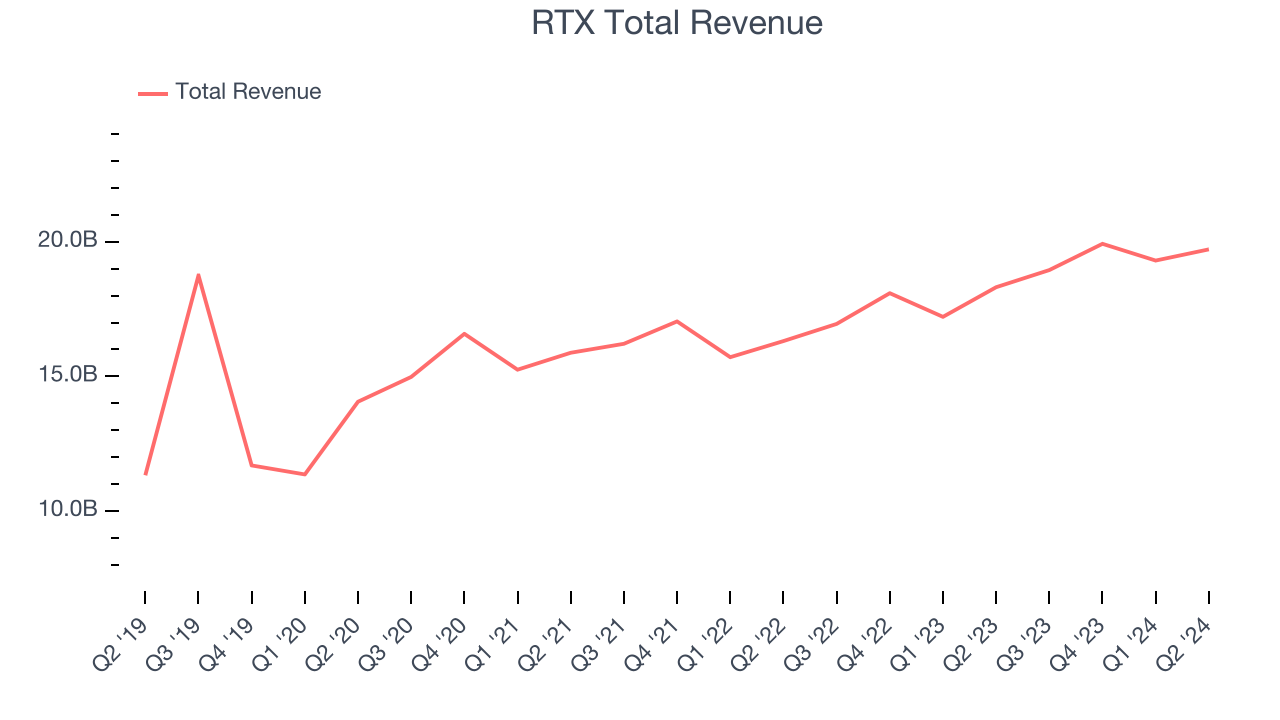
We at StockStory place the most emphasis on long-term growth, but within industrials, a half-decade historical view may miss cycles, industry trends, or a company capitalizing on catalysts such as a new contract win or a successful product line. RTX's annualized revenue growth of 9.2% over the last two years is above its five-year trend, suggesting its demand recently accelerated.
RTX also reports organic revenue, which strips out one-time events like acquisitions and currency fluctuations because they don't accurately reflect its fundamentals. Over the last two years, RTX's organic revenue averaged 15% year-on-year growth. Because this number is better than its normal revenue growth, we can see that some mixture of divestitures and foreign exchange rates dampened its headline performance. 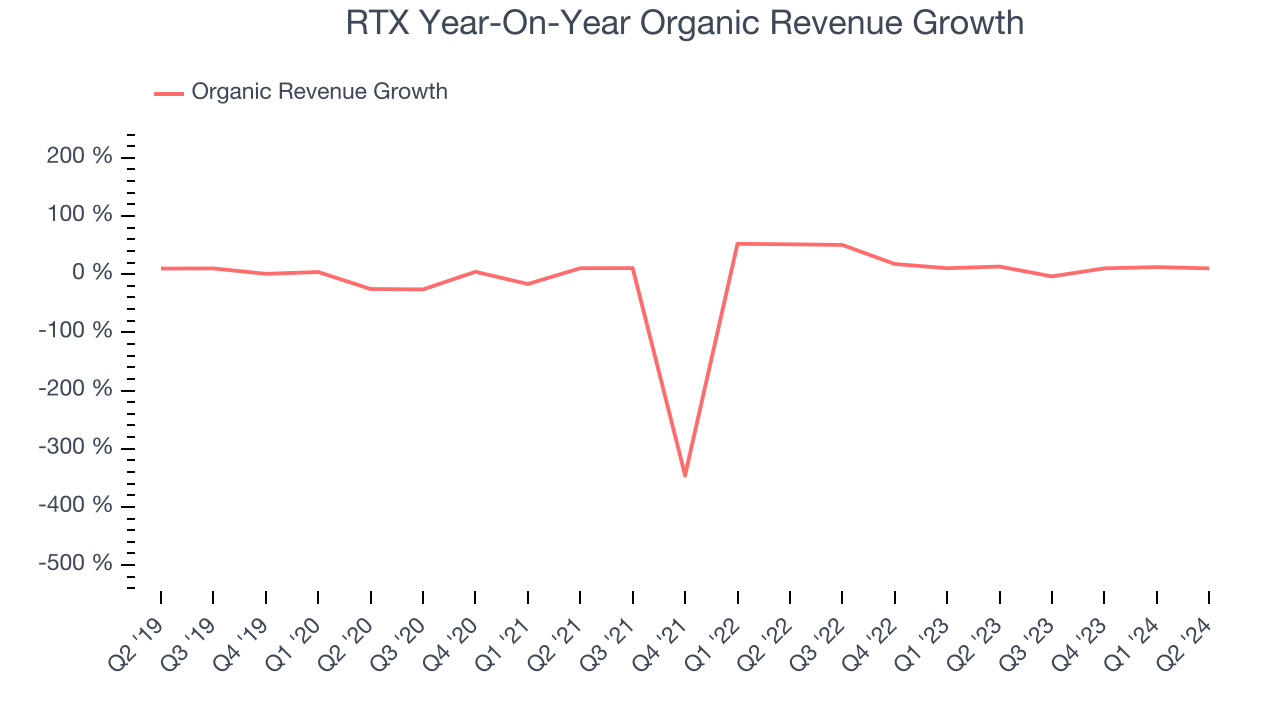
This quarter, RTX reported solid year-on-year revenue growth of 7.7%, and its $19.72 billion of revenue outperformed Wall Street's estimates by 2.3%. Looking ahead, Wall Street expects sales to grow 4.2% over the next 12 months, a deceleration from this quarter.
When a company has more cash than it knows what to do with, buying back its own shares can make a lot of sense–as long as the price is right. Luckily, we’ve found one, a low-priced stock that is gushing free cash flow AND buying back shares. Click here to claim your Special Free Report on a fallen angel growth story that is already recovering from a setback.
Operating Margin
RTX was profitable over the last five years but held back by its large expense base. It demonstrated paltry profitability for an industrials business, producing an average operating margin of 5.1%.
On the bright side, RTX's annual operating margin rose by 3.7 percentage points over the last five years.
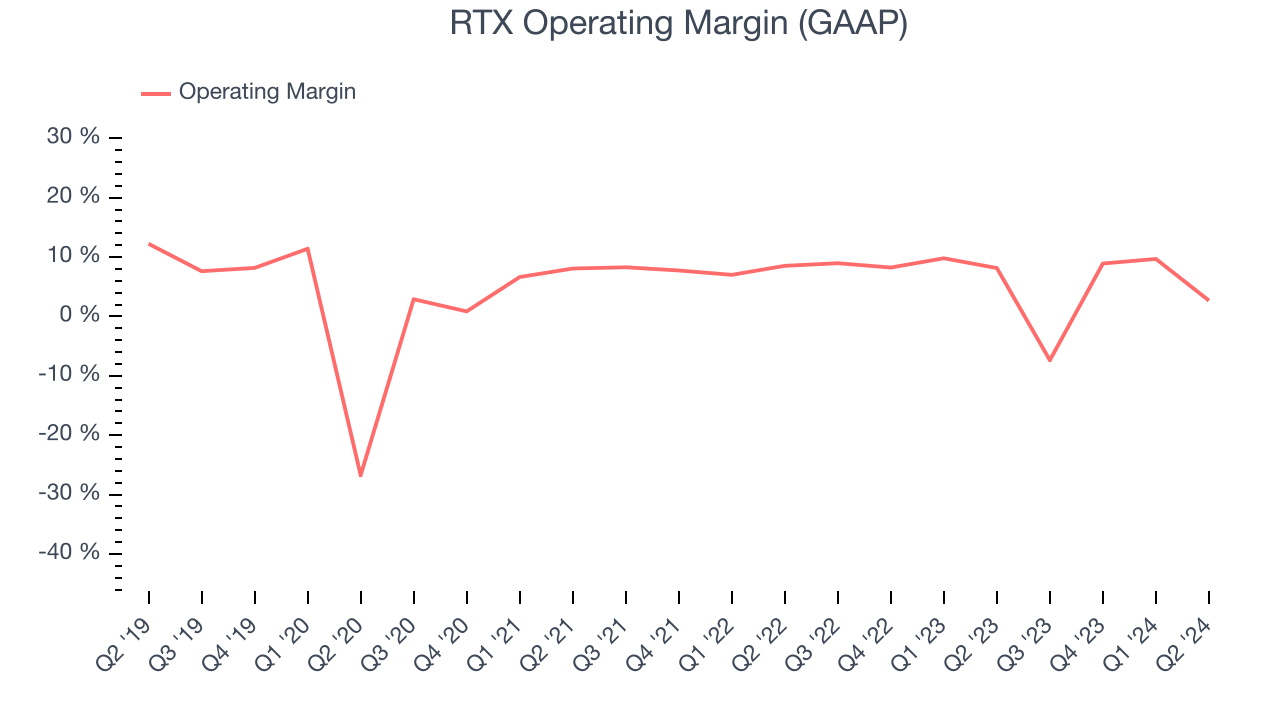
This quarter, RTX generated an operating profit margin of 2.7%, down 5.5 percentage points year on year. This contraction shows it was recently less efficient because its expenses grew faster than its revenue.
EPS
Sadly for RTX, its EPS declined by 6.5% annually over the last five years while its revenue grew by 4.9%. However, its operating margin actually expanded during this timeframe, telling us non-fundamental factors affected its ultimate earnings.
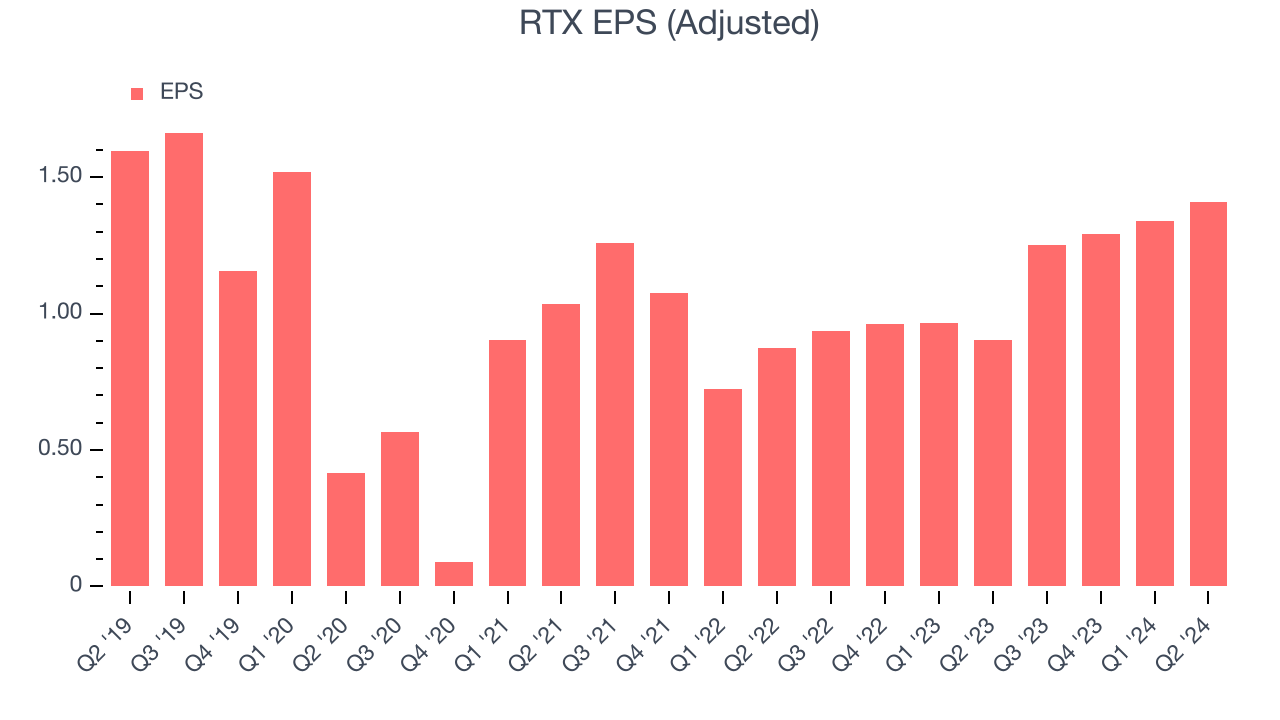
Diving into the nuances of RTX's earnings can give us a better understanding of its performance. A five-year view shows RTX has diluted its shareholders, growing its share count by 55.4%. This dilution overshadowed its increased operating efficiency and has led to lower per share earnings. Taxes and interest expenses can also affect EPS but don't tell us as much about a company's fundamentals.
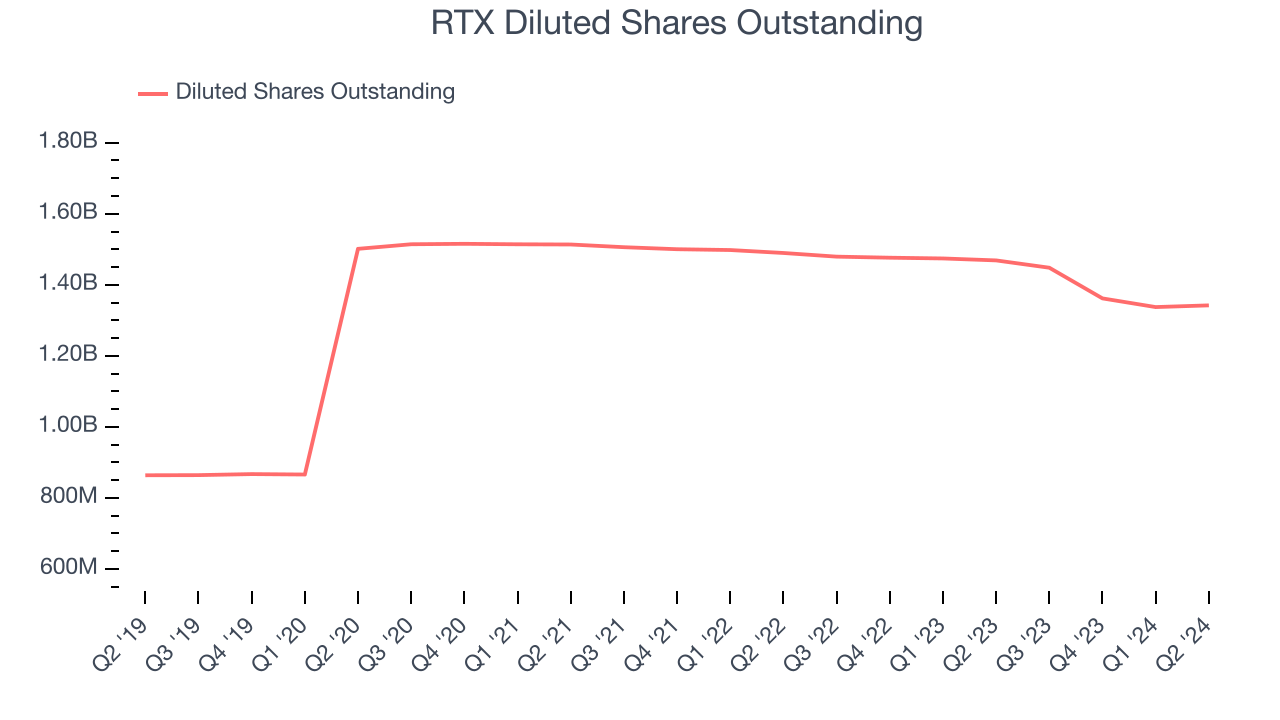
Like with revenue, we also analyze EPS over a more recent period because it can give insight into an emerging theme or development for the business. For RTX, its two-year annual EPS growth of 16% was higher than its five-year trend. This acceleration made it one of the faster-growing industrials companies in recent history.
In Q2, RTX reported EPS at $1.41, up from $0.90 in the same quarter last year. This print beat analysts' estimates by 8.6%. Over the next 12 months, Wall Street expects RTX to grow its earnings. Analysts are projecting its EPS of $5.29 in the last year to climb by 6.8% to $5.65.
Key Takeaways from RTX's Q2 Results
This was a beat and raise quarter. Specifically, we were impressed by how significantly RTX blew past analysts' organic revenue expectations this quarter. We were also excited its revenue outperformed Wall Street's estimates. That the company raised full year revenue and EPS expectations is icing on the cake. Overall, we think this was a really good quarter that should please shareholders. The stock traded up 3.1% to $108.10 immediately following the results.
RTX may have had a good quarter, but does that mean you should invest right now? When making that decision, it's important to consider its valuation, business qualities, as well as what has happened in the latest quarter. We cover that in our actionable full research report which you can read here, it's free.



/Quantum%20Computing/A%20concept%20image%20showing%20a%20ray%20of%20light%20passing%20through%20cyberspace_%20Image%20by%20metamorworks%20via%20Shutterstock_.jpg)
/Super%20Micro%20Computer%20Inc%20HQ%20photo-by%20Tada%20Images%20via%20Shutterstock.jpg)