
As the Q1 earnings season comes to a close, it’s time to take stock of this quarter’s best and worst performers in the property & casualty insurance industry, including Enact Holdings (NASDAQ:ACT) and its peers.
Property & Casualty (P&C) insurers protect individuals and businesses against financial loss from damage to property or from legal liability. This is a cyclical industry, and the sector benefits when there is 'hard market', characterized by strong premium rate increases that outpace loss and cost inflation, resulting in robust underwriting margins. The opposite is true in a 'soft market'. Interest rates also matter, as they determine the yields earned on fixed-income portfolios. On the other hand, P&C insurers face a major secular headwind from the increasing frequency and severity of catastrophe losses due to climate change. Furthermore, the liability side of the business is pressured by 'social inflation'—the trend of rising litigation costs and larger jury awards.
The 32 property & casualty insurance stocks we track reported a mixed Q1. As a group, revenues beat analysts’ consensus estimates by 1.9%.
In light of this news, share prices of the companies have held steady. On average, they are relatively unchanged since the latest earnings results.
Enact Holdings (NASDAQ:ACT)
Playing a critical role in helping first-time homebuyers access the housing market, Enact Holdings (NASDAQ:ACT) provides private mortgage insurance that enables lenders to offer home loans with lower down payments while protecting against borrower defaults.
Enact Holdings reported revenues of $317.9 million, up 2.5% year on year. This print exceeded analysts’ expectations by 1.3%. Despite the top-line beat, it was still a mixed quarter for the company.
“Enact delivered a strong start to 2026, reflecting disciplined execution, resilient credit performance, and our continued focus on long-term value creation,” said Rohit Gupta, President and CEO of Enact.
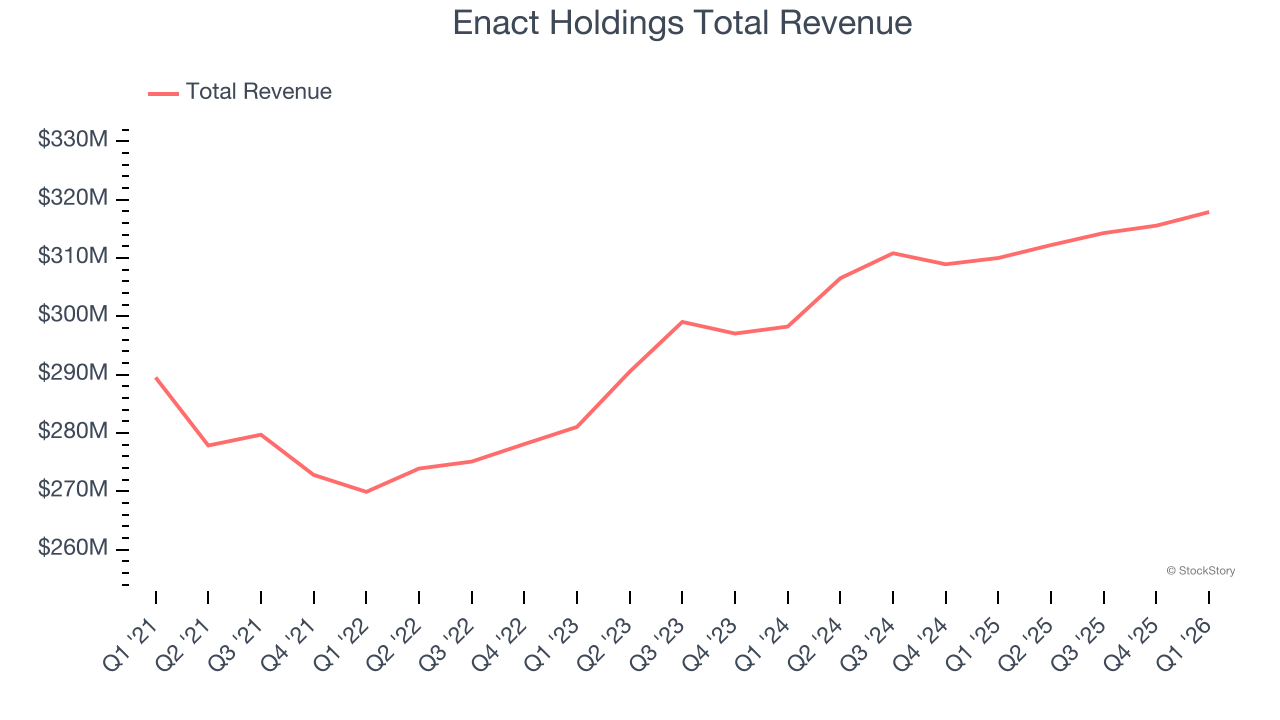
The market seems disappointed with the results as the stock is down 1.6% since reporting and currently trades at $41.64.
Read our full report on Enact Holdings here, it’s free.
Best Q1: Mercury General (NYSE:MCY)
Founded in 1961 and maintaining a network of over 6,300 independent agents across the country, Mercury General (NYSE:MCY) is an insurance company that primarily sells automobile insurance policies through independent agents in 11 states, with a strong focus on California.
Mercury General reported revenues of $1.54 billion, up 10.5% year on year, outperforming analysts’ expectations by 5.4%. The business had an incredible quarter with a beat of analysts’ EPS and net premiums earned estimates.
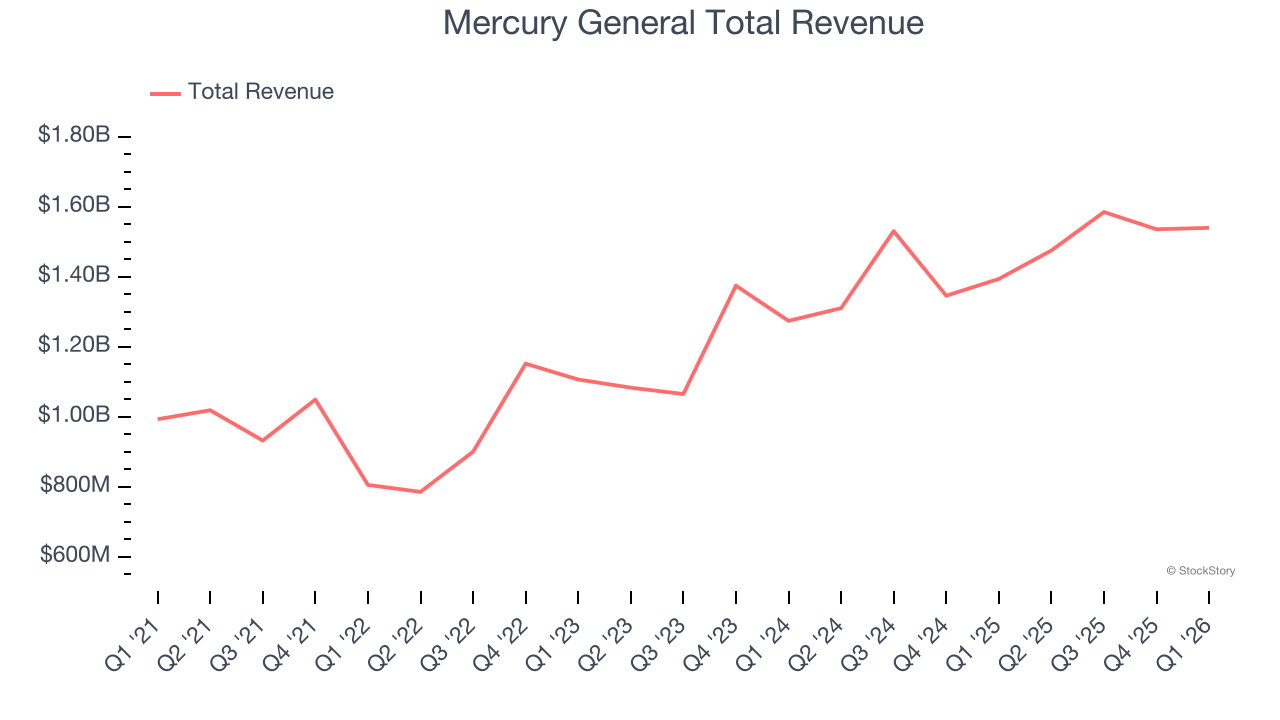
The market seems happy with the results as the stock is up 5.3% since reporting. It currently trades at $102.59.
Is now the time to buy Mercury General? Access our full analysis of the earnings results here, it’s free.
Weakest Q1: Fidelity National Financial (NYSE:FNF)
Issuing more title insurance policies than any other company in the United States, Fidelity National Financial (NYSE:FNF) provides title insurance and escrow services for real estate transactions while also offering annuities and life insurance through its F&G subsidiary.
Fidelity National Financial reported revenues of $3.23 billion, up 18.2% year on year, falling short of analysts’ expectations by 10.7%. It was a disappointing quarter as it posted a significant miss of analysts’ EPS estimates.
Fidelity National Financial delivered the weakest performance against analyst estimates in the group. As expected, the stock is down 8.9% since the results and currently trades at $46.71.
Read our full analysis of Fidelity National Financial’s results here.
Radian Group (NYSE:RDN)
Founded during the housing boom of 1977 and weathering multiple real estate cycles since, Radian Group (NYSE:RDN) provides mortgage insurance and real estate services, helping lenders manage risk and homebuyers achieve affordable homeownership.
Radian Group reported revenues of $475.2 million, up 48.9% year on year. This number beat analysts’ expectations by 12.8%. Overall, it was a strong quarter for the company.
The stock is down 2.9% since reporting and currently trades at $34.68.
Read our full, actionable report on Radian Group here, it’s free.
Stewart Information Services (NYSE:STC)
Founded in 1893 during America's westward expansion when property records were often disputed, Stewart Information Services (NYSE:STC) provides title insurance and real estate services, helping homebuyers, sellers, and lenders verify property ownership and protect against title defects.
Stewart Information Services reported revenues of $781.3 million, up 27.7% year on year. This result surpassed analysts’ expectations by 4.6%. It was an incredible quarter as it also logged a beat of analysts’ EPS estimates.
The stock is down 2.7% since reporting and currently trades at $66.49.
Read our full, actionable report on Stewart Information Services here, it’s free.
Market Update
Late in 2025 into early 2026, there was hand-wringing around artificial intelligence. For software companies, the fear was that AI would erode pricing power and compress margins as new tools made it easier to replicate what once required expensive enterprise platforms. Crypto investors had their own version of the same anxiety: if AI agents could trade, allocate capital, and manage wallets autonomously, what exactly was the long-term value of today’s crypto infrastructure?
These concerns triggered a noticeable rotation away from these sectors and into safer havens. But markets rarely dwell on one narrative for long. Spring 2026 came, and the focus shifted abruptly from technological disruption to geopolitical risk. The US’ conflict with Iran became the dominant driver of market psychology, and when geopolitics takes center stage, the script changes quickly. Investors stop debating growth rates and start worrying about oil supply, inflation, and global stability.
Want to invest in winners with rock-solid fundamentals? Check out our Strong Momentum Stocks and add them to your watchlist. These companies are poised for growth regardless of the political or macroeconomic climate.
StockStory’s analyst team — all seasoned professional investors — uses quantitative analysis and automation to deliver market-beating insights faster and with higher quality.



/2d%20illustration%20of%20Cloud%20computing%20by%20Blackboard%20via%20Shutterstock.jpg)
/Elon%20Musk%2C%20founder%2C%20CEO%2C%20and%20chief%20engineer%20of%20SpaceX%2C%20CEO%20of%20Tesla%20by%20Frederic%20Legrand%20-%20COMEO%20via%20Shutterstock.jpg)