
Dual Edge Research publishes two powerful newsletters that work great individually — and even better together. The Bull Strangle Newsletter focuses on stocks and options, combining stock ownership with premium-selling strategies to generate consistent income and market-beating returns. The Smart Spreads Newsletter specializes in seasonal commodity futures spreads, offering a diversified approach with low correlation to equities. Together, they deliver a complete investment perspective — one focused on income, the other on diversification — all under one simple subscription.
Introduction
Many investors hear the phrase "selling naked puts" and immediately think one thing:
- Risk.
After all, financial media often describes put selling as a strategy that works most of the time but occasionally suffers catastrophic losses. There is some truth to that statement. But there is also an important distinction that often gets overlooked. Selling puts is not inherently risky. Selling puts on the wrong stocks, at the wrong prices, without a systematic process, is risky. As with many investment strategies, the outcome depends far more on the underlying asset and the rules followed than on the strategy itself.
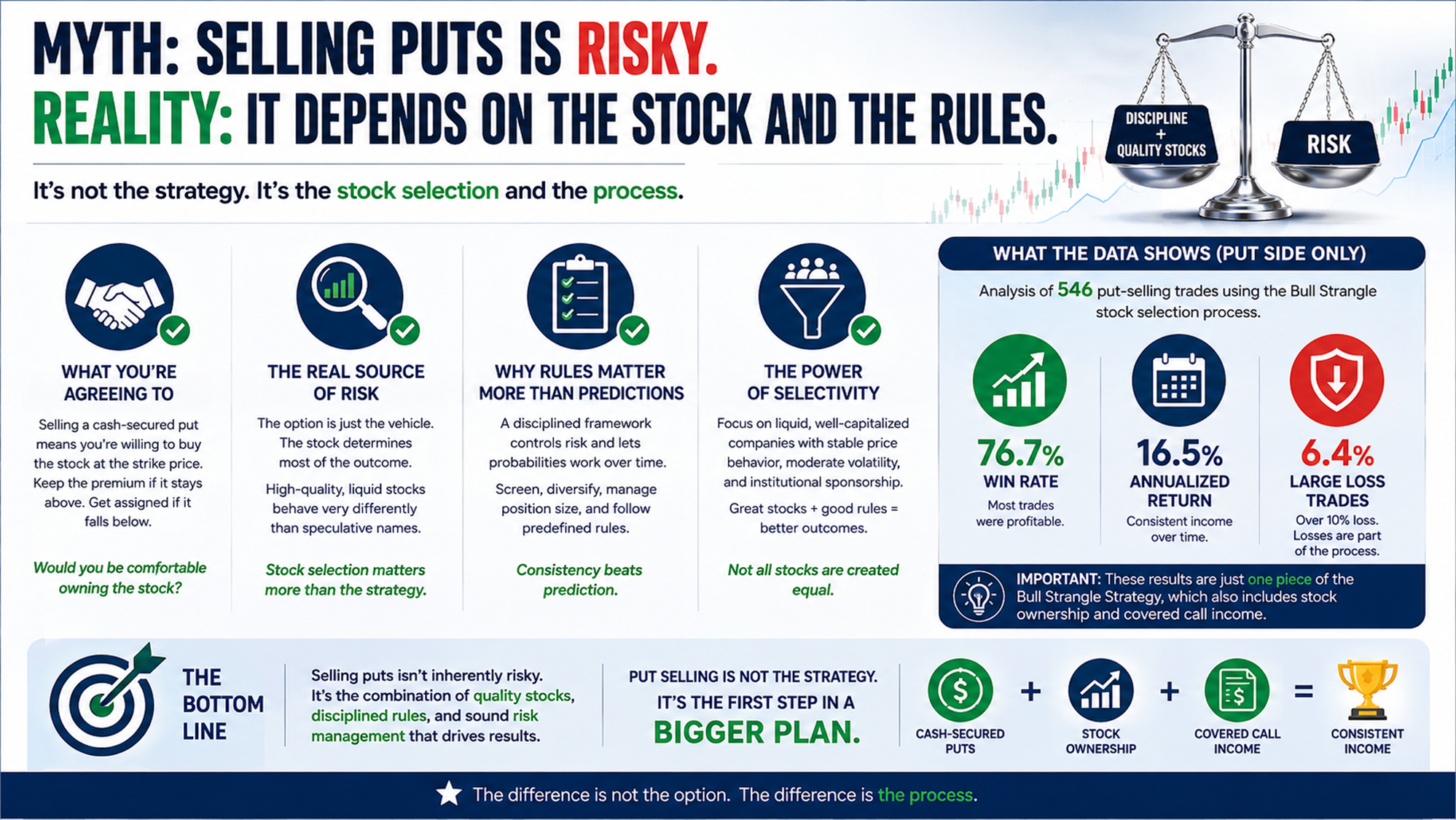
Understanding What You're Really Agreeing To
When you sell a cash-secured put, you are accepting an obligation to purchase a stock at a predetermined price if it falls below that level before expiration. In practical terms, you're saying:
- "I would be willing to own this stock at this price."
That is a very different proposition than making a speculative bet on a stock's direction. If the stock stays above the strike price, the option expires worthless, and the seller keeps the premium. If the stock falls below the strike price, the seller may be assigned shares at an effective purchase price that is reduced by the premium collected. Viewed this way, put selling is often less about option trading and more about stock acquisition. The critical question becomes:
- Would you be comfortable owning the stock if an assignment were to occur?
The Real Source of Risk
Many put-selling disasters have little to do with options themselves. Instead, they stem from poor stock selection. Consider two investors:
- Investor A sells puts on a highly speculative stock that has doubled in six weeks, trades at extreme valuations, and regularly experiences 10% daily swings.
- Investor B sells puts on a large-cap company with strong liquidity, consistent price behavior, and a long history of institutional ownership.
Both investors are technically using the same strategy. Yet the risk profiles are dramatically different. The option is merely the vehicle. The stock determines most of the outcome. This is why professional investors spend far more time evaluating underlying assets than evaluating option contracts.
Why Rules Matter More Than Predictions
Another common misconception is that successful put selling requires accurately predicting where stocks will go. In reality, a rules-based framework often matters far more than forecasting. Consider a process that:
- Screens for liquid, high-quality stocks
- Avoids earnings announcements
- Diversifies across sectors
- Uses predefined strike-selection criteria
- Maintains consistent position sizing
- Limits exposure to any single stock
None of these rules requires predicting tomorrow's market direction. Instead, they focus on controlling risk while allowing probabilities to work over time. This is often where individual investors get into trouble. Rather than following a repeatable process, they chase the highest premiums available. Unfortunately, the stocks offering the largest premiums are frequently the same stocks carrying the greatest risk.
What the Data Actually Shows
The perception that selling puts is inherently dangerous often comes from focusing on individual trades rather than evaluating a large sample of outcomes. To better understand the strategy, I analyzed 546 put-selling trades generated through the stock selection process used in the Bull Strangle Strategy. Looking only at the put side of the strategy, the results were surprisingly consistent:
- 76.7% of trades were profitable
- Average annualized return was 16.5%
- Only 6.4% of trades experienced losses greater than 10%
No strategy is perfect, and losing trades are an unavoidable part of investing. However, these results demonstrate that when put selling is combined with disciplined stock selection and consistent rules, the outcome can look very different from the high-risk reputation often associated with the strategy. It is also important to recognize that these statistics represent only one piece of the Bull Strangle Strategy. The strategy combines stock ownership, cash-secured puts, and covered call income into a single framework.
Put selling is often the first step in the process, serving as a mechanism to generate income while potentially acquiring stocks at attractive prices. If shares are assigned, covered calls become the next stage of the income-generation cycle. In other words, the put sale is not the entire strategy—it is simply one component of a broader, rules-based approach designed to transform market volatility from a source of uncertainty into a source of opportunity.
The Power of Selectivity
One lesson repeatedly observed in systematic option-selling research is that not all stocks are equally suited for income strategies. Certain characteristics tend to improve outcomes:
- Strong liquidity
- Stable price behavior
- Moderate volatility
- Institutional sponsorship
- Healthy technical trends
By narrowing the universe to stocks that exhibit these traits, investors can often improve consistency while reducing large-loss events. This is one reason why stock selection frequently has a greater impact on results than strike selection. A great option strategy applied to poor stocks often produces disappointing results. A disciplined strategy applied to high-quality candidates tends to produce far more stable outcomes.
Final Thoughts
The statement "selling puts is risky" is not entirely wrong. It is simply incomplete. Selling puts without regard for stock quality, diversification, position sizing, or market conditions can indeed be dangerous. But when combined with disciplined stock selection and a repeatable set of rules, put selling becomes something very different: a structured approach to generating income while potentially acquiring stocks at attractive prices. The difference is not the option. The difference is the process. The Bull Strangle strategy applies this philosophy through a systematic process that combines stock ownership with option income generation.
More Information
Now you can get two powerful newsletters for one simple price!
- For stocks and options, the Bull Strangle Newsletter shows you how to combine stock ownership with dual option selling — a disciplined strategy that has consistently outperformed the S&P 500.
- For commodity futures, the Smart Spreads Newsletter focuses on seasonal commodity spreads — a proven, low-correlation approach that thrives in all types of markets.
Each newsletter is designed to deliver consistent income on its own — but when used together, they create a complete, diversified trading approach that works in any market environment.
Visit BullStrangle.com to subscribe for just $1 for the first month.
For a video overview of the Bull Strangle Newsletter
For a video overview of the Smart Spreads Newsletter
Darren Carlat
Dual Edge Research
(214) 636-3133
DualEdgeResearch@gamil.com
Disclaimer
This information is for informational purposes only and should not be considered as investment advice. Past performance is not indicative of future results, and all investments carry inherent risk. Consult with a financial advisor before making any investment decisions.

/Micron%20Technology%20Inc_%20logo%20on%20building-by%20vzphotos%20vis%20iStock.jpg)