What a brutal six months it’s been for Wayfair. The stock has dropped 29% and now trades at $72.00, rattling many shareholders. This may have investors wondering how to approach the situation.
Is there a buying opportunity in Wayfair, or does it present a risk to your portfolio? Get the full breakdown from our expert analysts, it’s free.
Why Is Wayfair Not Exciting?
Even though the stock has become cheaper, we don’t have much confidence in Wayfair. Here are three reasons you should be careful with W, plus one stock we’d rather own.
1. Declining Active Customers Reflect Product Weakness
As an online retailer, Wayfair generates revenue growth by expanding its number of users and the average order size in dollars.
Wayfair struggled with new customer acquisition over the last two years as its active customers have declined by 2.5% annually to 21.4 million in the latest quarter. This performance isn’t ideal because internet usage is secular, meaning there are typically unaddressed market opportunities. If Wayfair wants to accelerate growth, it likely needs to enhance the appeal of its current offerings or innovate with new products. 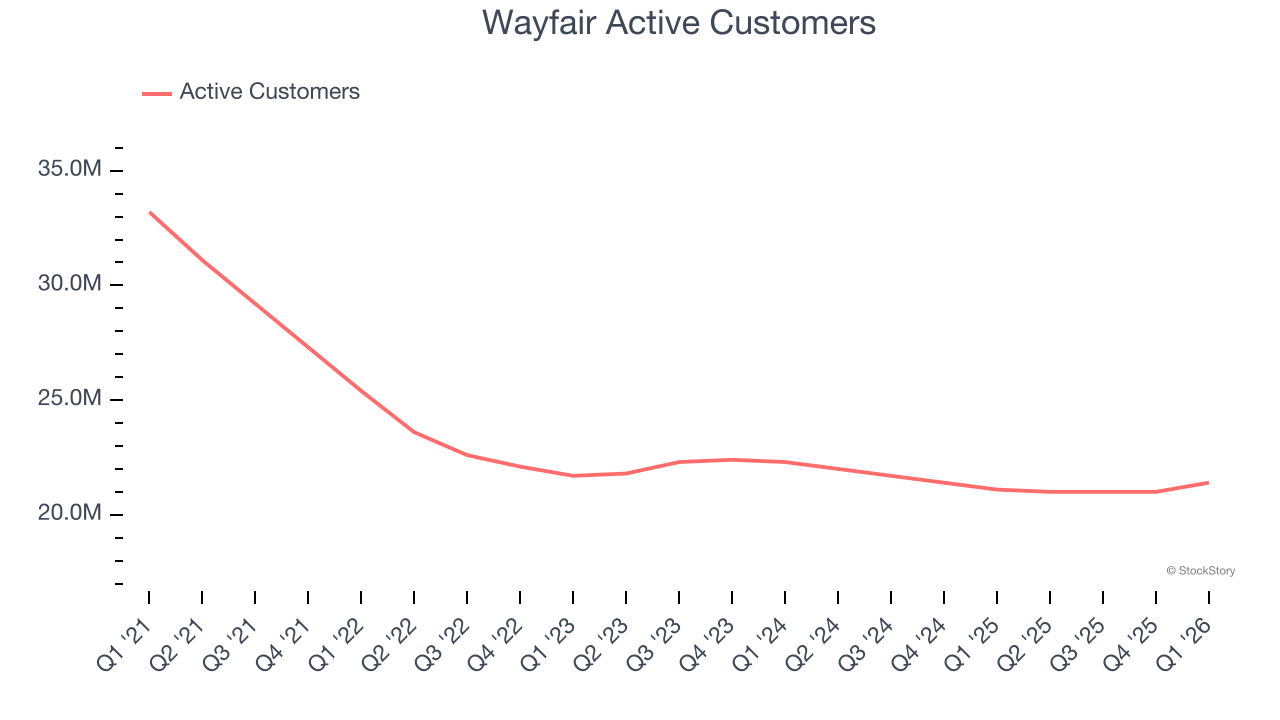
2. Projected Revenue Growth Is Slim
Forecasted revenues by Wall Street analysts signal a company’s potential. Predictions may not always be accurate, but accelerating growth typically boosts valuation multiples and stock prices while slowing growth does the opposite.
Over the next 12 months, sell-side analysts expect Wayfair’s revenue to rise by 5.3%. Although this projection suggests its newer products and services will fuel better top-line performance, it is still below the sector average.
3. Low Gross Margin Reveals Weak Structural Profitability
For online retail (separate from online marketplaces) businesses like Wayfair, gross profit tells us how much money the company gets to keep after covering the base cost of its products and services, which typically include the cost of acquiring the products sold, shipping and fulfillment, customer service, and digital infrastructure.
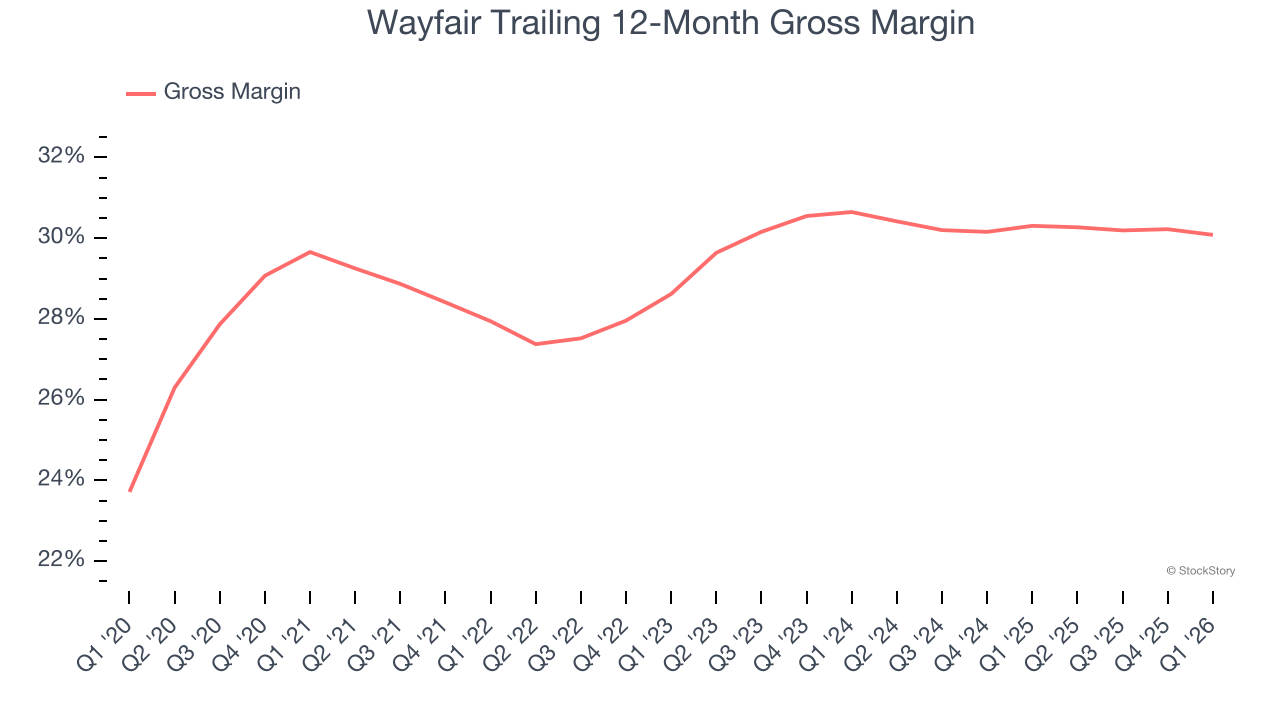
Wayfair’s unit economics are far below other consumer internet companies because it must carry inventories as an online retailer. This means it has relatively higher capital intensity than a pure software business like Meta or Airbnb and signals it operates in a competitive market. As you can see below, it averaged a 30.2% gross margin over the last two years. That means Wayfair paid its providers a lot of money ($69.81 for every $100 in revenue) to run its business.
Final Judgment
Wayfair isn’t a terrible business, but it isn’t one of our picks. Following the recent decline, the stock trades at 14.2× forward EV/EBITDA (or $72.00 per share). At this valuation, there’s a lot of good news priced in - we think there are better opportunities elsewhere. We’d recommend looking at one of Charlie Munger’s all-time favorite businesses.
High-Quality Stocks for All Market Conditions
ONE MORE THING: Top 6 Stocks for This Week. This market is separating quality stocks from expensive ones fast. AI is taking down whole sectors with no warning. In a rotation this fast, you need more than a list of good companies.
Our AI system flagged Palantir before it ran 1,662%. AppLovin before it ran 753%. Nvidia before it ran 1,178%. Each week it produces 6 new names that pass the same tests. Get Our Top 6 Stocks for Free HERE.
Stocks that have made our list include now familiar names such as Nvidia (+1,326% between June 2020 and June 2025) as well as under-the-radar businesses like the once-micro-cap company Kadant (+351% five-year return). Find your next big winner with StockStory today.

/A%20Palantir%20sign%20displayed%20on%20an%20office%20building%20by%20Poetra_RH%20via%20Shutterstock.jpg)
/Bundle%20of%20optical%20fiber%20cables%20with%20lights%20by%20volff%20via%20Adobe%20Stock.jpeg)