




Fires, Tolls, and Talks: A Market Held Hostage by the Strait
The defining event of the past month was the US-Iran conflict that began on February 28, 2026, and the de facto closure of the Strait of Hormuz. According to the EIA's May 12 Short-Term Energy Outlook, collectively Iraq, Saudi Arabia, Kuwait, the UAE, Qatar, and Bahrain shut in approximately 10.5 million barrels per day of crude oil production in April alone. Brent hit $138 per barrel on April 7, averaging $117 per barrel for the month. The EIA assumed in its report that the Strait would remain effectively closed until late May, with shipping resuming gradually into June.
On April 8, a Pakistan-brokered two-week ceasefire was agreed upon by both Washington and Tehran, which briefly opened the Strait to limited traffic and sent Brent crashing nearly 16% in a single session. However, the ceasefire was immediately fraught. Iran was reported by the Financial Times to be imposing cryptocurrency-denominated tolls of approximately $1 per barrel on passing tankers, which President Trump publicly condemned on Truth Social. The Islamabad talks between US Vice President JD Vance and Iranian Parliament Speaker Mohammad Bagher Ghalibaf on April 11-12 failed to produce a lasting agreement.
In early May, OPEC+ held its first meeting without the UAE (which departed the group effective May 1) and agreed to a largely symbolic production increase of 188,000 barrels per day. Al Jazeera noted this represented less than 2% of the supply volume disrupted by the Hormuz closure. Iran also unveiled a proposed "controlled maritime zone" through the Strait on May 20, via its newly created Persian Gulf Strait Authority. Secretary of State Marco Rubio flatly rejected this framing, stating that no country should accept Iran's effort to impose a tolling system on one of the world's most critical waterways.
As of today, May 24, the diplomatic picture is shifting meaningfully. On Saturday May 23, President Trump said the US and Iran had "largely negotiated" an agreement tied to reopening the Strait. Pakistan's Army Chief Asim Munir visited Tehran on May 23, with Pakistan's military describing more than 24 hours of intensive meetings as producing "encouraging progress toward a final understanding." Trump posted Sunday that talks are "proceeding in an orderly and constructive manner," though he cautioned he had told his negotiators "Not to rush into a deal" because "time is on our side." The US naval blockade remains in full force until any agreement is certified and signed. WTI was last seen trading near $96-$98 per barrel, down more than 4% on the week as diplomacy-driven selling offset residual supply fears.
Context - What the Market Has Done
- Since the wide volatile swings in the first half of April, market structure has transitioned into a compression phase with sellers stepping down offers while buyers continue stepping up bids.
- Sellers have recently lowered offers further toward the 105 area, identified as Daily level 1, reflecting reduced willingness to aggressively sell lower prices despite elevated volatility.
- Buyers have simultaneously stepped up bids and continue defending the 90 level, identified as Daily level 2, helping establish a tightening rotational range.
- Price action has increasingly shifted from directional expansion toward balanced two-way trade, suggesting the market is attempting to build value after the extreme geopolitical repricing seen earlier this quarter.
- Volatility remains elevated on headlines, but directional conviction has weakened compared to the aggressive momentum phases seen during March and early April.
- The market continues responding strongly to developments tied to Middle East shipping flows, inventory drawdowns, and broader geopolitical risk premium rather than traditional macroeconomic demand expectations alone.
- Structurally, the developing range between 105 resistance and 90 support reflects ongoing uncertainty as neither buyers nor sellers have yet established sustained control.
What to Watch in the Coming Weeks
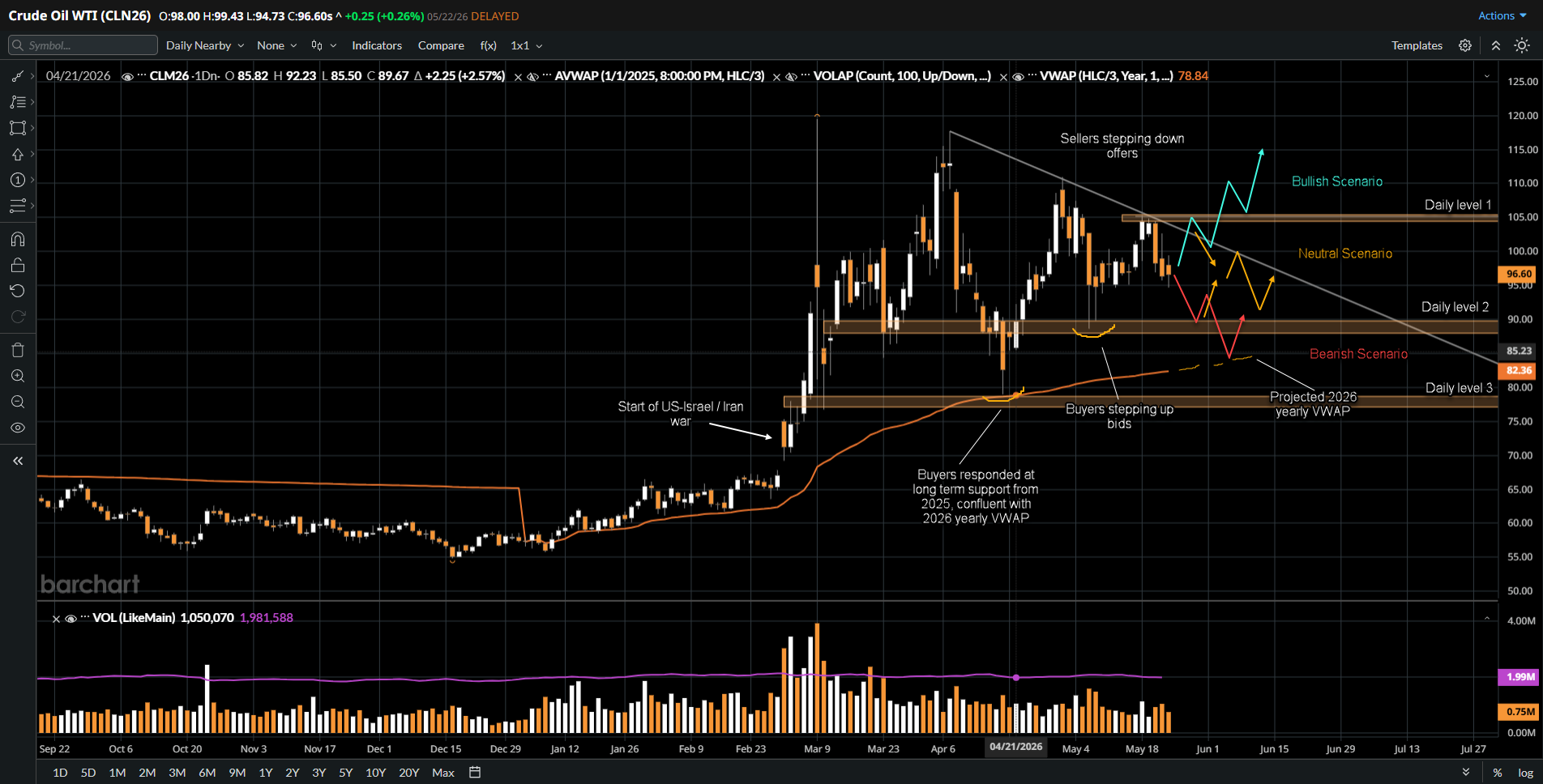
The key level to watch remains the 90 level (Daily Level 2).
Neutral Scenario
- The market continues to compress within the current range between 105 and 90, with no clear directional resolution as US-Iran talks drag on without a signed agreement but also without a complete breakdown.
- A scenario where Trump and Tehran continue to trade competing proposals through Pakistani mediators, keeping the Strait nominally closed but with selective ship passage, would sustain this ambiguity and support continued two-way rotation.
- Expect the market to build acceptance and value within this zone, chopping sideways as participants wait for a conclusive catalyst from the diplomatic channel.
Bearish Scenario
- If the market attempts higher but fails to revisit the 105 area, expect a move back down to the 90 level (Daily Level 2).
- If buyers are not present to defend, expect a further move down to the 85 area, which corresponds to the projected 2026 yearly VWAP, where buyers are expected to respond.
- If buyers fail to quickly reclaim prices back above 90 from that area, the market is vulnerable to a continuation move down toward the 78 area (Daily Level 3), a long-term support zone from 2025.
- The possible macro trigger here would be a finalized and certified US-Iran agreement that includes a credible, verified reopening of the Strait of Hormuz. A signed deal that allows Gulf producers to resume exports at scale would accelerate the return of the roughly 10.5 million barrels per day of shut-in Middle Eastern production that the EIA documented in April, and the market would move quickly to price in that supply recovery.
- An additional bearish catalyst would be news on a faster-than-expected ramp of the UAE's alternative pipeline that bypasses the Strait, which the UAE has indicated is nearly 50% complete, compounding supply-side pressure on prices.
Bullish Scenario
- If buyers are able to hold the 95 area or recover after a failed attempt back down to revisit the 90 level, expect a push up toward 105.
- If the market can accept and sustain trade above 105, the next meaningful targets are 110 and then 115, which correspond to previous swing highs from the height of the supply shock.
- The possible macro trigger here would be a breakdown or stalling of the current diplomatic momentum. If the Islamabad framework collapses, if Iran rejects the latest US proposal outright, or if Trump resumes the military blockade with renewed force after losing patience, expect the Strait to remain closed and supply fears to return aggressively.
- A secondary bullish trigger would be any aggressive Iranian move to formally assert sovereignty over the Strait through its newly created Persian Gulf Strait Authority, which Rubio has already rejected as unacceptable. Such a development could immediately re-escalate risk premium and likely put 105 and the previous swing highs back in play quickly.
Conclusion
Crude oil sits at a genuine inflection point. The technical picture reflects exactly what the macro backdrop demands, a market in wait-and-see mode, compressing between two well-defined levels while it waits for the geopolitical binary to resolve. The 90 level is the line in the sand. A signed US-Iran agreement that certifies Hormuz reopening and credibly restores Middle Eastern supply would likely accelerate the bearish scenario, with gradual price normalization toward the EIA's Q4 projection zone. A breakdown in talks, or a reversal of the current diplomatic momentum, would put 105 and the swing highs back in play quickly. With Pakistan actively mediating, Trump signaling patience but progress, and Iran still demanding reparations and sovereignty recognition over the Strait, this situation is far from settled. What levels are you watching, and how are you managing the headline risk?
We are a professional-grade futures brokerage engineered by traders to provide the high-performance architecture and futures trading platform required for serious market participation. We serve as a professional technical partner for traders who prioritize data integrity and objective analysis. Take the next step in your professional evolution and Open an Account today.
Disclaimer:
This article is provided for informational and educational purposes only and does not constitute financial, investment, or trading advice. The analysis presented reflects the author’s market observations and opinions at the time of writing and is not a recommendation to buy or sell any futures contract, security, or financial instrument. Futures trading involves significant risk and is not suitable for all market participants. Losses may exceed initial margin deposits, and market conditions can change rapidly.
Any scenarios, levels, or market expectations discussed are hypothetical in nature and are intended solely to illustrate potential market behavior. They do not represent actual trading results and should not be interpreted as guarantees of future performance. Past performance, market behavior, or historical price action are not indicative of future outcomes.
Readers are solely responsible for their own trading decisions and risk management. Always conduct independent research, consider your financial situation and risk tolerance, and consult with a qualified financial professional, if necessary, before engaging in futures or derivatives trading.


/Micron%20Technology%20Inc_billboard-by%20Poetra_RH%20via%20Shutterstock.jpg)
/Qualcomm%2C%20Inc_%20logo%20on%20phone-by%20viewimage%20via%20Shutterstock.jpg)

/Abbott%20Laboratories%20vials%20and%20Logo-by%20Melniov%20Dmitriy%20via%20Shutterstock.jpg)