


Off-price retail company Burlington Stores (NYSE:BURL) reported results in line with analysts' expectations in Q2 FY2023, with revenue up 9.46% year on year to $2.17 billion. The company also lowered its full-year revenue and EPS guidance. Burlington made a GAAP profit of $30.9 million, improving from its profit of $12 million in the same quarter last year.
Is now the time to buy Burlington? Find out by accessing our full research report, it's free.
Burlington (BURL) Q2 FY2023 Highlights:
- Revenue: $2.17 billion vs analyst estimates of $2.17 billion (small beat)
- EPS (non-GAAP): $0.60 vs analyst estimates of $0.46 (30.8% beat)
- EPS (non-GAAP) Guidance for Q3 2023 is $0.94 at the midpoint, above analyst estimates of $0.87
- Free Cash Flow of $18.7 million is up from -$82.4 million in the same quarter last year
- Gross Margin (GAAP): 41.8%, up from 39% in the same quarter last year
- Same-Store Sales were up 4% year on year
- Store Locations: 939 at quarter end, increasing by 62 over the last 12 months
Michael O’Sullivan, CEO, stated, “Compared to our peers, we have a huge opportunity to expand our store count. We also have potential to improve our sales productivity and individual store economics with our smaller store prototype. Over the past several months there has been an opening up in the supply of great real estate locations, driven by retail bankruptcies. We are very pleased that we have recently been able to acquire the leases to 62 former Bed Bath & Beyond stores. These locations together with the broader loosening of real estate supply should significantly strengthen our new store and relocation pipeline for 2024 and potentially beyond.”
Founded in 1972 as a discount coat and outerwear retailer, Burlington Stores (NYSE:BURL) is now an off-price retailer that has broadened into general apparel, footwear, and home goods.
Off-price retailers, which sell name-brand goods at major discounts because of their unique purchasing and procurement strategies, understand that everyone loves a good deal. Specifically, these companies buy excess inventory and overstocks from manufacturers and other retailers so they can turn around and offer these products at super competitive prices. Despite the unique draw lure of discounts, these off-price retailers must also contend with the secular headwinds of online penetration and stalling retail foot traffic in places like suburban shopping centers.
Sales Growth
Burlington is larger than most consumer retail companies and benefits from economies of scale, giving it an edge over its competitors.
As you can see below, the company's annualized revenue growth rate of 7.03% over the last four years (we compare to 2019 to normalize for COVID-19 impacts) was decent as it opened new stores and expanded its reach.
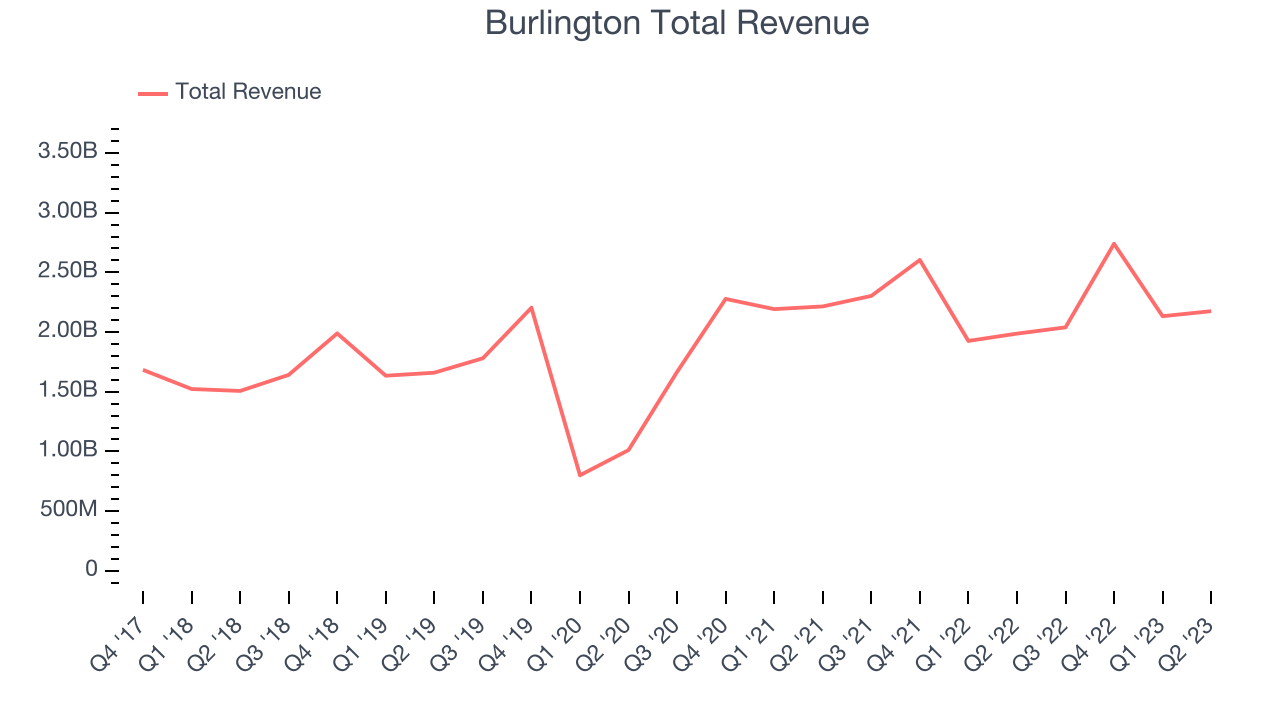
This quarter, Burlington grew its revenue by 9.46% year on year, in line with Wall Street's expectations. Looking ahead, the analysts covering the company expect sales to grow 11.9% over the next 12 months.
While most things went back to how they were before the pandemic, a few consumer habits fundamentally changed. One founder-led company is benefiting massively from this shift and is set to beat the market for years to come. The business has grown astonishingly fast, with 40%+ free cash flow margins, and its fundamentals are undoubtedly best-in-class. Still, its total addressable market is so big that the company has room to grow many times in size. You can find it on our platform for free.
Number of Stores
When a retailer like Burlington is opening new stores, it usually means that demand is greater than supply, and in turn, it's investing for growth. Since last year, Burlington's store count increased by 62 locations, or 7.07%, to 939 total retail locations in the most recently reported quarter.
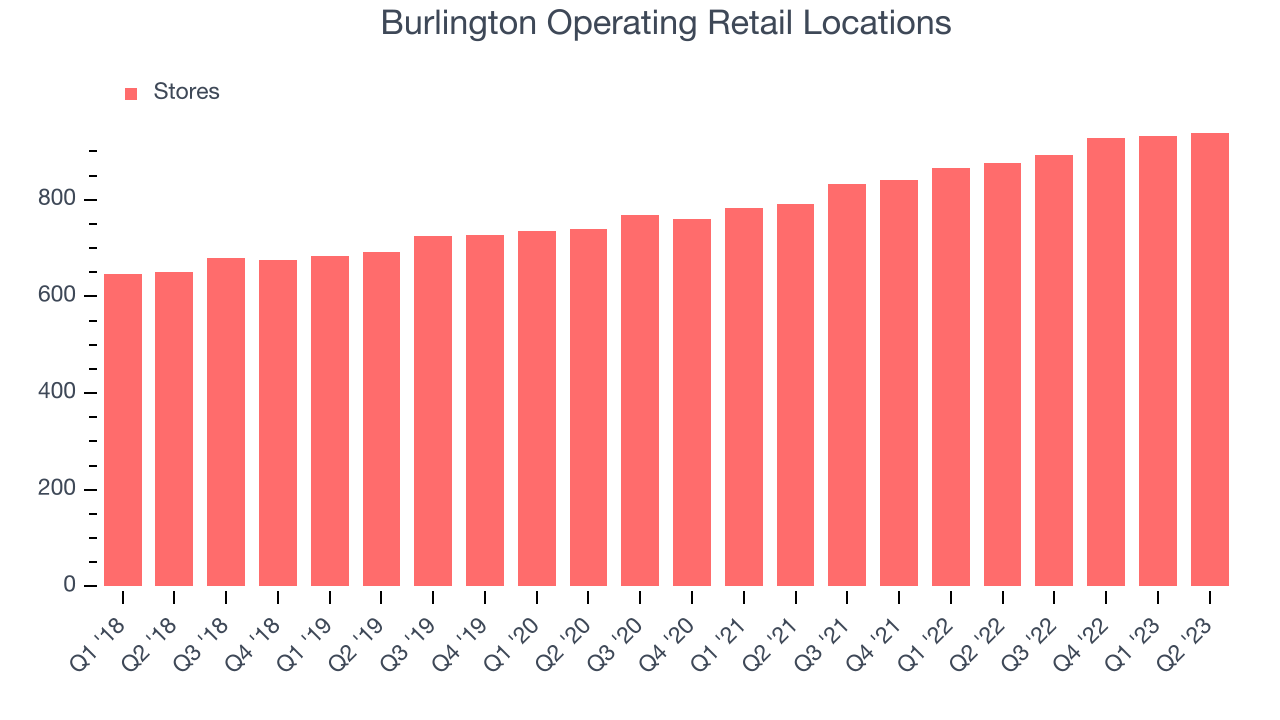
Over the last two years, the company has opened new stores rapidly and averaged 9.03% annual growth in its physical footprint. This store growth is among the fastest in the consumer retail sector. With an expanding store base and demand, revenue growth can come from multiple vectors: sales from new stores, sales from e-commerce, or increased foot traffic and higher sales per customer at existing stores.
Same-Store Sales
Same-store sales growth is a key performance indicator used to measure organic growth and demand for retailers.
Burlington's demand has been shrinking over the last eight quarters, and on average, its same-store sales have declined by 3% year on year. This performance is quite concerning and the company should reconsider its strategy before investing its precious capital into new store buildouts.
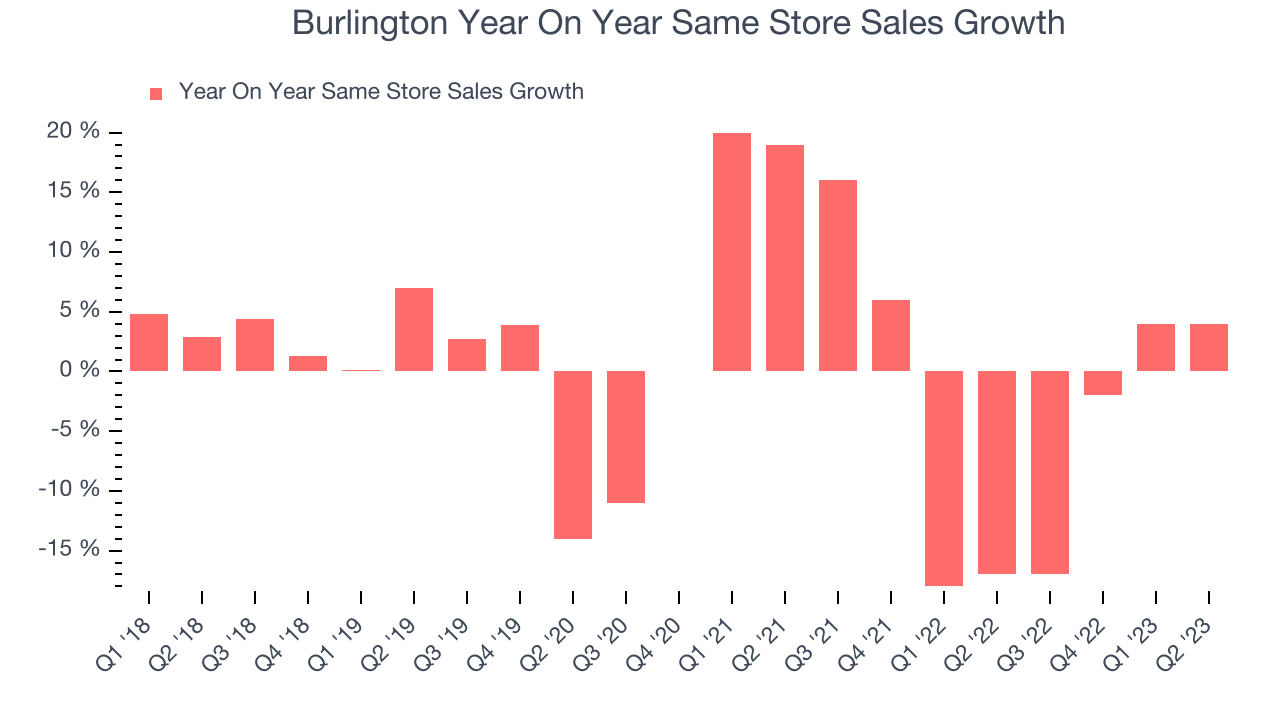
In the latest quarter, Burlington's same-store sales rose 4% year on year. This growth was a well-appreciated turnaround from the 17% year-on-year decline it had posted 12 months ago, showing that the business is regaining momentum.
Key Takeaways from Burlington's Q2 Results
Sporting a market capitalization of $10.9 billion, more than $521 million in cash on hand, and positive free cash flow over the last 12 months, we believe that Burlington is attractively positioned to invest in growth.
We were impressed by how significantly Burlington blew past analysts' EPS and adjusted EBITDA expectations this quarter. We were also glad that next quarter's earnings guidance exceeded Wall Street's estimates. It seems like Burlington is playing offense as it's prioritizing opening new stores. Over the past few months, it's used bankruptcies from other retail companies like Bed Bath & Beyond to acquire leases for new stores in great locations. On the other hand, Burlington lowered its full-year revenue and EPS guidance. Overall, this was a mediocre quarter for the company. The stock is flat after reporting and currently trades at $169 per share.
So should you invest in Burlington right now? When making that decision, it's important to consider its valuation, business qualities, as well as what has happened in the latest quarter. We cover that in our actionable full research report which you can read here, it's free.
One way to find opportunities in the market is to watch for generational shifts in the economy. Almost every company is slowly finding itself becoming a technology company and facing cybersecurity risks and as a result, the demand for cloud-native cybersecurity is skyrocketing. This company is leading a massive technological shift in the industry and with revenue growth of 50% year on year and best-in-class SaaS metrics it should definitely be on your radar.
The author has no position in any of the stocks mentioned in this report.




/A%20Palantir%20sign%20displayed%20on%20an%20office%20building%20by%20Poetra_RH%20via%20Shutterstock.jpg)