Dual Edge Research publishes two powerful newsletters that work great individually — and even better together. The Bull Strangle Newsletter focuses on stocks and options, combining stock ownership with premium-selling strategies to generate consistent income and market-beating returns. The Smart Spreads Newsletter specializes in seasonal commodity futures spreads, offering a diversified approach with low correlation to equities. Together, they deliver a complete investment perspective — one focused on income, the other on diversification — all under one simple subscription.
Introduction
Most spread traders begin by searching for charts that “look seasonal.” That approach is backwards. A professional spread watch list is built by identifying markets where structure, seasonality, and fundamentals consistently interact in a repeatable way. The objective is not simply finding trades. It is reducing thousands of possible combinations into a smaller universe of structurally aligned opportunities worth monitoring each week.
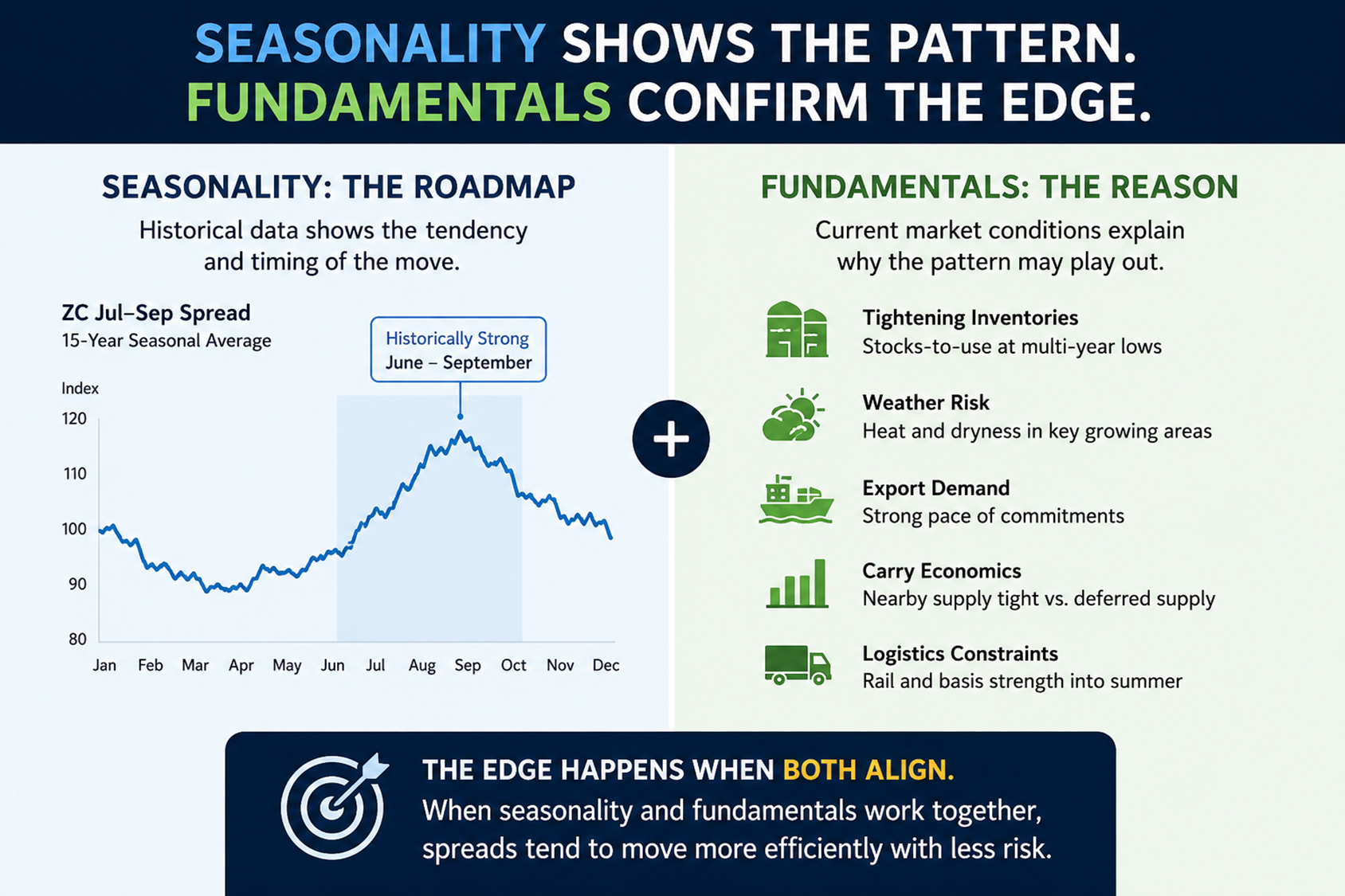
Calendar spreads depend on relationships between contracts, and those relationships are heavily influenced by inventory cycles, storage economics, production timing, weather, transportation, and hedging behavior. As a result, seasonality alone is not enough. The strongest watch lists combine historical tendencies with the underlying drivers that explain why those tendencies persist.
Start With Structural Markets
Not every market produces clean seasonal spread behavior. Energy markets often provide some of the clearest examples because storage economics and refinery demand create recurring curve behavior. Grain markets reflect planting and harvest cycles, while livestock markets respond to feed costs, herd management, and consumption patterns.
The goal is to focus on markets where seasonality reflects an underlying economic process rather than random historical coincidence. A spread that moved the same direction for 12 of the last 15 years is not automatically reliable. Without a structural explanation, the pattern may simply represent noise.
Use Seasonality as a Filter
Historical seasonality should function as a filter—not a signal. A quality watch list focuses on the persistence of the move: consistency across years, stability of the directional tendency, and reliability across different volatility environments. The objective is not finding the largest historical profit. It is identifying spreads that repeatedly express similar behavior over time. In many cases, the strongest structures are not explosive directional moves. They are slow, orderly carry adjustments that unfold consistently over several weeks.
Evaluate the Fundamental Backdrop
Seasonality becomes significantly more useful when supported by current market conditions. Tightening inventories, refinery maintenance, weather transitions, export demand shifts, or changes in carry economics can all reinforce a historical tendency. The purpose is not predicting headlines. It is determining whether the current environment supports the seasonal structure. When seasonality and fundamentals align, spreads often behave more efficiently. When they conflict, volatility and drawdowns tend to increase.
Narrow the List Further
After identifying structurally aligned opportunities, the watch list should be narrowed further using objective quality filters.
This may include evaluating liquidity, correlation stability between legs, holding duration, structural volatility, and the relationship between profits and drawdowns. The process is less about optimization and more about elimination.
Most spread combinations do not deserve capital. The objective is to reduce the opportunity set to the small percentage of structures that consistently demonstrate stability and persistence. Professional watch lists are also typically organized into categories such as core structures, secondary opportunities, or volatility-dependent setups. This framework helps traders prioritize capital while recognizing concentration risk across related markets.
Final Thought
The edge in spread trading rarely comes from predicting price direction alone. Historical seasonality provides the roadmap. Fundamental drivers explain why the roadmap exists. When both align, the watch list becomes more than a collection of charts. It becomes a framework for identifying higher-quality opportunities before the broader market fully recognizes them.
More Information
Now you can get two powerful newsletters — for one simple price!
- For stocks and options, the Bull Strangle Newsletter shows you how to combine stock ownership with dual option selling — a disciplined strategy that has consistently outperformed the S&P 500.
- For commodity futures, the Smart Spreads Newsletter focuses on seasonal commodity spreads — a proven, low-correlation approach that thrives in all types of markets.
Each newsletter is designed to deliver consistent income on its own — but when used together, they create a complete, diversified trading approach that works in any market environment.
Visit BullStrangle.com to subscribe for just $1 for the first month.
For a video overview of the Bull Strangle Newsletter
For a video overview of the Smart Spreads Newsletter
Darren Carlat
Dual Edge Research
(214) 636-3133
DualEdgeResearch@gail.com
Disclaimer
This information is for informational purposes only and should not be considered as investment advice. Past performance is not indicative of future results, and all investments carry inherent risk. Consult with a financial advisor before making any investment decisions.

/AI%20(artificial%20intelligence)/AI%20engineer%20working%20on%20laptop%20by%20ART%20STOCK%20CREATIVE%20via%20Shutterstock.jpg)
/Micron%20Technology%20Inc_billboard-by%20Poetra_RH%20via%20Shutterstock.jpg)
/Qualcomm%2C%20Inc_%20logo%20on%20phone-by%20viewimage%20via%20Shutterstock.jpg)
/Advanced%20Micro%20Devices%20Inc_%20logo%20and%20chart%20data-by%20Poetra_%20RH%20via%20Shutterstock.jpg)