




Transmission provider Allison Transmission (NYSE:ALSN) reported Q1 CY2026 results beating Wall Street’s revenue expectations, with sales up 83.6% year on year to $1.41 billion. The company expects the full year’s revenue to be around $5.75 billion, close to analysts’ estimates. Its GAAP profit of $1.33 per share was 34.5% below analysts’ consensus estimates.
Is now the time to buy Allison Transmission? Find out by accessing our full research report, it’s free.
Allison Transmission (ALSN) Q1 CY2026 Highlights:
- Revenue: $1.41 billion vs analyst estimates of $1.37 billion (83.6% year-on-year growth including the addition of the Allison Off-Highway business unit acquired on January 1, 2026 , 2.6% beat)
- EPS (GAAP): $1.33 vs analyst expectations of $2.03 (34.5% miss)
- Adjusted EBITDA: $362 million vs analyst estimates of $351.6 million (25.7% margin, 3% beat)
- The company reconfirmed its revenue guidance for the full year of $5.75 billion at the midpoint
- EBITDA guidance for the full year is $1.44 billion at the midpoint, below analyst estimates of $1.47 billion
- Operating Margin: 13.9%, down from 32.5% in the same quarter last year
- Free Cash Flow Margin: 7.3%, down from 20.2% in the same quarter last year
- Market Capitalization: $10.91 billion
David S. Graziosi, Chair, President and Chief Executive Officer of Allison commented, "Encouraging momentum in key end markets supported solid demand for both Allison business units in the first quarter. Despite ongoing geopolitical uncertainty, we will look to capitalize on further improvement in end markets conditions throughout the year, while continuing to integrate the Allison Off-Highway business unit, maintaining focus and confidence in our synergy capture target in support of our long-term growth and value creation strategy. For the first quarter, adjusted diluted EPS was $2.57, with expectation for the acquisition of the Allison Off-Highway business unit to be accretive to net income and diluted EPS in 2026."
Company Overview
Helping build race cars at one point, Allison Transmission (NYSE:ALSN) offers transmissions to original equipment manufacturers and fleet operators.
Revenue Growth
Examining a company’s long-term performance can provide clues about its quality. Any business can experience short-term success, but top-performing ones enjoy sustained growth for years. Thankfully, Allison Transmission’s 12.4% annualized revenue growth over the last five years was excellent. Its growth beat the average industrials company and shows its offerings resonate with customers.
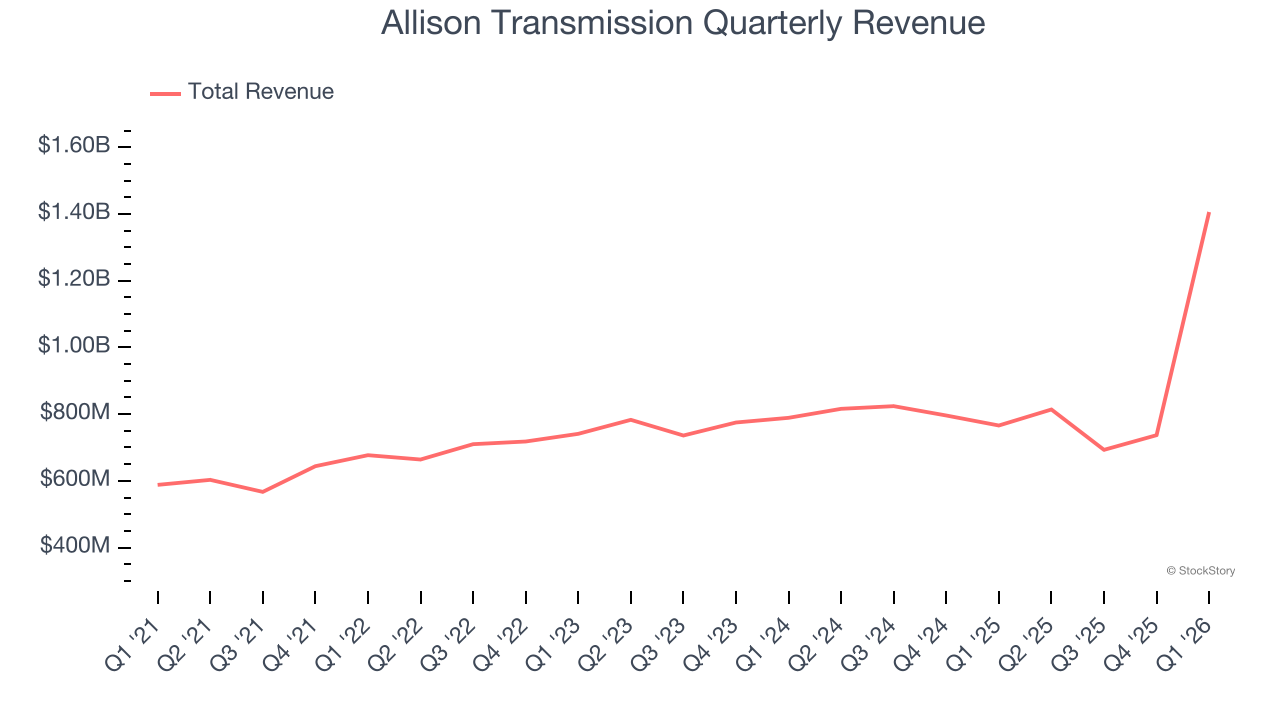
We at StockStory place the most emphasis on long-term growth, but within industrials, a half-decade historical view may miss cycles, industry trends, or a company capitalizing on catalysts such as a new contract win or a successful product line. Allison Transmission’s annualized revenue growth of 8.8% over the last two years is below its five-year trend, but we still think the results were respectable. 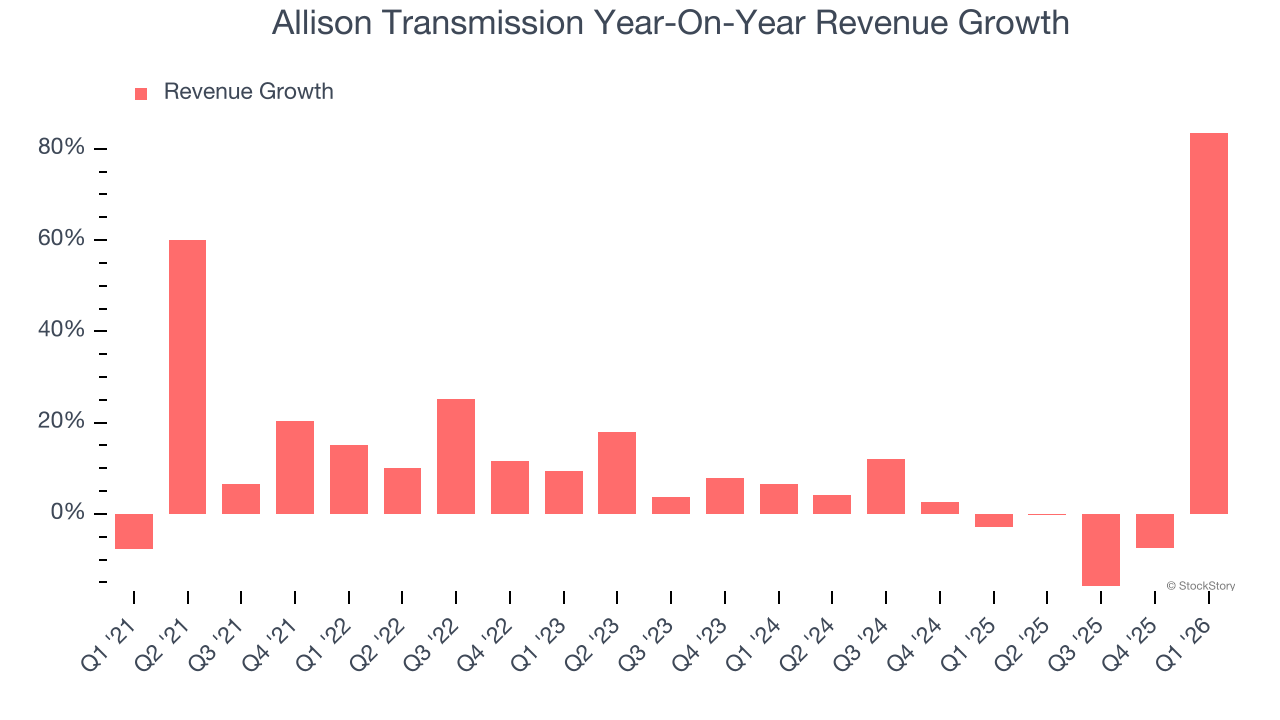
This quarter, Allison Transmission reported magnificent year-on-year revenue growth of 83.6%, and its $1.41 billion of revenue beat Wall Street’s estimates by 2.6%.
Looking ahead, sell-side analysts expect revenue to grow 61.7% over the next 12 months, an improvement versus the last two years. This projection is eye-popping and indicates its newer products and services will catalyze better top-line performance.
ONE MORE THING: 3 Hidden Platforms Growing 3X Faster than Amazon, Google, and PayPal. Amazon, Google, and Meta all followed the same playbook: Dominate an ignored market. Build an unbeatable moat. Scale until you’re unstoppable.
These three platforms are running that exact playbook right now. The early investors in Amazon made fortunes. The early investors in these could do the same. Get All 3 Stocks Here for FREE.
Operating Margin
Operating margin is an important measure of profitability as it shows the portion of revenue left after accounting for all core expenses – everything from the cost of goods sold to advertising and wages. It’s also useful for comparing profitability across companies with different levels of debt and tax rates because it excludes interest and taxes.
Allison Transmission has been a well-oiled machine over the last five years. It demonstrated elite profitability for an industrials business, boasting an average operating margin of 27.9%. This result isn’t surprising as its high gross margin gives it a favorable starting point.
Looking at the trend in its profitability, Allison Transmission’s operating margin decreased by 5.1 percentage points over the last five years. This raises questions about the company’s expense base because its revenue growth should have given it leverage on its fixed costs, resulting in better economies of scale and profitability.
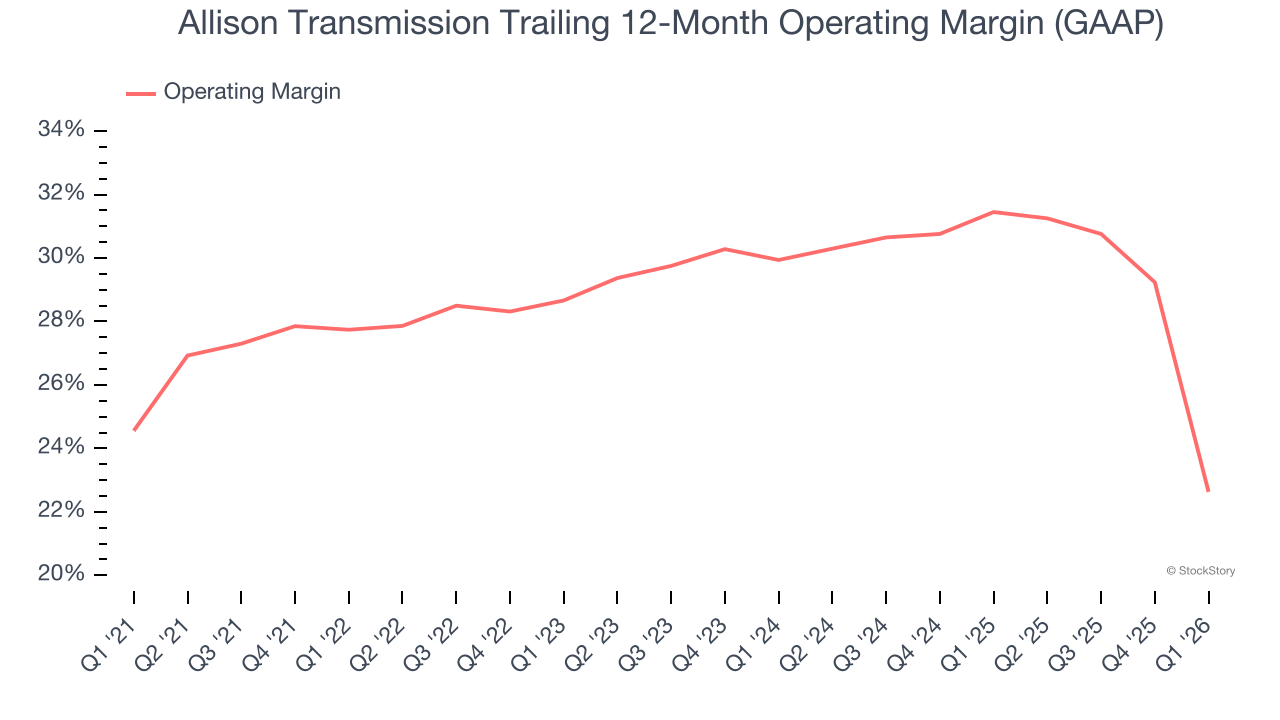
This quarter, Allison Transmission generated an operating margin profit margin of 13.9%, down 18.6 percentage points year on year. Since Allison Transmission’s gross margin decreased more than its operating margin, we can assume its recent inefficiencies were driven more by weaker leverage on its cost of sales rather than increased marketing, R&D, and administrative overhead expenses.
Earnings Per Share
We track the long-term change in earnings per share (EPS) for the same reason as long-term revenue growth. Compared to revenue, however, EPS highlights whether a company’s growth is profitable.
Allison Transmission’s EPS grew at 21% compounded annual growth rate over the last five years, higher than its 12.4% annualized revenue growth. However, this alone doesn’t tell us much about its business quality because its operating margin didn’t improve.
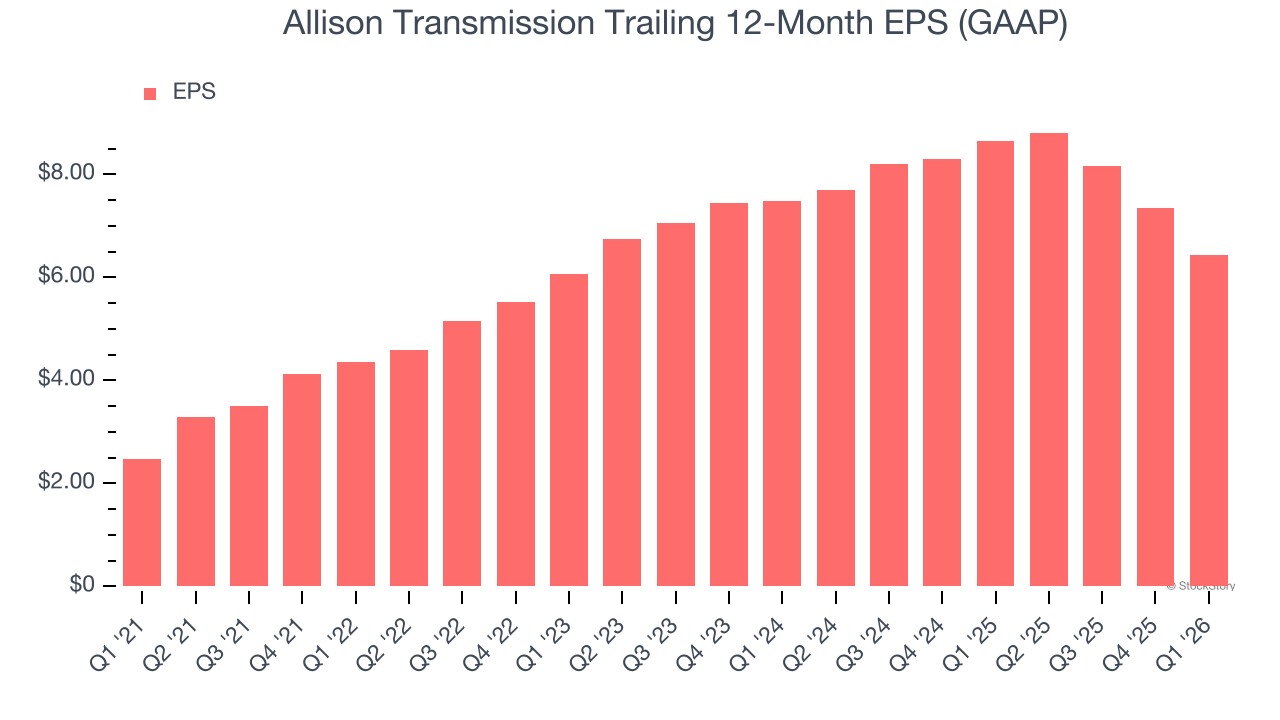
We can take a deeper look into Allison Transmission’s earnings to better understand the drivers of its performance. A five-year view shows that Allison Transmission has repurchased its stock, shrinking its share count by 24.8%. This tells us its EPS outperformed its revenue not because of increased operational efficiency but financial engineering, as buybacks boost per share earnings. 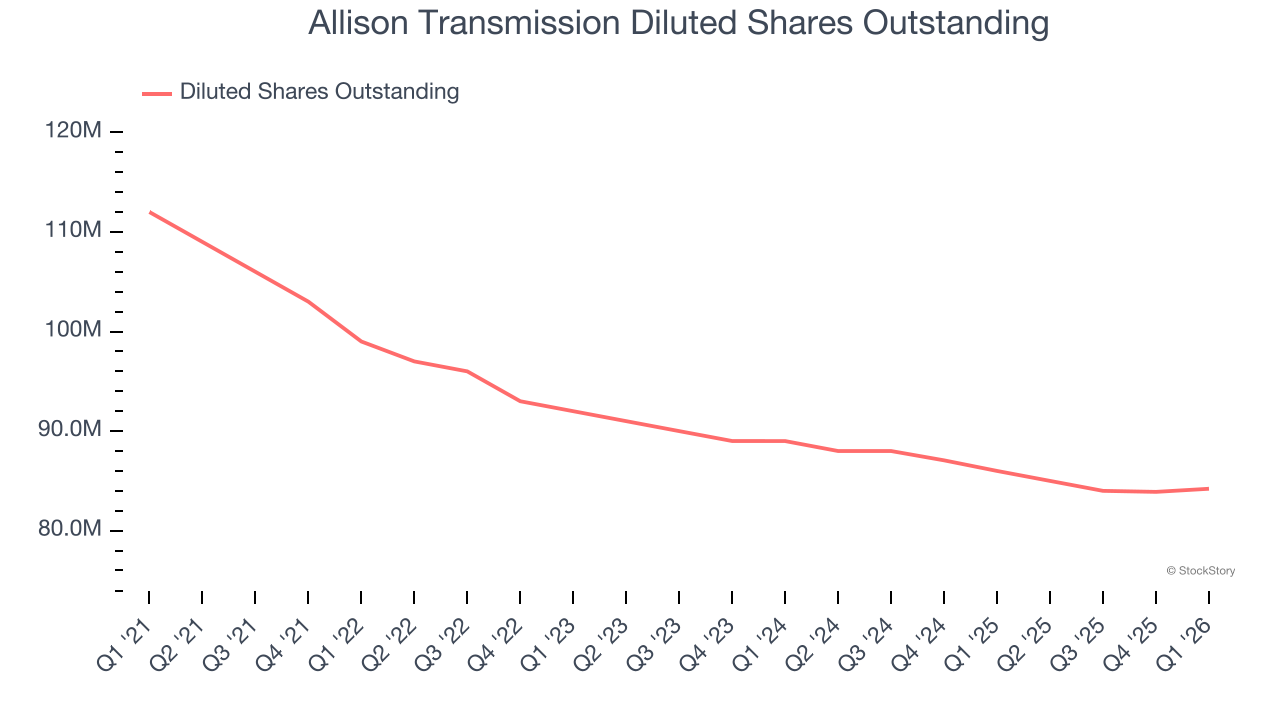
Like with revenue, we analyze EPS over a shorter period to see if we are missing a change in the business.
For Allison Transmission, its two-year annual EPS declines of 7.3% mark a reversal from its (seemingly) healthy five-year trend. These shorter-term results weren’t ideal, but given it was successful in other measures of financial health, we’re hopeful Allison Transmission can return to earnings growth in the future.
In Q1, Allison Transmission reported EPS of $1.33, down from $2.23 in the same quarter last year. This print missed analysts’ estimates, but we care more about long-term EPS growth than short-term movements. Over the next 12 months, Wall Street expects Allison Transmission’s full-year EPS of $6.44 to grow 49.1%.
Key Takeaways from Allison Transmission’s Q1 Results
We enjoyed seeing Allison Transmission beat analysts’ revenue expectations this quarter. We were also happy its EBITDA outperformed Wall Street’s estimates. On the other hand, its EPS fell short of Wall Street’s estimates. Overall, this was a weaker quarter. The stock remained flat at $128.43 immediately following the results.
Allison Transmission may have had a tough quarter, but does that actually create an opportunity to invest right now? What happened in the latest quarter matters, but not as much as longer-term business quality and valuation, when deciding whether to invest in this stock. We cover that in our actionable full research report which you can read here (it’s free).


/Amazon%20pickup%20%26%20returns%20building%20by%20Bryan%20Angelo%20via%20Unsplash.jpg)
/Microsoft%20Corporation%20logo%20on%20sign-by%20Jean-Luc%20Ichard%20via%20iStock.jpg)

/Alphabet%20(Google)%20Image%20by%20Markus%20Mainka%20via%20Shutterstock.jpg)