
Based on historical seasonal data and market patterns, the New Zealand Dollar/US Dollar (NZD/USD) pair often experiences a sell-off in early May, driven by a combination of seasonal factors and fundamental market dynamics.
Two primary reasons for this consistent sell-off include:
- Seasonal Risk-Off Sentiment ("Sell in May and Go Away"): The first week of May frequently coincides with a broader market tendency to shift away from riskier assets, known as the "sell in May and go away" effect. As a high-beta, "risk-on" commodity currency, the NZD is highly sensitive to market turbulence and typically suffers when investors reduce risk exposure and move toward the safe-haven US Dollar (USD).
- Weakness in Global Trade and Commodity Prices (China Factor): The NZD often weakens early in the second quarter (including early May) as market participants focus on slowing global growth, particularly in China, which is New Zealand's largest trading partner. Reduced demand for commodities, such as dairy, frequently puts downward pressure on the kiwi dollar during this period.
Additionally, monetary timing of the Reserve Bank of New Zealand (RBNZ) rate decisions often shows weakness from late February through mid-May, and a trend of capital outflows during this period.
Fun Fact
The New Zealand dollar (NZD) is commonly referred to as the "Kiwi" or "Kiwi dollar". The nickname, widely used by foreign exchange traders and in global markets, is derived from the flightless Kiwi bird featured on the nation's $1 coin. The currency was introduced in 1967, replacing the New Zealand pound.
Technical Picture
Source: Barchart
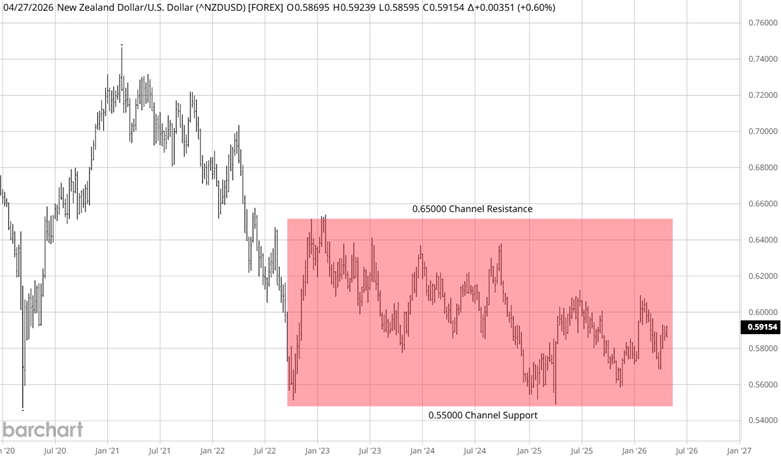
Since peaking in 2011 at 0.88404, the Kiwi has remained in a bearish downtrend, with a sideways channel ranging from a low of 0.55000 to a high of 0.65000 beginning in 2022. The market seems comfortable finding support and resistance at this channel mid-point of 0.60000. Currently, the Kiwi is trading just a few pips below the mid-point, creating an interesting pattern ahead of the upcoming seasonal sell.
Seasonal Pattern
Source: Moore Research Center, Inc. (MRCI)
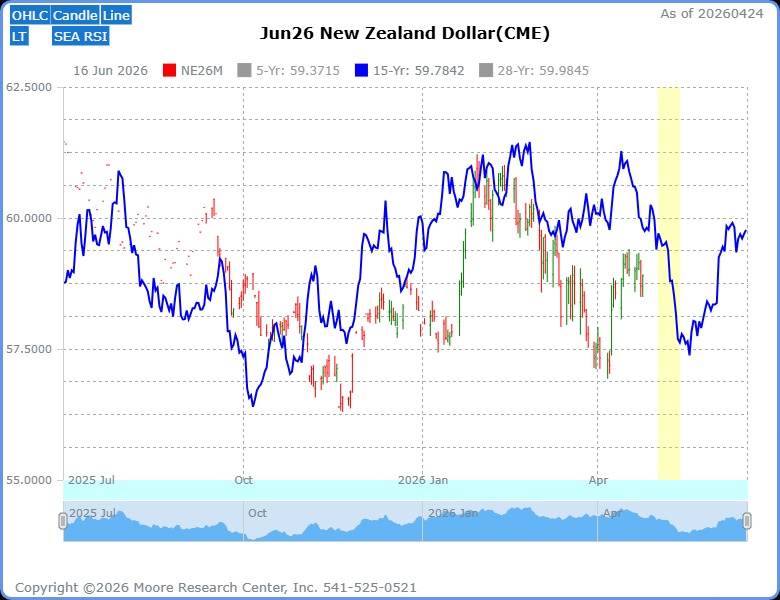
MRCI research was based on the New Zealand Dollar/US dollar June futures contract traded on the CME Group exchange. The futures contract and spot prices are highly correlated, making the research applicable to either spot- or futures-market traders.
The blue line represents a 15-year seasonal average of the New Zealand dollar June futures contract. At a glance, viewers can see that the Kiwi typically peaks in February, followed by a retest in April. This year's retest came short of the February price peak. Possibly indicating early aggressive selling into the Kiwi.
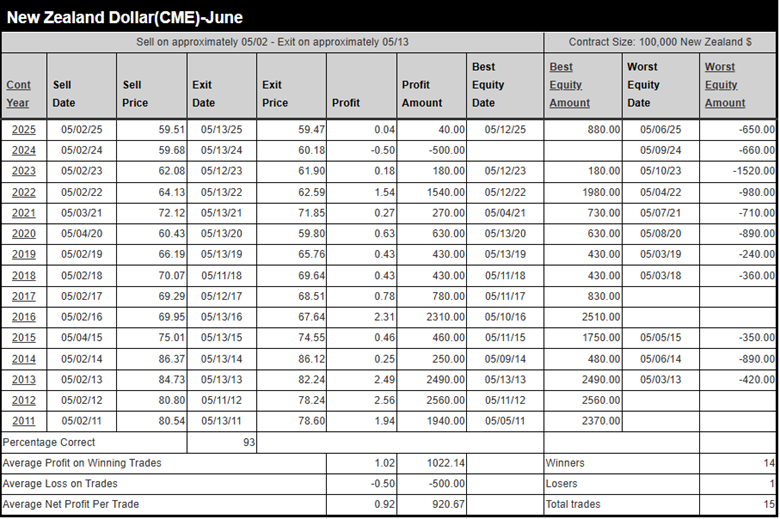
During MRCI's research, a high occurrence rate was observed, indicating significant selling pressure and creating a 12-calendar-day seasonal sell window (yellow box). In the past 15 years, the New Zealand dollar has closed lower on May 13 than on May 02 93% of the time. The hypothetical testing resulted in a reward/risk ratio of about 2:1, as the net win was $920.67 and the one loss in 14 years was $500.
The table below also shows that the New Zealand dollar futures had 4 years with no daily closing drawdowns.
Source: MRCI
As a crucial reminder, while seasonal patterns can provide valuable insights, they should not be the basis for trading decisions. Traders must consider technical and fundamental indicators, risk management strategies, and market conditions to make informed, balanced trading decisions.
Assets to Trade the Kiwi
Spot forex traders can trade the symbol ^NZDUSD using standard-size lots, as well as micro-lots.
Futures traders can use the symbol N6M26.
Options are available on the futures contracts.
In Closing…
Seasonality may point to an early-May sell window in NZD/USD, but it works best as context rather than a signal on its own. When seasonal pressure aligns with a bearish technical structure, softer commodity demand, and risk-off flows into the US dollar, it can provide traders with a stronger framework for evaluating setups. With the price sitting near a long-term pivot around 0.60000, this period may be worth watching closely.
For both newer and experienced traders, the key is combining these seasonal tendencies with price action, macro developments, and disciplined risk management. The Kiwi has a history of reacting sharply to shifts in sentiment and global growth expectations, which can create opportunity but also raise risk. Whether trading spot, futures, or options, the focus should be on using seasonality as one tool within a broader trading plan.
On the date of publication, Don Dawson did not have (either directly or indirectly) positions in any of the securities mentioned in this article. All information and data in this article is solely for informational purposes. For more information please view the Barchart Disclosure Policy here.




/Netflix%20open%20on%20tablet%20by%20rswebsols%20via%20Pixabay.jpg)