
Dual Edge Research publishes two powerful newsletters that work great individually — and even better together. The Bull Strangle Newsletter focuses on stocks and options, combining stock ownership with premium-selling strategies to generate consistent income and market-beating returns. The Smart Spreads Newsletter specializes in seasonal commodity futures spreads, offering a diversified approach with low correlation to equities. Together, they deliver a complete investment perspective — one focused on income, the other on diversification — all under one simple subscription.
Introduction
One of the most common questions among options income traders is simple: Should you sell weekly options or monthly options?
At first glance, the distinction feels important. Weekly options appear more flexible, while monthly options seem more traditional. But within a structured income framework, that difference becomes far less meaningful. What ultimately matters is not the label on the option, but how long the position is held and how capital is deployed. In a disciplined approach, both weekly and monthly options can be held for the same defined period—typically four weeks. Once that consistency is established, the focus shifts away from expiration type and toward structure.
The Real Decision: Timing, Not Expiration
The more important question is not weekly versus monthly. It’s whether capital is deployed all at once—or distributed over time.
Many traders who rely on a single monthly cycle naturally deploy capital at one point in time. The portfolio then becomes tied to that specific entry, and outcomes depend heavily on whether conditions were favorable at that moment. This creates a form of concentration that often goes unnoticed—concentration in timing.
The Structural Advantage of Weekly Entries
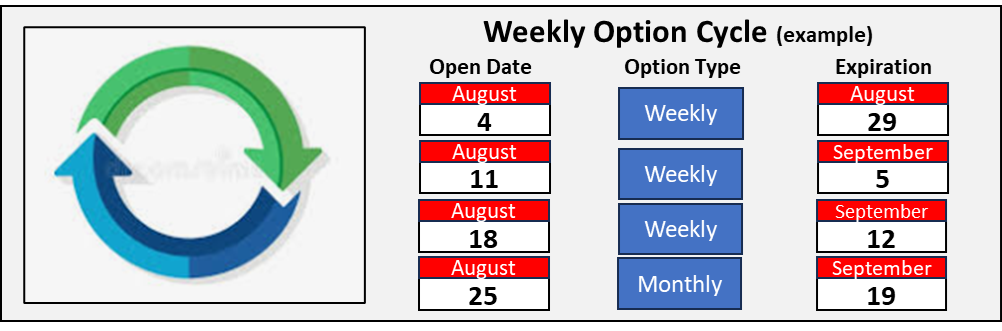
Weekly options offer an advantage not because they have a shorter duration, but because they allow a different entry process. By entering positions each week and holding them for approximately four weeks, capital is spread across time rather than being committed all at once. The result is a portfolio made up of four overlapping cycles, each initiated under different conditions. This structure—often referred to as a four-cycle weekly ladder—creates a more balanced approach to deployment.
Why Laddering Changes the Outcome
Spreading entries across multiple weeks changes how the portfolio behaves. Instead of relying on a single entry point, positions are initiated across a range of market environments. Volatility, price levels, and short-term trends will differ from week to week, and no single entry dominates the outcome. Markets rarely move in straight lines, and timing is never perfect. A laddered approach reduces the need for precision by distributing exposure across time, allowing the overall portfolio to settle into a more consistent pattern.
The Risk of All-at-Once Deployment
When capital is deployed all at once, the portfolio inherits the conditions of that specific moment. If the market extends or volatility rises, the entire position reflects that risk immediately. This leads to greater variability from one cycle to the next and increases sensitivity to short-term movement. The issue is not whether weekly or monthly options are used—it is the concentration of timing.
Integrating Weekly and Monthly Options
This framework does not require choosing one over the other. Monthly options can be used alongside weekly options when they align with the same four-week holding period. In both cases, the defining feature is the structure: a consistent holding period combined with staggered entries. When used this way, weekly options provide the mechanism for timing diversification, while monthly options can complement the portfolio without changing its overall behavior.
Final Thought
The edge in options income trading does not come from selecting a specific expiration cycle. It comes from how capital is deployed across time. That idea sits at the core of the Bull Strangle approach—using a structured 4-week ladder to enter positions gradually rather than all at once. By spreading entries across multiple weeks, timing risk is reduced, outcomes are smoothed, and the portfolio becomes less dependent on any single decision point.
Weekly options are not used for speed. They are used to build a structure. If you’re looking for a rules-based framework that applies this approach in real time—combining stock ownership with disciplined option selling—the Bull Strangle newsletter shows exactly how that process works, week after week.
More Information
Now you can get two powerful newsletters — for one simple price!
- For stocks and options, the Bull Strangle Newsletter shows you how to combine stock ownership with dual option selling — a disciplined strategy that has consistently outperformed the S&P 500.
- For commodity futures, the Smart Spreads Newsletter focuses on seasonal commodity spreads — a proven, low-correlation approach that thrives in all types of markets.
Each newsletter is designed to deliver consistent income on its own — but when used together, they create a complete, diversified trading approach that works in any market environment.
Visit BullStrangle.com to subscribe for just $1 for the first month.
For a video overview of the Bull Strangle Newsletter
For a video overview of the Smart Spreads Newsletter
Darren Carlat
Dual Edge Research
(214) 636-3133
DualEdgeResearch@gamil.com
Disclaimer
This information is for informational purposes only and should not be considered as investment advice. Past performance is not indicative of future results, and all investments carry inherent risk. Consult with a financial advisor before making any investment decisions.

/Super%20Micro%20Computer%20Inc%20HQ%20photo-by%20Tada%20Images%20via%20Shutterstock.jpg)

/Micron%20Technology%20Inc_billboard-by%20Poetra_RH%20via%20Shutterstock.jpg)
/Broadcom%20Inc%20logo%20on%20building-by%20Poetra_%20RH%20via%20Shutterstock.jpg)