




I wrote about gasoline on Barchart on February 8, cautioning, “The odds favor higher gasoline prices as the 2023 peak driving season approaches. An increase in the demand from China could turbocharge gasoline prices if OPEC does not ramp up supplies. Any price weakness in UGA could present buying opportunities over the coming weeks.”
That day, the nearby NYMEX RBOB gasoline futures price was at the $2.4250 per gallon level, with the United States Gasoline ETF (UGA) at $58.47 per share. On March 10, April gasoline futures were higher at $2.6458 per gallon, and the UGA was trading near the $59 per share level. I expect seasonality and other factors to increase prices over the coming months.
Gasoline futures remain elevated in March 2023
At just below $2.65 per gallon wholesale, nearby April NYMEX gasoline futures remain high going into the 2023 driving season.

The monthly chart highlights before 2022, the last time gasoline futures were higher than the current level in March was nine years ago in 2014.
The short-term trend is bullish
April gasoline futures reached a low of $2.2375 on December 12, 2022, when the continuous NYMEX crude oil futures contract fell to $70.08, and gasoline was at the start of the offseason for demand.
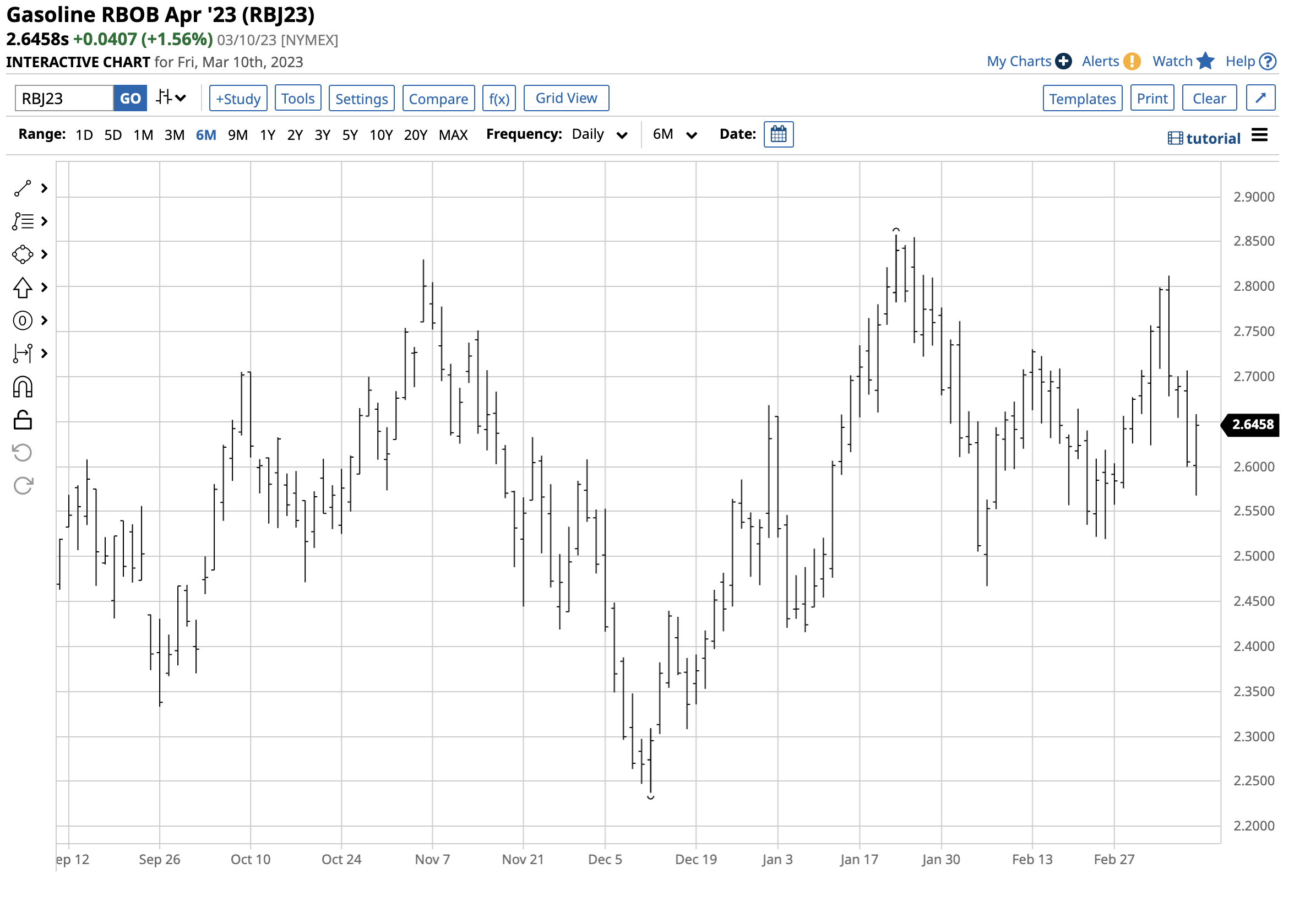
The six-month chart illustrates gasoline for April delivery has made higher lows and higher highs since mid-December 2022.
Geopolitics and China favor higher prices
While seasonality favors the upside in March 2023, other factors could cause another upside spike that impacts driver’s pocketbooks over the coming weeks and months.
The ongoing war in Ukraine is now in its second year, with no end in sight. Russia has used crude oil as an economic weapon against “unfriendly” countries supporting Ukraine. Moreover, Russia is the most influential nonmember of the international oil cartel, with production policy a function of negotiations and decisions from Riyadh, Saudi Arabia, and Moscow. As Russia funds its war effort with commodity revenues and OPEC has pricing power, Europe and the U.S. are at the cartel’s mercy for oil and oil product supplies and prices. The continuing war and bifurcation of the world’s nuclear powers favor higher oil and oil product prices.
China is the world’s second-leading economy and most populous nation. Aside from China’s “no-limits” alliance with Russia, it is emerging from COVID-19 protocols, increasing the demand for travel, fuel, and oil products. The bottom line is the geopolitical landscape, and the world’s leading commodity consumers are bullish factors for oil and oil product prices.
Meanwhile, the 2022 U.S. SPR sales have caused the reserves to decline to 371.6 million barrels, the lowest level since December 1983. The Biden administration has told the market it intends to replace the SPR at $70 per barrel and lower, which could put a floor under the oil price in 2023.
Interest rates and the dollar are weighing on prices- An opportunity
With stubborn inflation at the highest level in decades, the U.S. Fed is hell-bent on pushing the economic condition to its 2% target rate. Short-term U.S. interest rates will likely eclipse the 5% level and rise to 6% in 2023 if inflation remains elevated. The rising rate environment pushed the dollar index to a two-decade high. While the dollar index corrected lower, it bounced from just above 100 and was over 104.50 on March 10. A strong dollar and rising interest rates are typically bearish for commodity prices, and crude oil is no exception.
With the dollar and rates keeping a lid on oil and oil product prices, the peak demand season for gasoline on the horizon, and a tense geopolitical landscape, petroleum and products could be poised to rally. I view the current level at $2.65 per gallon wholesale, a bargain in gasoline as they are over $1 below the level in March 2022 and significantly under last year’s June $4.3260 record peak. While the upside could be explosive, the downside risk could be limited.
Buying UGA on price dips could be the optimal approach
The United States Gasoline ETF product was trading at around the $58.87 level on March 10. UGA has $72.610 million in assets under management and trades an average of 26,705 shares daily. The ETF charges a 0.96% management fee.
April gasoline futures rose from $2.2375 on December 12, 2022, to a $2.8578 high on January 23, a 27.7% increase. At just below the $2.65 level on March 10, gasoline prices are closer to the high.
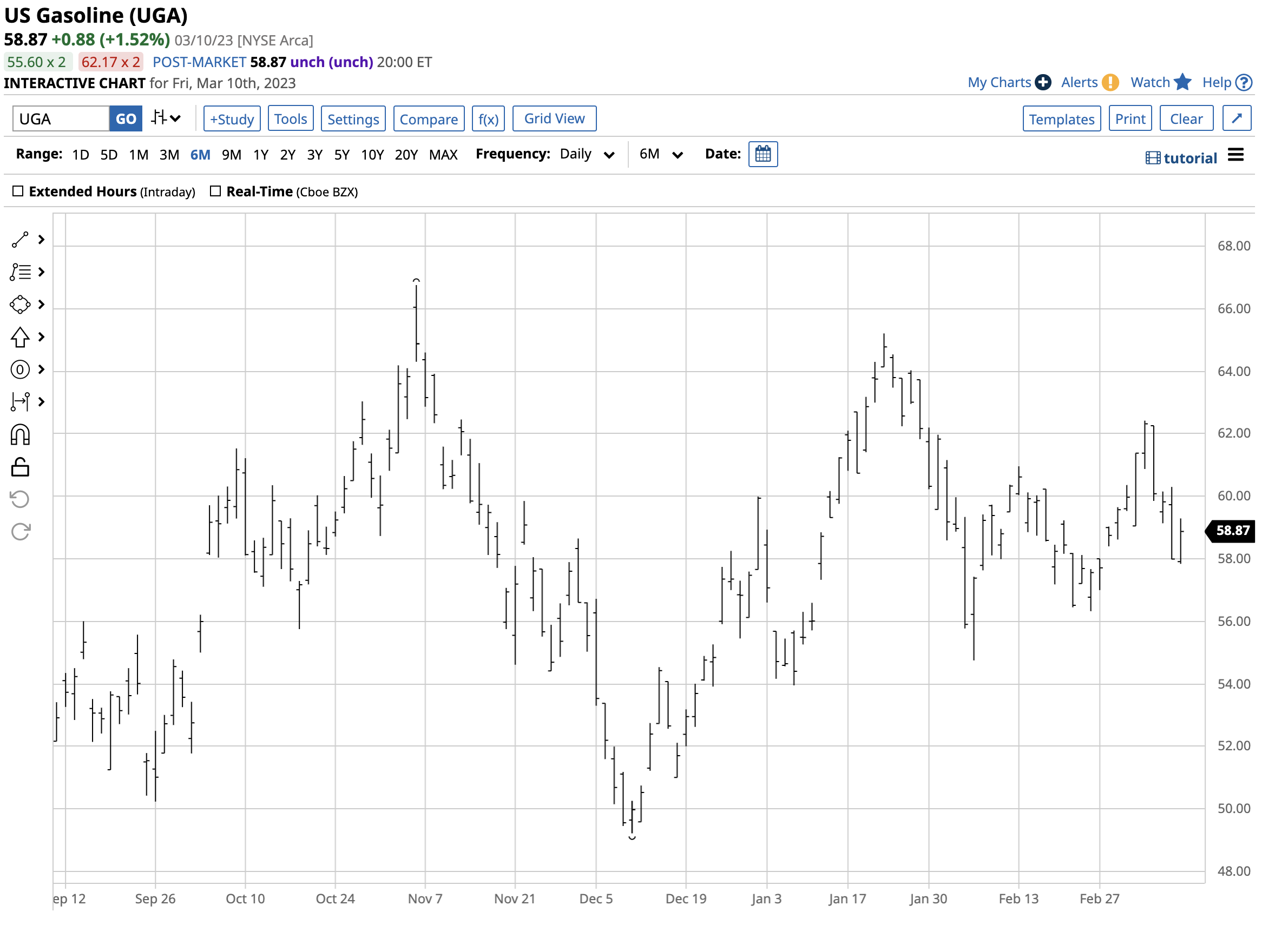
Over the same period, UGA rose from $49.22 to $65.21 per share or 32.5% as the ETF outperformed the April gasoline price on the upside.
The global landscape could limit gasoline’s downside as the market moves into the peak demand season. Buying UGA on price weakness could be the optimal approach over the coming weeks, as gasoline prices tend to peak during the spring and summer.
More Energy News from Barchart
- Nat-Gas Tumbles on Warmer U.S. Temps and Robust U.S. Nat-Gas Inventories
- Crude Oil Closes Higher as the Dollar Falls
- Crude Oil Rebounds as Interest Rate Concerns Ease
- Crude Prices Fall on Fears of Tighter Fed Policy
On the date of publication, Andrew Hecht did not have (either directly or indirectly) positions in any of the securities mentioned in this article. All information and data in this article is solely for informational purposes. For more information please view the Barchart Disclosure Policy here.



/Alibaba%20by%20Photo%20Agency%20via%20Shutterstock.jpg)

/An%20Intel%20sign%20out%20front%20of%20a%20corporate%20office%20by%20wolterke%20via%20Adobe%20Stock.jpeg)