/Facebook%20-tWX_ho-328k-unsplash.jpg)
Calendar spreads are an option trade that involves selling a short-term option and buying a longer-term option with the same strike.
Traders can use calls or puts and they can be set up to be neutral, bullish or bearish with neutral being the most common.
When doing bullish calendar spreads, we typically use calls to minimize the assignment risk. Likewise, if the calendar is set up with a bearish bias, we use puts.
Neutral calendars can use calls or puts, but calls are more common.
Let’s take a look at Barchart’s Long Call Calendar Screener for February 15th. I have added a filer for Market Cap above 40b and total call volume above 2,000 to remove small capitalization stocks.
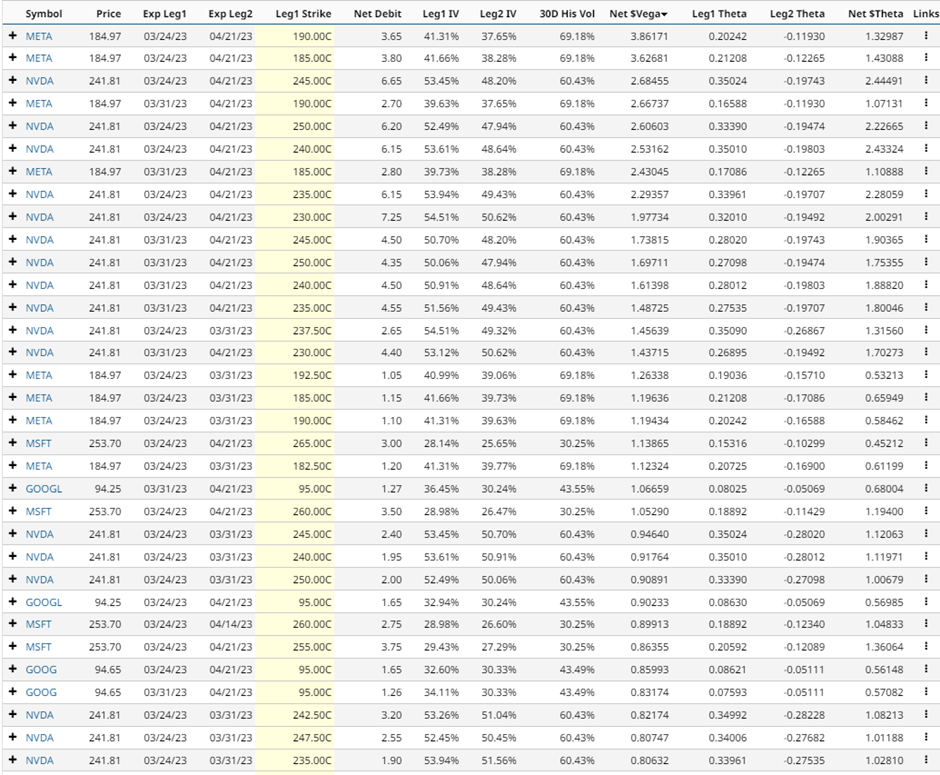
The screener shows some interesting calendar spread trades on popular stocks such as META, NVDA, GOOGL and NVDA. Let’s walk through a couple of examples.
META Neutral Calendar Spread
Let’s use the second META calendar for our first example as it is perfectly at-the-money.
With Meta Platforms stock trading at 184.97, setting up a calendar spread at 185 gives the trade a neutral outlook.
Selling the March 24 call option with a strike price of 185 and selling the 185 April 21 call will cost around $365. That is also the most the trade can lose.
The estimated maximum profit is $470, but that could vary depending on changes in implied volatility.
The idea with the trade is that if META stock remains around 185 for the next few days, the sold option will decay faster than the bought option allowing the trade to be closed for a profit.
The breakeven prices for the trade are estimated at around 174 and 199, but these can also change slightly depending on changes in implied volatility.
In terms of trade management if META broke through either 174 or 199, I would look to adjust or close the trade.
Let’s look at another example.
NVDA Neutral Calendar Spread
With Nvidia stock trading at 241.81, traders could sell the 245-strike March 24th call and buy the 245-strike April 21 call.
That net cost for the trade would be around $665 per spread, and that is the most the trade can lose.
The estimated maximum profit is $780, but that could vary depending on changes in implied volatility.
The breakeven prices for the trade are estimated at around 227 and 268, but these can also change slightly depending on changes in implied volatility.
GOOGL Neutral Calendar Spread
The last example we will look at is on GOOGL stock.
With Google stock trading at 94.25, traders could sell the 95-strike March 31st call and buy the 95-strike April 21 call.
That results in a net cost for the trade of $127 per spread, and that is the most the trade can lose.
The estimated maximum profit is $180, but that could vary depending on changes in implied volatility.
The breakeven prices for the trade are estimated at around 90.50 and 100.50 but these can also change slightly depending on changes in implied volatility.
Mitigating Risk
Thankfully, calendar spreads are risk defined trades, so they have some build in risk management. Position sizing is crucial to ensure that minimal damage is done if the trade suffers a full loss.
One way to set a stop loss for a calendar spread is close the trade if the loss is 20-30% of the premium paid.
Calendar spreads can also contain early assignment risk, so be mindful of that if the stock breaks through the short strike and it’s getting close to expiry.
If you have any questions, feel free to reach out to me by email or on Twitter.
Please remember that options are risky, and investors can lose 100% of their investment.
This article is for education purposes only and not a trade recommendation. Remember to always do your own due diligence and consult your financial advisor before making any investment decisions.
More Stock Market News from Barchart
- There's A Gold Rush For “Gene Therapy”
- Stocks Mixed as Powell Softens His Tone
- S&P 500: Red Light-Green Light Study for Stock Shopping
- It’s Time Elon Musk Plans a Holiday With Booking Holdings
On the date of publication, Gavin McMaster did not have (either directly or indirectly) positions in any of the securities mentioned in this article. All information and data in this article is solely for informational purposes. For more information please view the Barchart Disclosure Policy here.

/Sign%20of%20Intel%20at%20entrance%20%20by%20michaelmond.jpeg)

/NVIDIA%20Corp%20logo%20outside%20building-by%20BING-JHEN_HONG%20via%20iStock.jpg)