




Selling cash secured puts on stocks an investor is happy to take ownership of is a great way to generate some extra income. A cash-secured put involves writing an at-the-money or out-of-the-money put option and simultaneously setting aside enough cash to buy the stock. The goal is to either have the put expire worthless and keep the premium, or to be assigned and acquire the stock below the current price. It’s important that anyone selling puts understands that they may be assigned 100 shares at the strike price.
Why Trade Cash Secured Puts?
Selling cash secured puts is a bullish trade but slightly less bullish than outright stock ownership. If the investor was strongly bullish, they would prefer to look at strategies like a long call, a bull call spread, or a poor man’s covered call. Investors would sell a put on a stock they think will stay flat, rise slightly, or at worst not drop too much.
Cash secured put sellers set aside enough capital to purchase the shares and are happy to take ownership of the stock if called upon to do so by the put buyer. Naked put sellers, on the other hand, have no intention of taking ownership of the stock and are purely looking to generate premium from option selling strategies.
The more bullish the cash secure put investor is, the closer they should sell the put to the current stock price. This will generate the most amount of premium and also increase the chances of the put being assigned. Selling deep-out-of-the-money puts generates the smallest amount of premium and is less likely to see the put assigned.
JNJ Cash Secure Put Example
Johnson & Johnson (JNJ) is currently the most oversold stock in the Dow Jones Industrials Index ($DOWI) (DIA) according to the relative strength indicator.
Yesterday, with JNJ trading at 153.26, the May put option with a strike price of 145 was trading around $2.20. Traders selling this put would receive $220 in option premium. In return for receiving this premium, they have an obligation to buy 100 shares of JNJ for $145. By May 19, if JNJ is trading for $140, or $120, or even $80, the put seller still has to buy 100 shares at $145.
But, if JNJ is trading above $145, the put option expires worthless, and the trader keeps the $220 option premium. The net capital at risk is equal to the strike price of 145, less the 2.20 in option premium. So, if assigned, the net cost basis will be $142.80. That’s not bad for a stock currently trading at $153.26. That’s a 6.83% discount from the price it was trading yesterday.
If JNJ stays above $145, the return on capital is:
$220 / $14,280 = 1.54% in 79 days, which works out to 7.03% annualized.
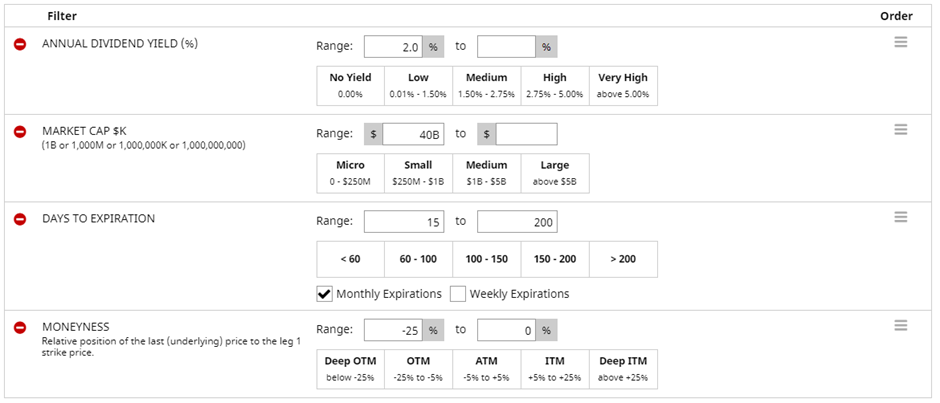
Either the put seller achieves a 7.03% annualized return or gets to buy a high yielding stock for a 6.83% discount. You can find other ideas like this using the Naked Put Screener. Below you can see some parameters that you might consider for running this screener. Feel free to tweak them as you see fit.
Company Details
The Barchart Technical Opinion rating is a 100% Sell and ranks in the Top 1% of all short term signal directions.
Long term indicators fully support a continuation of the trend.
The market is in highly oversold territory. Beware of a trend reversal.
Of 17 analysts covering JNJ, 7 have a Strong Buy rating, 1 has a Moderate Buy and 9 have a Hold rating.
Johnson & Johnson's biggest strength is its diversified business model. It operates through pharmaceuticals, medical devices and consumer products divisions. Its diversification helps it to withstand economic cycles more effectively. J&J has one of the largest research and development (R&D) budget among pharma companies. J&J's worldwide business is divided into three segments: Pharmaceutical, Medical Devices and Consumer. The company has several drugs covering a broad range of areas such as neuroscience, cardiovascular & metabolism, immunology, oncology, pulmonary hypertension and infectious diseases and vaccines. The Medical Devices Segment offers products in the orthopedics, surgery, interventional solutions and vision markets. The Consumer Segment segment includes a broad range of products covering the areas of baby care, beauty/skin health, oral care, wound care and womens' health care, as well as over-the-counter (OTC) pharmaceutical products.
Summary
While this type of strategy requires a lot of capital, it is a great way to generate an income from stocks you want to own. If you end up being assigned, you can sit back and collect the nice 2.90% dividend on offer from JNJ. You can do this on other stocks as well, but remember to start small until you understand a bit more about how this all works.
Risk averse traders might consider buying an out-of-the-money put to protect the downside.
If you have any questions, feel free to reach out to me by email or on Twitter.
Please remember that options are risky, and investors can lose 100% of their investment.
This article is for education purposes only and not a trade recommendation. Remember to always do your own due diligence and consult your financial advisor before making any investment decisions.
More Stock Market News from Barchart
- Stocks Fall Back on Concern Global Central Banks Will Keep Raising Rates
- Investors Are Still Keen on Microsoft Stock, Making Short Put Plays Popular
- Airbnb’s High Valuation has Analysts Concerned
- Stocks Mixed on Weak U.S. Economic News and Higher Global Bond Yields
On the date of publication, Gavin McMaster did not have (either directly or indirectly) positions in any of the securities mentioned in this article. All information and data in this article is solely for informational purposes. For more information please view the Barchart Disclosure Policy here.

/Micron%20Technology%20Inc_%20logo%20on%20building-by%20vzphotos%20vis%20iStock.jpg)


/AI%20(artificial%20intelligence)/AI%20engineer%20working%20on%20laptop%20by%20ART%20STOCK%20CREATIVE%20via%20Shutterstock.jpg)
/A%20corporate%20office%20for%20IBM%20by%20HJBC%20via%20Adobe%20Stock.jpeg)