Editor's note: Any and all references to time frames longer than one trading day are for purposes of market context only, and not recommendations of any holding time frame. Daily rebalancing ETFs are not meant to be held unmonitored for long periods. If you don't have the resources, time or inclination to constantly monitor and manage your positions, leveraged and inverse ETFs are not for you.
Investing in the funds involves a high degree of risk. Unlike traditional ETFs, or even other leveraged and/or inverse ETFs, these leveraged and/or inverse single-stock ETFs track the price of a single stock rather than an index, eliminating the benefits of diversification. Leveraged and inverse ETFs pursue daily leveraged investment objectives, which means they are riskier than alternatives which do not use leverage. They seek daily goals and should not be expected to track the underlying stock’s performance over periods longer than one day. They are not suitable for all investors and should be utilized only by investors who understand leverage risk and who actively manage their investments. The Funds will lose money if the underlying stock’s performance is flat, and it is possible that the Bull Fund will lose money even if the underlying stock’s performance increases, and the Bear Fund will lose money even if the underlying stock’s performance decreases, over a period longer than a single day. Investing in the Funds is not equivalent to investing directly in LMT.
Key Takeaways
The Middle East shock has revived two fast-moving narratives at once: higher oil and renewed defense demand.
WTI briefly spiked to nearly $120, putting energy stocks and inflation-sensitive trades back in focus.
Potential trade ideas can be viewed broad to specific: energy majors, oil and gas stocks, defense names, and then Lockheed Martin itself.
The key question for traders is whether this is a durable repricing, or a headline spike that fades once the panic cools.
The “war tape” is back, and so is the market’s instinct to reach for defense and energy. Oil surged as traders priced in supply disruption risk tied to the widening U.S.-Israel-Iran conflict, with WTI briefly nearly touching $120 a barrel intraday before pulling back. That kind of move does not just hit the commodity complex—it ripples through many sectors.
For short-term traders, this sets up many different potential options. They include large-cap energy, narrow into oil and gas exploration and production stocks, aerospace and defense, and finally a single name that sits near the center of the rearmament conversation: Lockheed Martin.
Energy: The Broad Macro Expression
If crude stays elevated, integrated majors and diversified energy names may benefit from stronger commodity-linked cash flow and renewed investor attention. But the other side is just as important: if policymakers move to stabilize markets, or if the oil spike proves temporary, the energy trade can cool quickly.
Bullish Energy Catalysts
Crude shock revives sector leadership.
Inflation hedging flows can favor energy equities.
Large-cap energy often becomes the first stop in a geopolitical oil move.
Bearish Energy Catalysts
Government intervention could cap the move.
A de-escalation headline could hit oil fast.
Higher energy prices can also hurt broader risk appetite.
Direxion Daily Energy Bull 2X ETF (Ticker: ERX) seeks daily investment results, before fees and expenses, of 200% of the performance of the Energy Select Sector Index*. Direxion Daily Energy Bear 2X ETF (Ticker: ERY) seeks daily investment results, before fees and expenses, of 200% of the inverse (or opposite), of the performance of the Energy Select Sector Index.
Oil Stocks: A Higher-Beta Equity Version Of The Crude Story
When crude jumps, oil and gas exploration and production (E&P) stocks often join in. It’s just important to remember that the companies’ stocks are not the same thing as trading oil itself as a commodity. E&P equities can amplify the oil narrative, but they also carry company-level operating and balance-sheet sensitivities. When oil reverses, they can unwind just as quickly.
Bullish Oil-Stock Catalysts
Higher crude can quickly improve revenue expectations for E&P names.
E&P names may move more aggressively than broad energy.
Supply-disruption fears keep the group in the headlines.
Bearish Oil-Stock Catalysts
These are equities, not barrels—execution and cost pressures still matter.
A fast oil reversal can hit E&P stocks harder than integrated energy.
Crowded momentum can create violent pullbacks.
Direxion Daily S&P Oil & Gas Exp. & Prod. Bull 2X ETF (Ticker: GUSH) seeks daily investment results, before fees and expenses, of 200% of the performance of the S&P Oil & Gas Exploration & Production Select Industry Index*. Direxion Daily S&P Oil & Gas Exp. & Prod. Bear 2X ETF (Ticker: DRIP) seeks daily investment results, before fees and expenses, of 200% of the inverse (or opposite), of the performance of the S&P Oil & Gas Exploration & Production Select Industry Index.
Aerospace And Defense: The Sector-Level Security Trade
Defense is the other obvious branch of this story. Recent reports have focused on the White House pressing major contractors to boost production after U.S. strikes on Iran drew down munitions stockpiles.
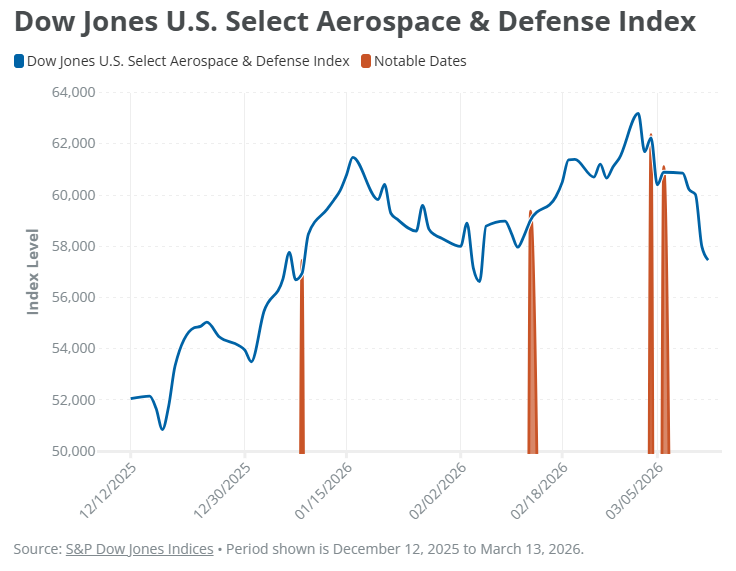
The performance data quoted represents past performance. Past performance does not guarantee future results. One cannot invest directly in an index.
Bullish Defense Catalysts
Stockpile replenishment can support production visibility.
Heightened geopolitical risk can keep the sector bid.
Budget and procurement urgency may outlast the immediate news cycle.
Bearish Defense Catalysts
Policy and contracting headlines can be uneven.
Strong runs can leave little room for disappointment.
A cooling conflict narrative can take urgency out of the trade.
Direxion Daily Aerospace & Defense Bull 3X ETF (Ticker: DFEN) seeks daily investment results, before fees and expenses, of 300% of the performance of the Dow Jones U.S. Select Aerospace & Defense Index*.
Lockheed Martin: The Specific Name Traders May Circle
Then there is Lockheed itself. Reuters reported in January that the company gave an upbeat 2026 outlook and struck a profit-sharing deal with the U.S. tied to air-defense missile production. That makes LMT a more specific way to express the same broad defense thesis, but with single-name upside and downside around execution, contracts, and expectations.
Bullish Lockheed Catalysts
Missile-demand visibility remains strong.
Production expansion supports the replenishment theme.
Single-name focus can attract traders looking for a cleaner defense expression.
Bearish Lockheed Catalysts
Expectations may already reflect a lot of good news.
Program timing and government negotiations can introduce friction.
Single-stock trades can react more sharply to company-specific headlines.
Direxion Daily LMT Bull 2X ETF (Ticker: LMTL) seeks daily investment results, before fees and expenses, of 200% of the performance of the common shares of Lockheed Martin Corporation. Direxion Daily LMT Bear 1X ETF (Ticker: LMTS) seeks daily investment results, before fees and expenses, of 100% of the inverse (or opposite), of the performance of the common shares of Lockheed Martin Corporation (Ticker: LMT).
What Traders Are Watching Next
Whether oil can hold onto panic-driven gains after WTI’s near-$120 spike.
Whether the market keeps favoring broad energy, or rotates harder into E&P stocks.
Whether defense replenishment headlines turn into clearer production and contract follow-through.
Whether Lockheed-specific news starts to outperform the broader defense basket.
*Definitions and Index Descriptions
An investor should carefully consider a Fund’s investment objective, risks, charges, and expenses before investing. A Fund’s prospectus and summary prospectus contain this and other information about the Direxion Shares. To obtain a Fund’s prospectus and summary prospectus call 866-476-7523 or visit our website at direxion.com. A Fund’s prospectus and summary prospectus should be read carefully before investing.
The Energy Select Sector Index (IXETR) is provided by S&P Dow Jones Indices and includes domestic companies from the energy sector which includes the following industries: oil, gas and consumable fuels; and energy equipment and services.
The S&P Oil & Gas Exploration & Production Select Industry Index (SPSIOPTR) is provided by Standard & Poor’s Index Provider and includes domestic companies from the oil and gas exploration and production sub-industry. The Index is a modified equal-weighted index that is designed to measure the performance of a sub-industry or group of sub-industries determined based on the Global Industry Classification Standards (GICS).
The Dow Jones U.S. Select Aerospace & Defense Index (DJSASDT) is provided by S&P Dow Jones Indices LLC (the “Index Provider”). The Index attempts to measure the performance of the aerospace and defense industry of the U.S. equity market. The Index Provider selects the stocks comprising the Index from the aerospace and defense sector on the basis of the float-adjusted, market capitalization-weight of each constituent. Aerospace companies include manufacturers, assemblers and distributors of aircraft and aircraft parts. Defense companies include producers of components and equipment for the defense industry, such as military aircraft, radar equipment and weapons.
One cannot invest directly in an index.
The “Energy Select Sector Index” is a product of S&P Dow Jones Indices LLC (“SPDJI”), and has been licensed for use by Rafferty Asset Management, LLC (“Rafferty”). Standard & Poor’s® and S&P® are registered trademarks of Standard & Poor’s Financial Services LLC (“S&P”); Dow Jones® is a registered trademark of Dow Jones Trademark Holdings LLC (“Dow Jones”); and these trademarks have been licensed for use by SPDJI and sublicensed for certain purposes by Rafferty. Rafferty’s ETFs are not sponsored, endorsed, sold or promoted by SPDJI, Dow Jones, S&P, their respective affiliates and none of such parties make any representation regarding the advisability of investing in such product(s) nor do they have any liability for any errors, omissions, or interruptions of the Energy Select Sector Index.
The “S&P Oil & Gas Exploration & Production Select Industry Index” is a product of S&P Dow Jones Indices LLC (“SPDJI”), and has been licensed for use by Rafferty Asset Management, LLC (“Rafferty”). Standard & Poor’s® and S&P® are registered trademarks of Standard & Poor’s Financial Services LLC (“S&P”); Dow Jones® is a registered trademark of Dow Jones Trademark Holdings LLC (“Dow Jones”); and these trademarks have been licensed for use by SPDJI and sublicensed for certain purposes by Rafferty. Rafferty’s ETFs are not sponsored, endorsed, sold or promoted by SPDJI, Dow Jones, S&P, their respective affiliates and none of such parties make any representation regarding the advisability of investing in such product(s) nor do they have any liability for any errors, omissions, or interruptions of the S&P Oil & Gas Exploration & Production Select Industry Index.
The “Dow Jones U.S. Select Aerospace & Defense Index” is a product of S&P Dow Jones Indices LLC (“SPDJI”), and has been licensed for use by Rafferty Asset Management, LLC (“Rafferty”). Standard & Poor’s® and S&P® are registered trademarks of Standard & Poor’s Financial Services LLC (“S&P”); Dow Jones® is a registered trademark of Dow Jones Trademark Holdings LLC (“Dow Jones”); and these trademarks have been licensed for use by SPDJI and sublicensed for certain purposes by Rafferty. Rafferty’s ETFs are not sponsored, endorsed, sold or promoted by SPDJI, Dow Jones, S&P, their respective affiliates and none of such parties make any representation regarding the advisability of investing in such product(s) nor do they have any liability for any errors, omissions, or interruptions of the Dow Jones U.S. Select Aerospace & Defense Index.
Direxion Shares Risks – An investment in a Fund involves risk, including the possible loss of principal. A Fund is non-diversified and includes risks associated with the Fund’s concentrating its investments in a particular industry, sector, or geography which can increase volatility. The use of derivatives such as futures contracts and swaps are subject to market risks that may cause prices to fluctuate over time.
Leverage Risk – Each Fund obtains investment exposure in excess of its net assets by utilizing leverage and may lose more money in market conditions that are adverse to its investment objective than a fund that does not utilize leverage. A total loss may occur in a single day. Leverage will also have the effect of magnifying any differences in the Fund’s correlation or inverse correlation with the Index and may increase the volatility of the Fund.
Daily Index Correlation Risk – A number of factors may affect the Bull Fund’s ability to achieve a high degree of correlation with the Index and therefore achieve its daily leveraged investment objective. The Bull Fund’s exposure to the Index is impacted by the Index’s movement. Because of this, it is unlikely that the Bull Fund will be perfectly exposed to the Index at the end of each day. The possibility of the Bull Fund being materially over- or under-exposed to the Index increases on days when the Index is volatile near the close of the trading day.
Daily Inverse Index Correlation Risk – A number of factors may affect the Bear Fund’s ability to achieve a high degree of inverse correlation with the Index and therefore achieve its daily inverse leveraged investment objective. The Bear Fund’s exposure to the Index is impacted by the Index’s movement. Because of this, it is unlikely that the Bear Fund will be perfectly exposed to the Index at the end of each day. The possibility of the Bear Fund being materially over- or under-exposed to the Index increases on days when the Index is volatile near the close of the trading day.
Energy Sector Risk – Energy sector securities may be adversely impacted by changes in the levels and volatility of global energy prices, global supply and demand, and capital expenditures on the exploration and production of energy sources.
Oil and Gas Industry Risk – Companies in the oil and gas industries are affected by supply and demand both for their specific product or services and for energy products in general.
Aerospace and Defense Industry Risk — The aerospace and defense industry can be significantly affected by government regulation and spending policies because companies involved in this industry rely, to a significant extent, on government demand for their products and services.
Industrials Sector Risk — Stock prices of issuers in the industrials sector are affected by supply and demand both for their specific product or service and for industrials sector products in general.
Lockheed Martin Corporation Investing Risk – LMT faces risks associated with: dependance on U.S. Government contracts; the F-35 program which is approximately 26% of the company’s net sales is reliant on continued government funding; extensive procurement laws and regulations; variability in current contracts and programs as well as performance and ability to control costs; more audits due to government contracts; heavy dependance on suppliers and subcontractors; reliant on development of new technology; public health events; international sales pose different economic, regulatory and competitive risks; among other risks.
Additional risks of each Fund include Effects of Compounding and Market Volatility Risk, Derivatives Risk, Counterparty Risk, Rebalancing Risk, Intra-Day Investment Risk, Concentration Risk, Market Risk, Non-Affiliation Risk, Security Volatility Risk and Cash Transaction Risk. Additionally, for the Direxion Daily LMT Bear 1X ETF, Shorting or Inverse Risk. Please see the summary and full prospectuses for a more complete description of these and other risks of a Fund.
Distributor: ALPS Distributors, Inc.



/A%20photo%20of%20a%20Sandisk%20Solid%20State%20Drive%20by%20Top%20Popular%20Vector%20by%20Shutterstock.jpg)