Editor's note: Any and all references to time frames longer than one trading day are for purposes of market context only, and not recommendations of any holding time frame. Daily rebalancing ETFs are not meant to be held unmonitored for long periods. If you don't have the resources, time or inclination to constantly monitor and manage your positions, leveraged and inverse ETFs are not for you.
Investing in the funds involves a high degree of risk. Unlike traditional ETFs, or even other leveraged and/or inverse ETFs, these leveraged and/or inverse single-stock ETFs track the price of a single stock rather than an index, eliminating the benefits of diversification. Leveraged and inverse ETFs pursue daily leveraged investment objectives, which means they are riskier than alternatives which do not use leverage. They seek daily goals and should not be expected to track the underlying stock’s performance over periods longer than one day. They are not suitable for all investors and should be utilized only by investors who understand leverage risk and who actively manage their investments. The Funds will lose money if the underlying stock’s performance is flat, and it is possible that the Bull Fund will lose money even if the underlying stock’s performance increases, and the Bear Fund will lose money even if the underlying stock’s performance decreases, over a period longer than a single day. Investing in the Funds is not equivalent to investing directly in TSLA or NFLX.
Key Takeaways
Tesla’s pullback reflects rising expectations risk, with autonomy timelines and growth clarity now critical to sentiment.
Netflix’s rebound is driven by ads and subscriber strength, but sustainability depends on margins and content ROI.
Both stocks face near-term catalyst risk, with upcoming earnings likely to define direction.
Market is demanding more than “good” results, meaning even solid execution may not be enough to sustain momentum.
Shares of Tesla, Inc. (Ticker: TSLA) have continued their correction since the all-time high of 498.83 from December 22, 2025. There have been some notable developments on the “Million Mile Battery” front, yet it hasn’t been enough to turn the tide in favor of the bulls.
EV and Energy Leadership
Tesla remains the undisputed leader in electric vehicles, energy storage, and autonomous driving technology, powered by its vertical integration, Gigafactory network, and full self-driving (FSD) software that seamlessly integrates with vehicle hardware, energy products, and future robotics. The company maintains a vast installed base of millions of vehicles and rapidly growing energy deployments worldwide, fostering exceptionally high switching costs through its Supercharger network, over-the-air updates, and ecosystem of sustainable energy solutions.
This ecosystem propels growth across automotive, energy storage, and services, delivering resilient revenue with improving margins in key segments and strong free cash flow generation aligned with the global transition to EVs, renewables, and autonomy.
Recent results showcase this prowess: Revenue reached $24.90 billion in Q4 (above estimates) with Earnings per Share (EPS)* of $0.50 (beating consensus), supported by record energy storage deployments and continued FSD adoption momentum. This underscores improving operational efficiency and future visibility from energy ramps and autonomy without overdependence on any single vehicle model.
Tesla is set up for sustained revenue growth, with potential boosts from next-generation vehicle platforms, Megapack scaling, Robotaxi deployment, and Optimus robotics. Analysts emphasize strong free cash flow, operational leverage, and better cycle resilience than traditional auto or tech peers.
Traders that the recent decline as a dip buying opportunity may find a trade with Direxion’s Daily Tesla Bull 2X ETF (Ticker: TSLL), which seeks daily investment results, before fees and expenses, of 200% of the performance of Tesla, Inc. common stock (Ticker: TSLA).
Below is a daily chart of TSLA as of March 26, 2026.
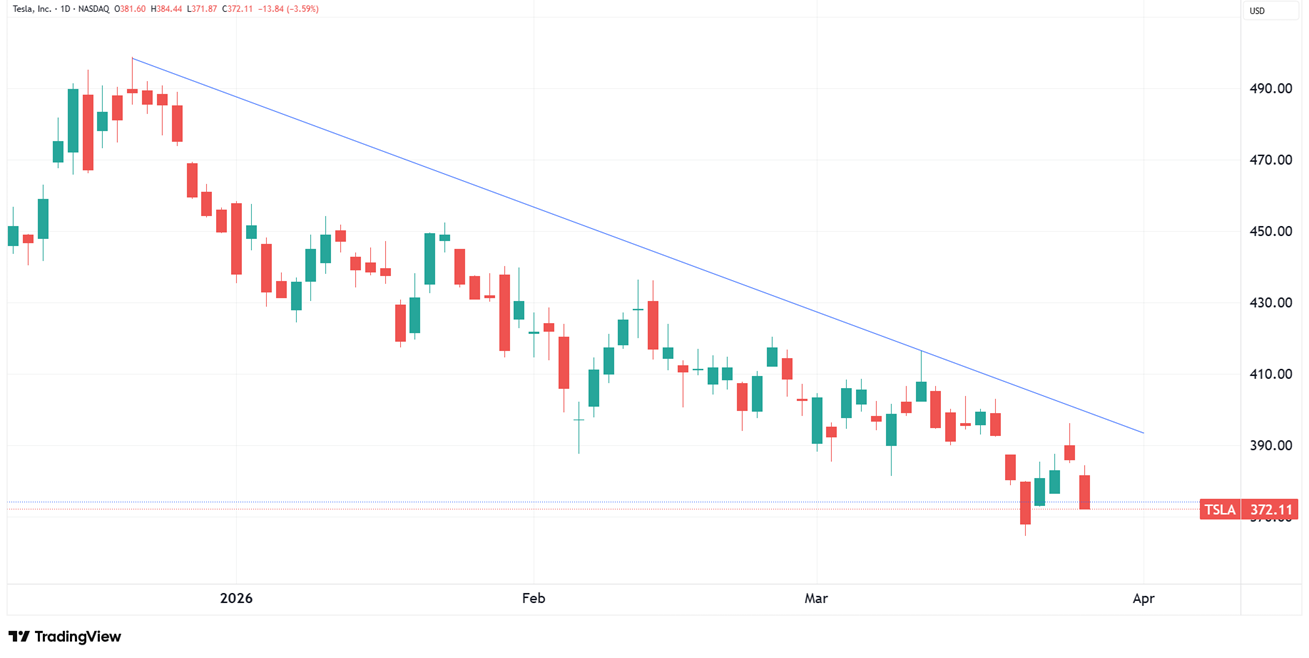
Source: StockCharts.com
Candlestick charts display the high and low (the stick) and the open and close price (the body) of a security for a specific period. If the body is filled, it means the close was lower than the open. If the body is empty, it means the close was higher than the open.
The performance data quoted represents past performance. Past performance does not guarantee future results.
Autonomy Delay Overhang or Legitimate Hesitations?
The skeptical outlook on Tesla highlights worries over production and margin pressures, premium valuations (typically high 30s to low 40s forward P/E*), and exposure to economic headwinds like consumer spending moderation, intensifying EV competition, or regulatory hurdles for full self-driving.
Despite a solid earnings report, the stock has not sustained a clear uptrend at all since its peak in 2025. The market needs more than solid execution, and wants transformative catalysts beyond current trends.
Risks involve potential vehicle demand slowdowns or saturation in key markets, fierce competition from legacy automakers and Chinese EV players, or if autonomy (Robotaxi/Optimus) timelines slip from projected ramps.
Any guidance slip or external hit could deflate multiples rapidly. Traders need to watch the next earnings report (likely April 21for Q1). Positive updates on vehicle deliveries, energy storage growth, FSD adoption, and shareholder returns could fuel upside, while muted signals or cost pressures might spur downside.
If results fail to deliver, Direxion’s Daily TSLA Bear 1X ETF (Ticker: TSLS), which seeks daily investment results, before fees and expenses, of 100% of the inverse performance in common shares of Tesla, Inc. (Ticker: TSLA) could see a bid.
Netflix Looks for Support Before Earnings
Following a sharp selloff in the back-half of 2025, shares of Netflix, Inc. (Ticker: NFLX) have staged a notable comeback since the low of 75.01 on February 23. Is this the start of a new bull trend? Or, was the powerful rally just a dead-cat bounce before the downside woes continue?
Subscription Growth is Key
Netflix remains the key player in global streaming entertainment, powered by its expansive content library, AI-enhanced recommendations, and expanding ad-supported tier that seamlessly integrates across devices and platforms. The company maintains a vast installed base of over 300 million paid memberships worldwide, fostering exceptionally high engagement and switching costs through exclusive originals and personalized viewing experiences.
This ecosystem propels robust growth in revenue, which now blends subscriptions with accelerating advertising and delivers consistent double-digit increases with improving operating margins. Subscriptions and ads offer predictable, high-quality recurring earnings, less susceptible to one-off content bets and more aligned with the ongoing shift to on-demand entertainment.
Recent results showcase this prowess: Revenue surged to $12.05 billion in Q4 (up approximately 17% year-over-year), driven by solid subscriber additions and the early ramp of the ad tier. The company also projected ad revenue roughly doubling in 2026, underscoring massive future visibility and monetization potential without overdependence on traditional subscriber metrics alone.
This base and advertising momentum sets Netflix up for sustained revenue growth, with potential boosts from global membership expansion, pricing adjustments, and further ad-tier penetration.
Traders that think the latest bullish momentum can continue may find a trade with Direxion’s Daily NFLX Bull 2X ETF (Ticker: NFXL), which seeks daily investment results, before fees and expenses, of 200% of the performance of Netflix, Inc. common stock (Ticker: NFLX).
Below is a daily chart of NFLX as of March 26, 2026.
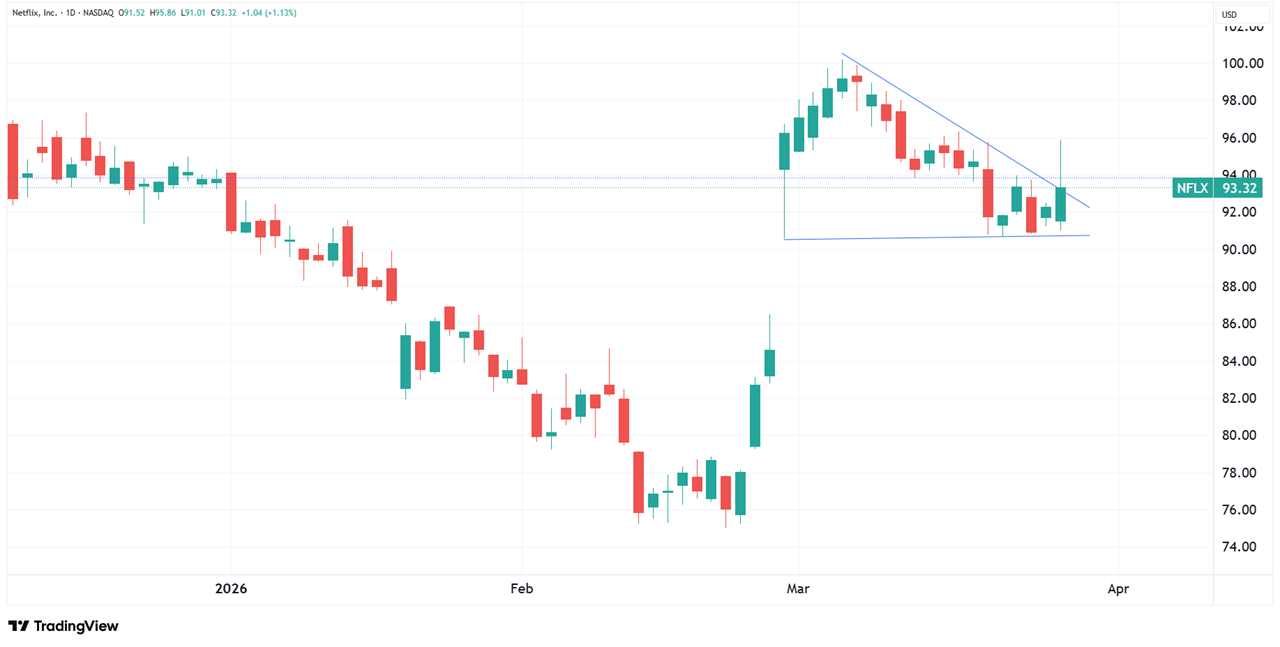
Source: TradingView.com
Candlestick charts display the high and low (the stick) and the open and close price (the body) of a security for a specific period. If the body is filled, it means the close was lower than the open. If the body is empty, it means the close was higher than the open.
The performance data quoted represents past performance. Past performance does not guarantee future results.
Content Cost Overhang?
The bearish view on Netflix concerns worries over escalating content production and acquisition costs, premium valuations (typically in the high 30s forward P/E), and exposure to economic headwinds like consumer spending moderation or intensifying competition.
Despite a solid earnings report, the stock has not sustained a clear uptrend at all since its peak in 2025. The market demands more than solid execution, seeking transformative catalysts beyond current trends.
Risks involve potential subscriber growth slowdowns or saturation in mature markets, fierce competition from Disney+, Amazon Prime Video, or other streamers, or if ad revenue growth tapers from projected highs. Any guidance slip or external hit could deflate multiples rapidly.
Traders need to monitor the upcoming earnings report (likely April 16 for Q1). Positive updates on membership growth, ad-tier traction, content slate strength, and shareholder returns could fuel upside, while muted signals or rising cost pressures might spur downside.
If bearish regain control, Direxion’s Daily NFLX Bear 1X ETF (Ticker: NFXS), which seeks daily investment results, before fees and expenses, of 100% of the inverse performance in common shares of Netflix, Inc. (Ticker: NFLX) could see a rally.
*Definitions and Index Descriptions
An investor should carefully consider a Fund’s investment objective, risks, charges, and expenses before investing. A Fund’s prospectus and summary prospectus contain this and other information about the Direxion Shares. To obtain a Fund’s prospectus and summary prospectus call 866-476-7523 or visit our website at direxion.com. A Fund’s prospectus and summary prospectus should be read carefully before investing.
Leverage Risk – The Bull Fund obtains investment exposure in excess of its net assets by utilizing leverage and may lose more money in market conditions that are adverse to its investment objective than a fund that does not utilize leverage. A total loss may occur in a single day. Leverage will also have the effect of magnifying any differences in the Fund’s correlation with TSLA or NFLX and may increase the volatility of the Bull Fund.
Daily Correlation Risk - A number of factors may affect the Bull Fund’s ability to achieve a high degree of correlation with TSLA or NFLX and therefore achieve its daily leveraged investment objective. The Bull Fund’s exposure to TSLA or NFLX is impacted by TSLA or NFLX's movement. Because of this, it is unlikely that the Bull Fund will be perfectly exposed to TSLA or NFLX at the end of each day. The possibility of the Bull Fund being materially over- or under-exposed to TSLA or NFLX increases on days when TSLA or NFLX is volatile near the close of the trading day.
Daily Inverse Correlation Risk - A number of factors may affect the Bear Fund’s ability to achieve a high degree of inverse correlation with TSLA or NFLX and therefore achieve its daily inverse investment objective. The Bear Fund’s exposure to TSLA or NFLX is impacted by TSLA or NFLX's movement. Because of this, it is unlikely that the Bear Fund will be perfectly exposed to TSLA or NFLX at the end of each day. The possibility of the Bear Fund being materially over- or under-exposed to TSLA or NFLX increases on days when TSLA or NFLX is volatile near the close of the trading day.
Tesla, Inc. Investing Risk — Tesla, Inc. faces risks associated with future growth and success of consumers’ demand for electric vehicles; increasing competition; variability in the market for electric vehicles; potential delays in developing and launching new products; mismatches between supply and demand for the products; charging networks may be difficult to establish; product liability claims; cyberattacks; financial costs; system security and data breeches; as well as the risks related to the fact that communications from Mr. Musk to the public may significantly impact the trading price of TSLA.
Automotive Companies Risk — The automotive industry can be highly cyclical, and companies in the industry may suffer periodic operating losses. Automotive companies can be significantly affected by labor relations, fluctuating component prices and supplier disruptions.
Netflix, Inc. Investing Risk – Netflix, Inc. faces risks related to maintaining and expanding membership for its streaming services; competition in the entertainment video market; unforeseen costs or liability in connection with content that is acquired, produced, licensed and/or distributed through its service, among other risks.
Entertainment Industry Risk — Companies in the entertainment industry may be impacted by the high costs of research and development of new content and services in an effort to stay relevant in a highly competitive industry, and entertainment products may face a risk of rapid obsolescence.
Consumer Discretionary Sector Risk — Because companies in the consumer discretionary sector manufacture products and provide discretionary services directly to the consumer, the success of these companies is tied closely to the performance of the overall domestic and international economy.
Communication Services Sector Risk — The communication services sector may be dominated by a small number of companies which may lead to additional volatility in the sector. Communication services companies are particularly vulnerable to the potential obsolescence of products and services due to technological advances and the innovation of competitors.
Additional risks of each Fund include Effects of Compounding and Market Volatility Risk, Derivatives Risk, Counterparty Risk, Rebalancing Risk, Intra-Day Investment Risk, Industry Concentration Risk, Market Risk, Indirect Investment Risk, and Cash Transaction Risk. Additionally, for the Direxion Daily TSLA Bear 1X ETF and Direxion Daily NFLX Bear 1X ETF, Shorting or Inverse Risk. Please see the summary and full prospectuses for a more complete description of these and other risks of a Fund.
Distributor: ALPS Distributors, Inc.



/A%20photo%20of%20a%20Sandisk%20Solid%20State%20Drive%20by%20Top%20Popular%20Vector%20by%20Shutterstock.jpg)