






Dual Edge Research publishes two powerful newsletters that work great individually — and even better together. The Bull Strangle Newsletter focuses on stocks and options, combining stock ownership with premium-selling strategies to generate consistent income and market-beating returns. The Smart Spreads Newsletter specializes in seasonal commodity futures spreads, offering a diversified approach with low correlation to equities. Together, they deliver a complete investment perspective — one focused on income, the other on diversification — all under one simple subscription.
Introduction
One of the most misunderstood aspects of options income trading is where the edge actually comes from. Most traders focus on structure—what to sell, how far out-of-the-money, and which expiration to use. Those decisions matter, but they are not what ultimately drives consistency. The real edge begins earlier. It starts with the stock selection.
The Role of the Watch List
In the Bull Strangle framework, the watch list is not just a list of tradable stocks. It is a pre-filtered universe built to eliminate weak candidates before capital is ever deployed. The focus is simple: identify stocks with stable behavior, clear levels, liquid options, and no near-term event risk. This matters because underperformance is rarely driven by outright losing trades—it comes from trades that win, but don’t pay, or carry unnecessary downside risk. The watch list solves that problem in advance.
What the Watch List is Designed to Capture
At its core, the process looks for stocks in one of two conditions: stability within a defined range, or controlled transitions where risk can still be managed. Instead of forcing a strategy onto any stock, the goal is to find stocks that already fit the strategy.
Example 1: NetApp (NTAP) — At a Decision Point
NetApp is a clean example of a stock approaching a key inflection point. After a prolonged downtrend defined by lower highs, the stock has stabilized and begun to recover, reclaiming its short-term moving averages. It is now pressing into a major resistance zone between roughly $104 and $108—an area defined by both the 100- and 200-day averages and a descending trendline.
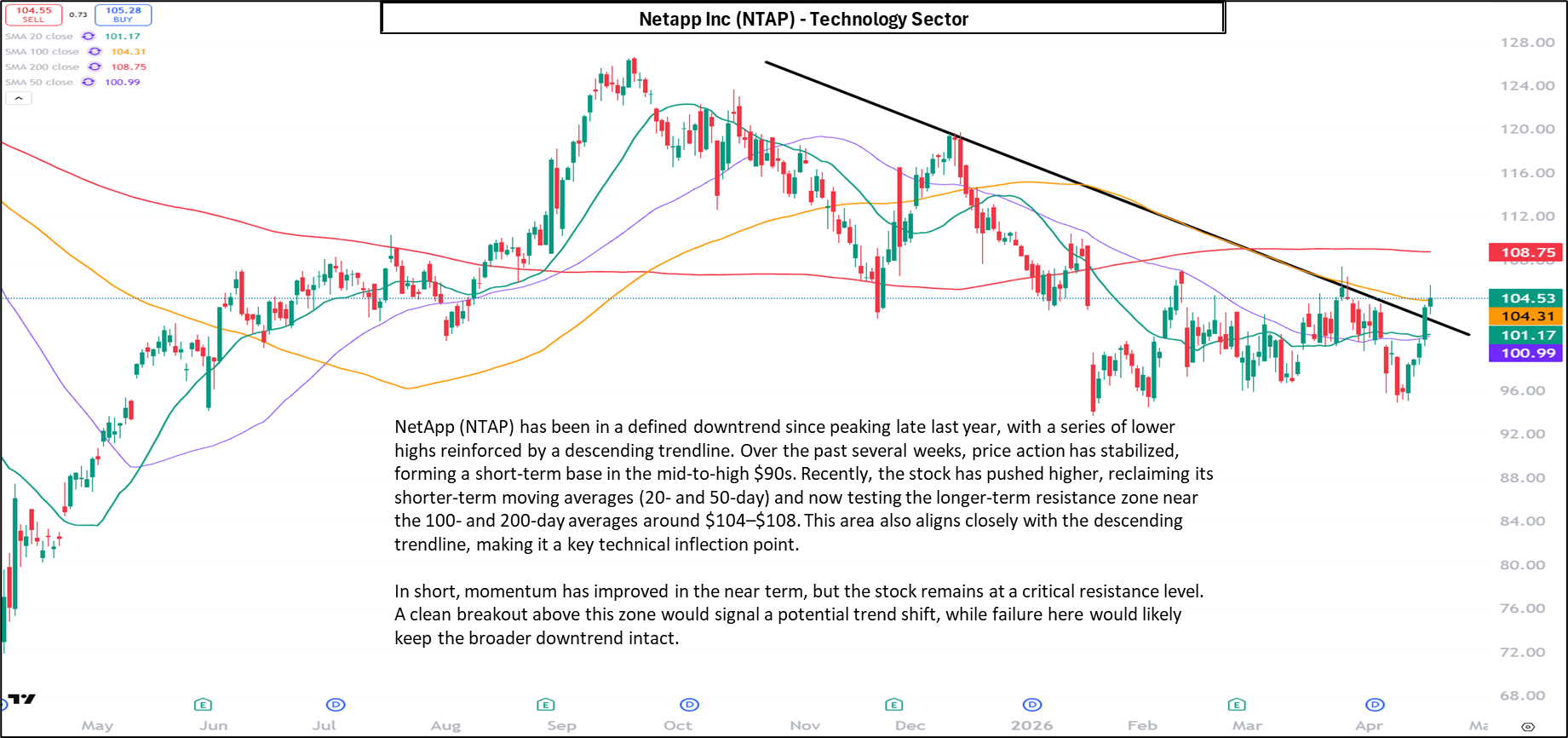
This creates a well-defined setup. Momentum has improved, but the broader trend has not yet reversed. This is not about predicting a breakout. It is about recognizing that price is testing a boundary. If resistance holds, the setup favors premium collection against a clearly defined ceiling. If price breaks higher, the setup changes—and the stock can be reassessed before entry.
Example 2: ZIM Integrated Shipping (ZIM) — Stability After Volatility
ZIM reflects a different type of opportunity—one driven by stabilization following a headline event. After the proposed acquisition by Hapag-Lloyd, with an indicated offer price of $35 per share, the stock surged toward $30 before pulling back into the $25–$27 range. Since then, price action has tightened, with support forming near $26. This behavior suggests the market is no longer reacting to the headline but instead pricing in time and uncertainty around the deal's completion.
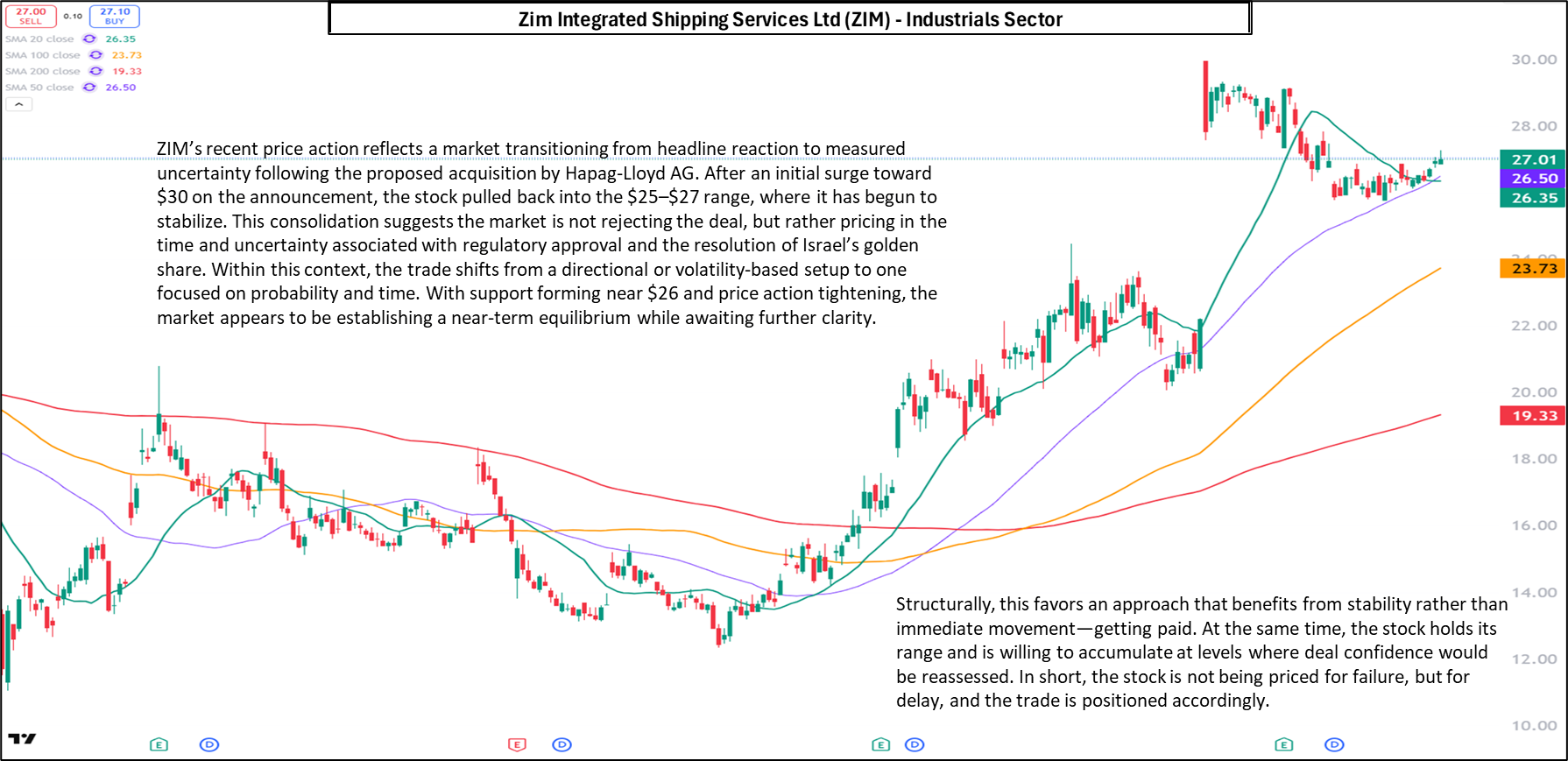
In this context, the trade shifts away from direction and toward probability. The structure favors owning the stock while getting paid to wait—buying shares, selling the $26 put to generate additional premium, and notably not selling a call. With the potential upside tied to a $35 takeout price, capping that upside would run counter to the structure of the opportunity.
The Bigger Picture: Selection Before Structure
These examples highlight the core idea. NTAP is testing resistance within a broader downtrend. ZIM is stabilizing following a period of volatility. Different setups, but both share the same structural characteristics: defined levels, controlled behavior, and measurable risk.
That is what the watch list is designed to identify. Because once selection is correct, the options structure becomes a tool—not a crutch.
Selection is the Edge
The Bull Strangle Newsletter applies this same watch list discipline each week—focusing on stock selection first, then structuring trades around stability, probability, and time decay. The result is a repeatable process designed to generate consistent income while keeping risk defined and controlled.
More Information
Now you can get two powerful newsletters — for one simple price!
- For stocks and options, the Bull Strangle Newsletter shows you how to combine stock ownership with dual option selling — a disciplined strategy that has consistently outperformed the S&P 500.
- For commodity futures, the Smart Spreads Newsletter focuses on seasonal commodity spreads — a proven, low-correlation approach that thrives in all types of markets.
Each newsletter is designed to deliver consistent income on its own — but when used together, they create a complete, diversified trading approach that works in any market environment.
Visit BullStrangle.com to subscribe for just $1 for the first month.
For a video overview of the Bull Strangle Newsletter
For a video overview of the Smart Spreads Newsletter
Darren Carlat
Dual Edge Research
(214) 636-3133
DualEdgeResearch@gamil.com
Disclaimer
This information is for informational purposes only and should not be considered as investment advice. Past performance is not indicative of future results, and all investments carry inherent risk. Consult with a financial advisor before making any investment decisions.



/AI%20(artificial%20intelligence)/Ai%20chip%20by%20Quality%20Stock%20Arts%20via%20Shutterstock.jpg)

/A%20close-up%20of%20the%20Broadcom%20logo%20on%20a%20smartphone%20by%20Timon%20via%20Adobe%20Stock.jpeg)