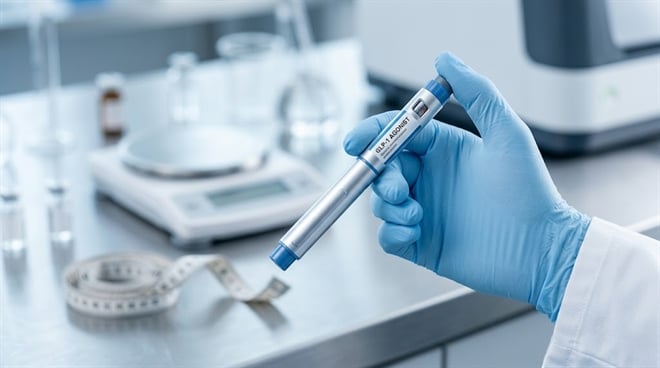
Weight loss drugs are big business, with the GLP-1 receptor agonist market expected to nearly triple in size to $185 billion by 2033, a compound annual growth rate of about 12.4%. Although increasingly a global medical phenomenon, the bulk of the market still exists in the United States, and domestic investors can get in on the action by targeting companies that manufacture these powerful drugs.
It's a mistake to assume that all sales of GLP-1 drugs will be limited to the major products Ozempic or Wegovy, both manufactured by pharma giant Novo Nordisk A/S (NYSE: NVO). The demand in this relatively new space is so great that a growing number of alternatives are quickly emerging, despite the seeming dominance of a few major players. Below, we'll look at a standalone, lesser-known biotech developer with a promising alternative in the works, as well as two exchange-traded funds (ETFs) that can give broad and diversified exposure to the whole industry at once.
A Pivot Toward GLP-1 Drugs Could Be Transformational for Structure Therapeutics
Structure Therapeutics (NASDAQ: GPCR) is a biotechnology company developing drugs focused on G protein-coupled receptors, or GPCRs. The firm has traditionally targeted new treatments for metabolic and inflammatory diseases like fibrosis or nonalcoholic steatohepatitis.
The company has more recently followed the trend toward GLP-1 drugs as well, and its aleniglipron has recently demonstrated 16.3% weight loss, adjusted for certain trial factors, and could beat out some competitors in terms of safety and manufacturing costs.
Though Structure is not currently profitable, it does have a solid cash position of about $1.4 billion. This should give it ample runway over the next several quarters as it continues to develop aleniglipron, with the drug candidate moving toward a critical Phase 3 trial.
Analysts have flagged Structure for its strong potential based on the promise of aleniglipron. Ratings for GPCR stock include 15 out of 18 ratings of Buy or equivalent. Shares have been hit fairly hard so far this year, declining by 20% in the midst of a challenging set of external factors, but bullishness still wins the day across Wall Street: with a consensus price target of $110, Structure's share price could more than double.
The First GLP-1 Agonist ETF Is Building a Track Record of Success
Investors should know that there is massive potential in the GLP-1 space thanks to the recent proliferation of ETFs dedicated to this investment strategy. The Roundhill GLP-1 & Weight Loss ETF (NASDAQ: OZEM) was an early leader in this space, launching in mid-2024. The fund takes a fairly focused approach, targeting about two dozen pharmaceutical companies positioned to benefit from the growth of the GLP-1 agonist industry.
Novo Nordisk and major rival Eli Lilly & Co. (NYSE: LLY) feature prominently, accounting for nearly 30% of the portfolio in total. The fund's basket is fairly broad, though, and includes a number of domestic and international names to provide substantial geographical diversification.
Crucially, the fund provides exposure not only to large companies involved in producing or selling GLP-1 therapeutics, but also to those creating other weight loss enablers and even to companies supporting the supply chain vital to production.
As an actively managed fund, OZEM has an expense ratio of 0.59%; this may be high in comparison with ETFs overall but is actually quite competitive relative to other active funds. The fund is quite niche, so it has a modest asset base of some $52 million and relatively low trading volumes. Still, it is up an impressive 45% in the last year, rewarding those investors willing to buy and hold. A modest dividend serves as an added bonus.
Another GLP-1 ETF With a Passive Approach
An alternative in the GLP-1 ETF space is the Amplify Weight Loss Drug & Treatment ETF (NYSEARCA: THNR). In many ways THNR is quite similar to OZEM: this fund also carries an annual fee of 0.59% and tracks roughly two dozen pharma names connected to the GLP-1 agonist market. It also weighs Novo Nordisk and Eli Lilly heavily, although these two companies combine to make up just around a quarter of the portfolio, so there is a bit more room in the case of THNR for access to other companies.
A big difference, though, is that THNR is not an actively managed fund. Rather, it tracks an index of companies in the GLP-1 industry. Its weighting is determined by float-adjusted market cap, and its portfolio is influenced by factors such as market cap weighting and trading volume.
While the basket is rebalanced just four times a year, some investors may find that this passive reflection of the market is more suitable for their interests than an active management approach.
On the other hand, THNR's asset base is tiny, at just $4 million, and its trading volume matches. The fund has returned about 30% in the last year—still roughly on par with the broader market, but well below OZEM.
Where Should You Invest $1,000 Right Now?
Before you make your next trade, you'll want to hear this.
MarketBeat keeps track of Wall Street's top-rated and best performing research analysts and the stocks they recommend to their clients on a daily basis.
Our team has identified the five stocks that top analysts are quietly whispering to their clients to buy now before the broader market catches on... and none of the big name stocks were on the list.
They believe these five stocks are the five best companies for investors to buy now...
The article "3 Ways to Invest in the Growing GLP-1 Weight Loss Market" first appeared on MarketBeat.

/Alphabet%20Inc_%20and%20Google%20logos%20by%20IgorGolovinov%20via%20Shutterstock.jpg)
/Technological%20process%20of%20soldering%20chip%20components%20on%20PCB%20board%20by%20I%20Viewfinder%20via%20Adobe%20Stock.jpeg)