The information and opinions expressed below are based on my analysis of price behavior and chart activity
Sign Up to receive Walsh Trading’s 1st Half of 2026 Market Outlook First Half of 2026 Outlook for the Livestock and Grain markets.
Thursday, April 16, 2026
June Live Cattle (Daily)
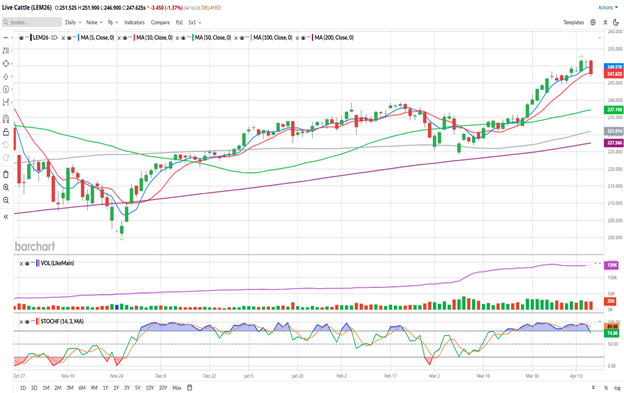
Today, June Live Cattle closed at 247.625, down 3.450 on the day. New contract, and all-time highs were set in Live Cattle futures on Tuesday this week, but the Doji on Wednesday and the bearish push today has changed the short-term outlook, in my opinion. Feeders also set new contract highs, but did not reach the all-time highs. Scroll down to see the weekly charts for both Live and Feeder Cattle.
If you look at the chart above, you may notice a few things. Today’s settlement marks the first time that June Fats have closed below the 10-day moving average (red, 248.012) in about a month, March 13th to be precise. It’s been touched/tested a few times, since then, but has held as support. The past three sessions have posted what some may consider an “Evening Star” pattern, which is usually a sign of trend reversal. New highs and a very bullish day on Tuesday, followed by a Doji or equilibrium day on Wednesday and then a bearish breakdown today which set new lows for the week. That doesn’t seem very friendly or bullish to my eye. The 5-day moving average (blue) is now offering potential resistance at 249.570. The 50-day (green, 237.190), the 100-day (grey, 231.014) and the 200-day (purple, 227.566) are all still inclined higher and offering potential support levels. Stochastics (bottom sub-graph) are starting to turn down, out of an overbought condition, as well.
The 250.000 level that was breached this week, may offer some big, fat round number resistance, in my opinion. It held as support on Wednesday, but was broken somewhat aggressively today.
Tomorrow after the close, the USDA will release this month’s Cattle on Feed report. Estimates that I’ve seen peg the entire Cattle herd at 99.5% of last year with Placements and Marketings estimates both near 93.5% of last year’s numbers. If the report comes in at roughly those numbers, it will be a ”bullish” release, as it will show the Cattle numbers in the US continue to decline. I’m coming to the idea that the numbers need to be substantially lower than estimated for the market to get a strong bullish reaction on Monday.
The US/Iran hostilities have essentially been paused, but many folks are very skeptical that the truce will hold. Stock Indexes have recovered back to the levels they were trading at before the war broke out, for the most part (the Dow and Russell still have some work to do) and Crude Oil and Fuel prices have not accelerated higher and appear to be waiting on confirmation of more war or no more war. I do have a concern that if fuel prices remain elevated for an extended period, that could offer some problems for retail beef demand. Demand (and beef imports) remain very strong, at present, but could make some folks to make different protein choices if the economy sours.
There have also been rumors of the southern border re-opening to Live (feeder) Cattle imports. The USDA did their best to quash that rumor, but the perception seems to be that the border re-opening would be bearish. In the short-term, I would agree with that because perception can rule the markets, but the re-open will be phased in stages and won’t be like flipping a switch up to 100% of what it was. In the long run, it will take some time to ramp back up to 100k+ animals every month, I think.
I’m still bullish Cattle and Beef prices. We have less cattle and more people to feed. But the charts look heavy to my eye and I think we may be due for a short-term pullback.
June Live Cattle and May Feeders (Weekly)
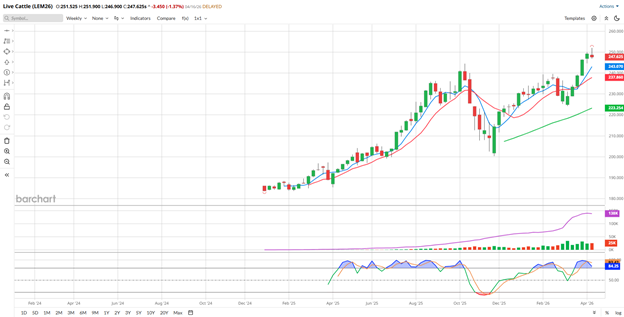
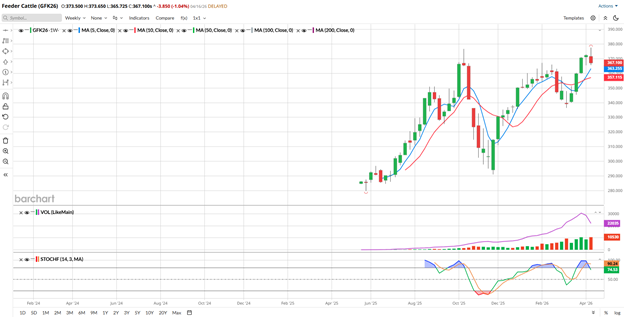
The weekly Live Cattle chart doesn’t look too alarming, to me. The weekly Feeder Chart has the potential to put in a double-top. I think this week’s bar in both Fats and Feeders look very similar to the high bar from October. Bars that post spike highs and then close on their lows are usually not bullish, in my opinion. Stay tuned to see if profit-taking and a bearish push materialize next week. The weekly moving averages are all in a bullish configuration and may offer support, should the market get weak.
Aggressive and well-margined traders that are bullish may do well to consider new entry points near the February highs, or about 10.000 lower than today’s close in Live Cattle. I think the 50-day moving average near 237.000 might be a reasonable entry target. That also, roughly, corresponds with the 10-week moving average on the weekly Live Cattle chart above. You could also get long the market with a buy stop above the 250.000 level, buying into market and price strength.
Producers or hedgers may do well to consider Put options to protect their downside risk. (I would prefer options because the overall trend is still up and margin calls on futures hedge positions are no fun for anyone) June Live Cattle options expire in 50 days. The 240 Puts settled at 3.025 today, or $1,210 per option, before your commissions/fees. May Feeder Cattle options expire in 35 days. The 355 Puts settled at 2.950, or $1,475 per option, before your commissions and fees. If the Puts work in your favor, you could then take them off and establish short futures hedges. I’m of the opinion that price weakness could last though mid-May, if the seasonal charts that I look at are any indication.
Sign Up to receive Walsh Trading’s 1st Half of 2026 Market Outlook First Half of 2026 Outlook for the Livestock and Grain markets.
If you like what you’ve read here and would like to see more like this from Walsh Trading, please Click here and sign up for our daily futures market email.
Jefferson Fosse Walsh Trading
Direct 312 957 8248 Toll Free 800 556 9411
jfosse@walshtrading.com www.walshtrading.com
Walsh Trading, Inc. is registered as a Guaranteed Introducing Broker with the Commodity Futures Trading Commission and an NFA Member.
Futures and options trading involves substantial risk and is not suitable for all investors. Therefore, individuals should carefully consider their financial condition in deciding whether to trade. Option traders should be aware that the exercise of a long option will result in a futures position. The valuation of futures and options may fluctuate, and as a result, clients may lose more than their original investment. The information contained on this site is the opinion of the writer or was obtained from sources cited within the commentary. The impact on market prices due to seasonal or market cycles and current news events may already be reflected in market prices. PAST PERFORMANCE IS NOT NECESSARILY INDICATIVE OF FUTURE RESULTS. All information, communications, publications, and reports, including this specific material, used and distributed by Walsh Trading, Inc. (“WTI”) shall be construed as a solicitation for entering into a derivatives transaction. WTI does not distribute research reports, employ research analysts, or maintain a research department as defined in CFTC Regulation 1.71.

/Advanced%20Micro%20Devices%20Inc_%20office%20sign-by%20Poetra_RH%20via%20Shutterstock.jpg)

/CPU%20Chip.jpg)