




Weather Shocks and a Short Squeeze Reignite the Cocoa Trade
Cocoa has shifted from a market dominated by bearish surplus expectations to one driven almost entirely by weather risk and positioning unwind. On June 10, 2026, Japan's Meteorological Agency confirmed that an El Niño pattern had formed across the equatorial Pacific, a development that historically brings warmer and drier conditions to West Africa and raises concern over the health of the 2026 and 2027 main crops. That confirmation has been compounded by acute physical disruption on the ground. Heavy rainfall in Ivory Coast and Ghana has flooded roads and cut off farmer access to farms and ports, with accumulated June rainfall already approaching typical full month averages in both countries. The excess moisture has also raised the risk of brown rot disease, a fungal threat that can meaningfully reduce yields heading into the harvest. On the supply forecast side, StoneX recently lowered its projected global cocoa surplus for the 2026 and 2027 season to 149,000 tons, down sharply from its earlier estimate of 267,000 tons in January, while also trimming its 2025 and 2026 surplus estimate to 247,000 tons. Positioning has amplified these fundamental shifts. The latest Commitment of Traders report showed managed money had pushed net short positions to roughly 21,111 contracts, the highest level in more than three years, leaving the market vulnerable to a violent short covering rally once a bullish catalyst emerged. That is largely what unfolded, with cocoa surging more than five percent in a single session as funds rushed to cover, even as a firm US dollar and a broader risk off tone in equities, including notable declines in the S&P 500 and Nasdaq, would normally have capped gains. The combination of confirmed El Niño risk, physical crop disruption, shrinking surplus forecasts, and a crowded short base have together pushed cocoa to its highest levels since mid May.
What the Market Has Done
- Cocoa has been in a downtrend for the past year, but since March, buyers have stepped up bids, establishing a pattern of higher highs and higher lows.
- Buyers were able to probe above 4500, daily level 4, in May, but found responsive sellers there, which caused prices to rotate back down.
- Buyers then stepped up bids again in the 3700 area, using that zone as a base to bid prices higher, eventually pushing the market up to 5250.
- In doing so, the market cleanly broke above 4500, daily level 3, which marks a significant shift in market structure.
What to Expect in the Coming Weeks
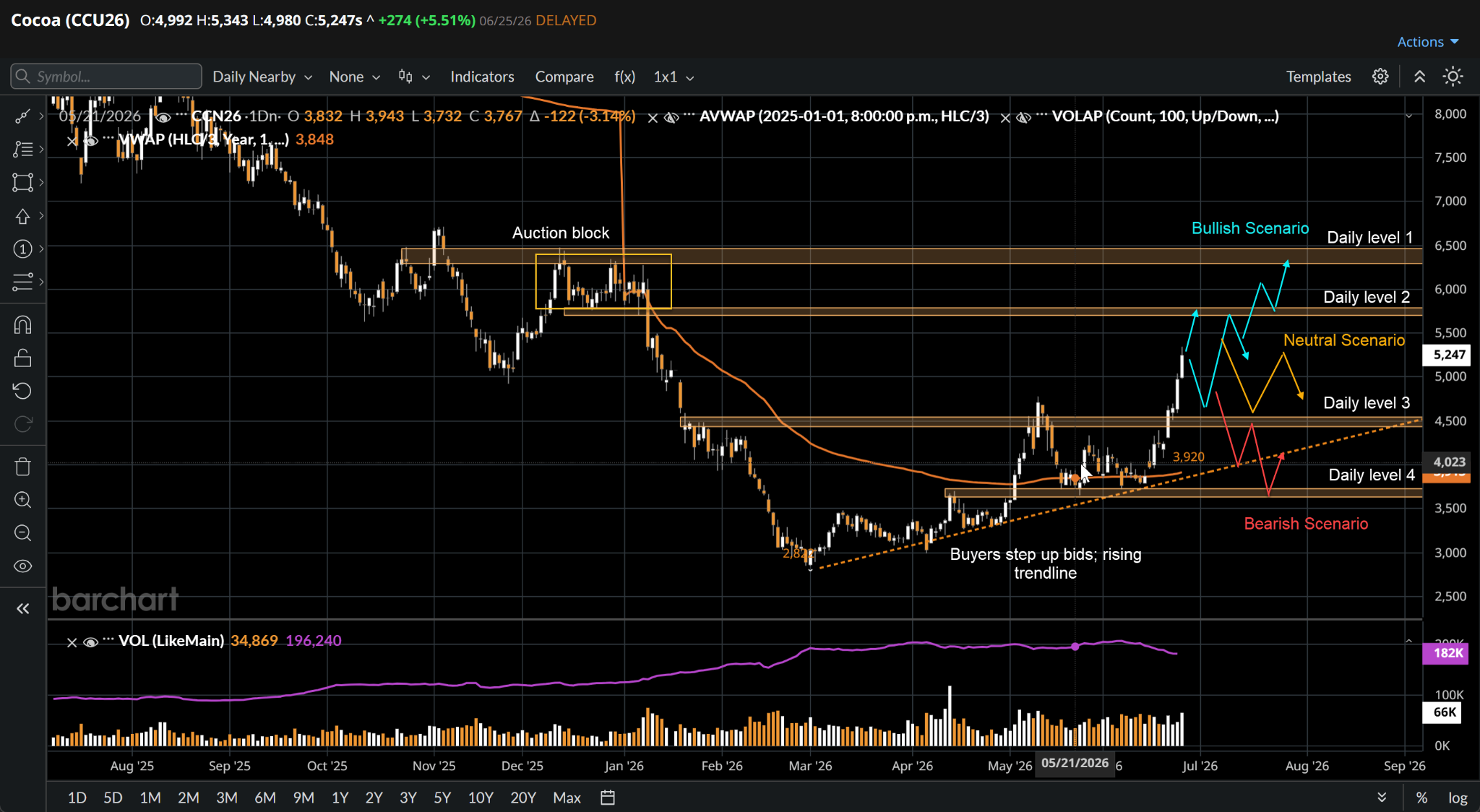
The key level to watch going forward is 4500, daily level 3.
Bullish Scenario
- If the market pulls back to 4500, expect buyers to step in there to bid prices higher for a continuation move up to 5750, daily level 2, where sellers are expected to respond.
- Above that level, expect a move through auction block 1 toward the 6450 area, daily level 1.
- Market acceptance above 4500 would be significant, as it would represent a break of the prevailing structural downtrend.
- A possible catalyst for this scenario would be confirmation that El Niño related dryness is intensifying further in Ivory Coast and Ghana, or fresh data showing flooding and brown rot damage has materially reduced the size of the 2026 and 2027 main crop, which would reinforce the tighter supply narrative and encourage continued short covering.
Neutral Scenario
- After the past week's rally, expect some two way rotation between 5500 and 4500 as the market works to re-establish value within this range.
- A possible catalyst for this scenario would be mixed or inconclusive crop data out of West Africa, where some reports point to continued flooding risk while others, such as the cumulative Ivory Coast port arrival figures, suggest supply has so far held up reasonably well, leaving traders without a clear enough signal to push decisively in either direction.
Bearish Scenario
- If buyers fail to defend 4500, expect a move back down toward the 3900 area, which lines up with the projected rising trendline and the yearly VWAP.
- A failure there could open the door to a deeper move down to 3650, daily level 4, where buyers are expected to respond.
- A possible catalyst for this scenario would be a stronger than expected US dollar, which recently rallied to a 13 month high, combined with a broader risk off shift in equities, or fresh data showing Ivory Coast shipments continuing to run ahead of last year's pace, which would undercut the tight supply narrative and could trigger renewed long liquidation.
Conclusion
Cocoa's reversal off its yearly lows reflects a rare alignment of technical and fundamental forces. From a technical standpoint, the break above 4500 daily level 3 has shifted market structure from bearish to constructive, and 4500 now stands as the key pivot that will determine whether this move extends toward 5750 and eventually 6450, or whether it stalls and rotates back toward 3900 and 3650. From a fundamental standpoint, the confirmation of El Niño, ongoing flooding and disease risk in Ivory Coast and Ghana, and shrinking surplus forecasts from StoneX have all reinforced the case for tighter supply heading into the 2026 and 2027 season, while a historically crowded short position has added fuel to the rally through aggressive covering. With weather risk in West Africa likely to remain the dominant driver of price action through the heart of the growing season, how do you see cocoa balancing these supply threats against its still deeply oversold longer term trend in the weeks ahead?
We are a professional-grade futures brokerage engineered by traders to provide the high-performance architecture and futures trading platform required for serious market participation. We serve as a professional technical partner for traders who prioritize data integrity and objective analysis. Take the next step in your professional evolution and Open an Account today.
Disclaimer:
This article is provided for informational and educational purposes only and does not constitute financial, investment, or trading advice. The analysis presented reflects the author’s market observations and opinions at the time of writing and is not a recommendation to buy or sell any futures contract, security, or financial instrument. Futures trading involves significant risk and is not suitable for all market participants. Losses may exceed initial margin deposits, and market conditions can change rapidly.
Any scenarios, levels, or market expectations discussed are hypothetical in nature and are intended solely to illustrate potential market behavior. They do not represent actual trading results and should not be interpreted as guarantees of future performance. Past performance, market behavior, or historical price action are not indicative of future outcomes.
Readers are solely responsible for their own trading decisions and risk management. Always conduct independent research, consider your financial situation and risk tolerance, and consult with a qualified financial professional, if necessary, before engaging in futures or derivatives trading.

/AI%20(artificial%20intelligence)/Ai%20chip%20by%20Quality%20Stock%20Arts%20via%20Shutterstock.jpg)

/A%20hand%20holding%20a%20phone%20with%20the%20Reddit%20logo_%20Mamun_Sheikh%20via%20Shutterstock_.jpg)
/Seagate%20sign%20on%20the%20building%20atits%20operational%20headquarters%20By%20JHVEPhoto.jpeg)
/Apple%20logo%20on%20store%20front%20by%20frantic00%20via%20iStock.jpg)