




When silver futures were ascending over $100 per ounce, we described the market as being “Gamestopped.” At the time, there was criticism of this opinion, suggesting it was not possible to manipulate a massive global commodity market such as silver in the same manner as an off-the-grid stock could be. However, we stand by our assessment. The silver market is not nearly as liquid as the masses assumed it to be. On a good day, the front-month futures contract might trade 80,000 to 100,000 contracts, but on a quiet day, it might only trade 30,000 to 50,000 contracts. To put this into perspective, the most liquid contracts, such as the E-mini S&P 500, range between 1.5 and 2.5 million contracts traded, and the 3-month SOFR trades 5 to 6 million contracts daily. In my view, silver is small enough to be overtaken by online trading sleuths and was likely the target of an online pump-and-dump scheme. Nevertheless, the charts are giving us some hints at what might happen next.
Although such schemes are technically illegal, they are difficult to police. The culprits are no longer a few brokers in boiler rooms working by landline phones. Instead, there are large numbers of bad actors, many of whom don't understand that what they are doing is unethical and will almost certainly cause harm to themselves and others. Further complicating the issue are algorithms that trigger buying and selling in futures markets based on trending keywords on X or in the news. It needn’t be truthful or factual, just popular market-moving ideas. In short, market participants are outsourcing their thoughts to AI and online communities, and it is causing assets to disconnect from realistic fundamentals. While we all like to think fundamentals drive market prices, markets are ultimately priced by buyers and sellers with various motivations and influences. More specifically, humans are driven by emotion and narratives, and computers exacerbate the situation.
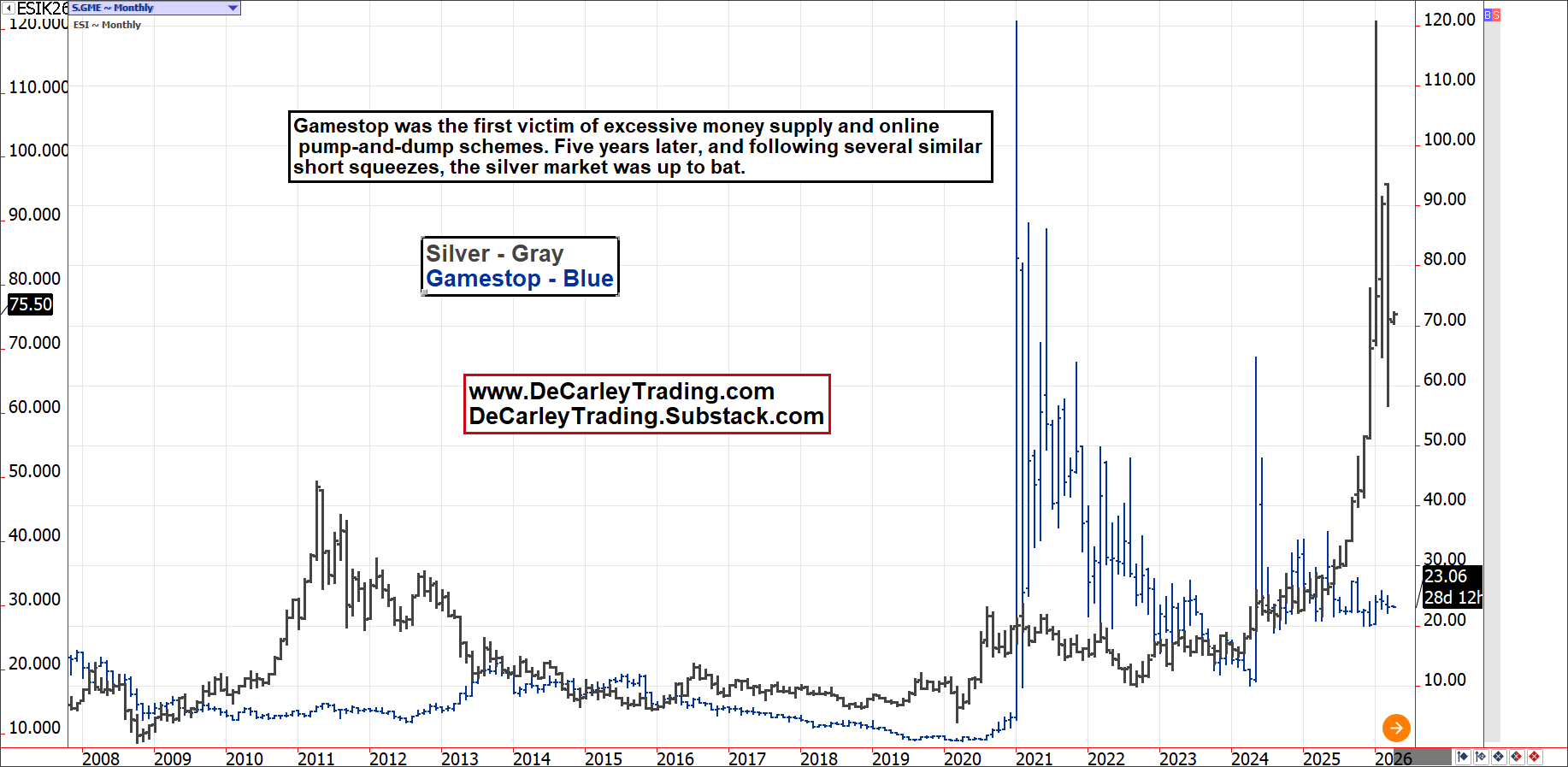
When we compare a monthly chart of GameStop stock with that of silver futures, we see glaring similarities. The same can be said when comparing the core dynamics of the environment in which these market moves occurred. For instance, both GameStop and silver had high short interest relative to available supply. Once the parabolic move started, there was a constant loop of short squeezing and dealers being forced to buy the underlying assets to cover short call option exposure (Gamma Squeeze). Both markets were driven by retail traders, and social-media-coordinating hype framed as “retail traders vs. Wall Street” with a David and Goliath context. Both GameStop and silver bulls were/are convinced the market is manipulated by Wall Street and/or banks; sticking it to the man was a desired result. Lastly, the meme-momentum becomes a self-fulfilling prophecy. Anyone with internet access was inundated with an overwhelming narrative of bullishness, causing massive amounts of money to flow into assets (GameStop and silver) that couldn’t absorb the liquidity in a reasonable manner. Lastly, both events lead to higher margins and restrictions on brokerage trading to stop the bleeding for bulls and bears alike. So, yes…silver was GameStopped.
Also, similar to the GameStop era, we are seeing subsequent attempts by online accounts to pump the silver market. In recent days, we have seen multiple anonymous X accounts stirring up the idea that large speculators are buying silver call options with strikes at $1,000 (not a typo… not $100 per ounce, but $1,000). Any reasonable person would identify this as a pump-and-dump social media post; yet we have seen it work repeatedly in recent years on multiple ticker symbols and cryptocurrencies. If you have some spare time, you can review the silver-pumping thread here: https://x.com/i/trending/2038640494494838994 .
Here are the thoughts I shared with Kitco News yesterday on this topic: I assume the $1,000 calls referenced in the trending X thread are trading on exchanges other than the CME or LME (crypto or forex brokers). The CME lists $1,000 silver calls with a December 2026 expiration, but there isn't a single contract with open interest (nobody has traded it). However, the exchange lists settlement prices for options that don’t actually trade; yesterday’s settlement price was $1,490! Silver options have become so expensive that small retail speculators are forced to buy call options with strike prices that are wildly out of the money, because that is all they can afford, or at least all they want to risk. When an asset goes viral, FOMO takes over, and traders are willing to pay a high price for improbable bets because they would rather have chips on the table than sit at the casino bar, left out of the excitement.
This reminds me of 2022; traders were buying US natural gas options with strike prices of $30.00 and $40.00 because they wanted in with limited risk but couldn't afford near-the-money strikes (which were $10.00). At the time, buying $40.00 natural gas calls was justified because “everyone was doing it,” but reasonable thinkers wouldn’t have expected those prices to be reached. In retrospect, I am sure those buyers had severe remorse.
In today’s silver options market, even those buying $1,000 calls likely don't expect the price to reach that level; they just want in on the action without having to put up margin. In the case of the December $1,000 calls, they can get into the market with limited risk for 237 days for less than $1,500 at risk. The margin to hold silver futures is currently over $50,000 based on the exchange minimum, but many brokerages are charging double that to protect themselves and their clients. An at-the-money call option for December 2026 is going for about $60,000. If you are a die-hard metals bull wanting a long-term play and only want to risk a few thousand, the December $1,000 calls don’t sound as crazy.
As a reminder, this is part of the GameStop playbook highlighted above. The GameStop squeeze occurred in waves, with each subsequent wave smaller than the previous. Those promoting deep OTM call options in large sizes are hoping for a repeat of the Reddit phenomenon in which silver prices get sucked higher in subsequent lower waves. If enough people buy wildly out-of-the-money calls, the dealers and market makers that sold them could be forced to buy futures at some point to hedge their risk, then the rally feeds on itself. This repeats until speculators have lost enough money to lose interest. It isn't healthy, and it has nothing to do with fundamentals; it is a modern-day pump-and-dump scheme.
Contrary to the narrative trending on X, buying absurd lottery ticket options in large volumes isn’t bullish; it is bearish. This practice drives up implied volatility in the market; elevated option market volatility is always temporary, and it almost always accompanies a trend reversal.
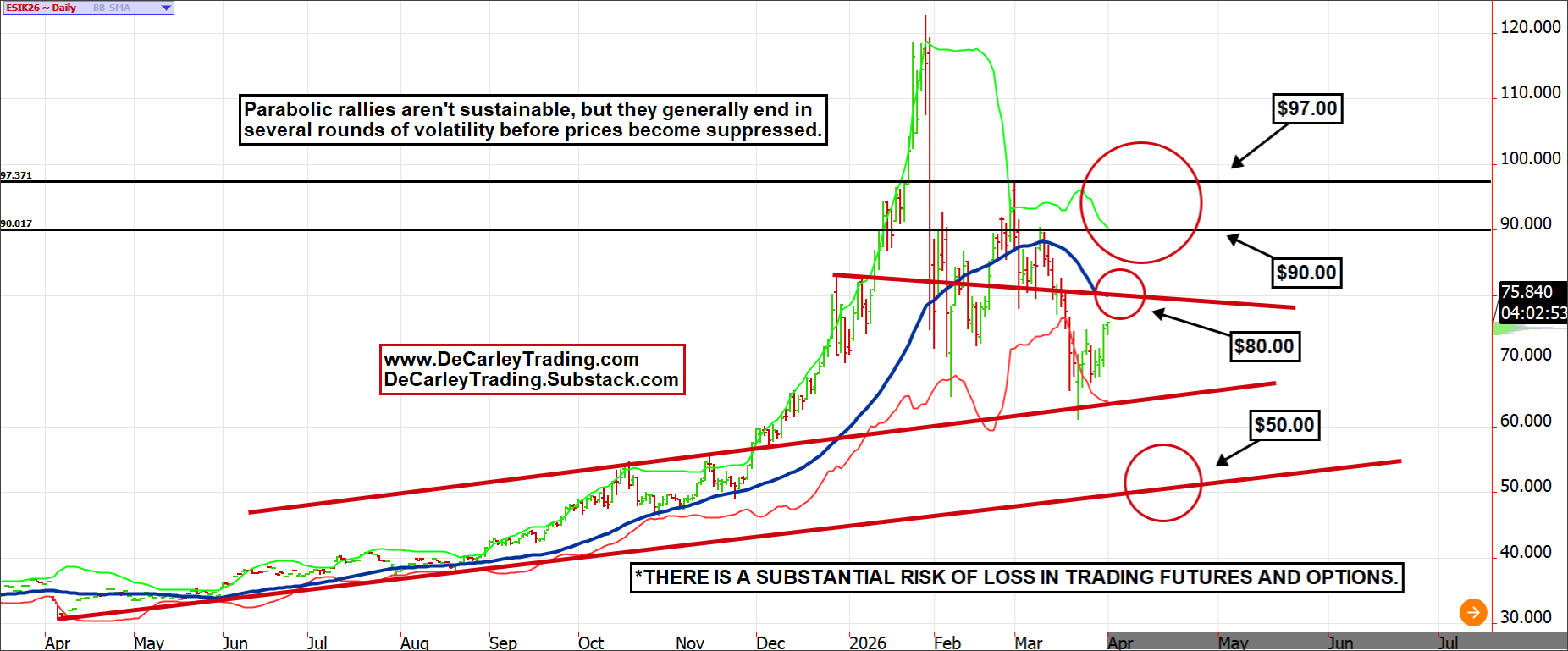
With this behavior in mind and the GameStop chart as our guide, we suspect silver could see temporary rallies into the $90.00 or even $100.00 area, but we believe the eventual outcome will look much like GameStop's. Of course, silver has manufacturing and precious-metal value, so it might not give back as much as GameStop did, but a full round trip to $50.00 silver is a real possibility. If the fundamentals no longer favor silver, $30.00 could be seen again in the long run.
DeCarley Trading (a division of Zaner Financial Services)
866-790-TRADE (8723)
702-947-0701 (local)
info@DeCarleyTrading.com
www.DeCarleyTrading.com
DOWNLOAD THE DECARLEY TRADING MOBILE APP IN YOUR APP STORE!

/Micron%20Technology%20Inc_%20logo%20on%20building-by%20vzphotos%20vis%20iStock.jpg)
/AI%20(artificial%20intelligence)/AI%20engineer%20working%20on%20laptop%20by%20ART%20STOCK%20CREATIVE%20via%20Shutterstock.jpg)
/A%20corporate%20office%20for%20IBM%20by%20HJBC%20via%20Adobe%20Stock.jpeg)