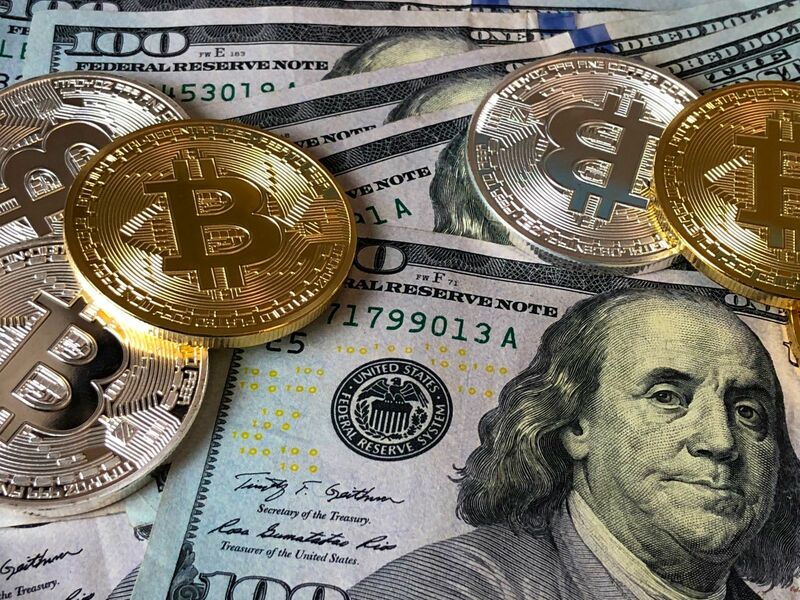
Likely to very few people’s surprise, Coinbase (COIN) suffered steeply over recent sessions. On Monday, Sept. 19, COIN stock ended the day down 5.5%, reflecting brewing pessimism over the underlying cryptocurrency sector. While Coinbase itself provides exceptional conveniences for everyday folks to buy and sell decentralized digital assets, with the demand profile reeling, investors rushed for the exits.
Two factors immediately come to mind. First, on a nearer-term basis, the much-anticipated event called the Merge – involving a major blockchain network transitioning to a more efficient consensus mechanism called proof of stake – came and went without so much as a blip in terms of positive momentum. If anything, the Merge has been a disappointment. Several cryptos find themselves down significantly over the trailing week.
As I’ve noted several times in prior Barchart.com publications, investors had to be aware of the phenomenon known as buy the rumor, sell the news. Typically, when everybody bets on the same horse, the subsequent rewards will likely be limited. Moreover, investors place wagers on what might happen, not what is happening.
Given that the Merge was a long known and broadcasted event, it’s possible that the market already provided the valuation bump prior to the event materializing. Once the big game finished, no incentive existed for buying tickets. So, that’s a net negative for COIN stock.
Second, the fundamentals don’t bode well for Coinbase and similar crypto wallet and exchange services. Late last month, Federal Reserve chair Jerome Powell during his monetary policy speech indicated effectively that higher interest rates were necessary to combat inflation and thus prevent longer-term damage.
While Powell’s thesis arguably rings true, it also means that risk-on assets suffer from an incentivization problem. Therefore, it wasn’t terribly shocking that COIN stock became the subject of unusual options activity – and not in an encouraging way.
The Bears Move in on COIN Stock
Following the close of the Sept. 19 session, COIN stock attracted plenty of unwanted attention. Specifically, pessimistic traders targeted two put options against Coinbase, which rise in value as the underlying security declines. First, they moved in on the $50 puts with an expiration date of Oct. 7, 2022. Second, traders eyeballed the $61 puts with an expiration date of Sept. 23, 2022 – this coming Friday.
In the further expiry-date option, volume reached 5,551 contracts against an open interest reading of 208, or a volume-to-open-interest ratio of 26.69. Its bid-ask spread as represented by the midpoint price (61 cents) was 9.84%. For the option expiring at the end of this business week, it featured a volume-OI ratio of 19.04. Its spread came out to 5.19%.
For reference, COIN stock closed at $69.93 in the open market on Monday.
While cryptos may have been the hottest sector of 2021, circumstances have drifted badly this year. Based on data from Barchart.com, the put-call open interest ratio for COIN stock is currently 1. Mathematically, this indicates an even number of calls and puts being purchased. However, since the market tends to have an upward bias, the true delineation point between bullishness and bearishness is 0.70.
Therefore, an OI ratio of 1 indicates that traders are purchasing more puts than calls, reflecting pessimism for COIN stock. In addition, analysts are starting to pivot away from the opportunity. Three months ago, among 15 covering analysts, only one had a sell rating (a strong sell). In the current month, among 19 analysts, three rated COIN a sell (one moderate sell, two strong sells).
Incentivization Challenges
Moving forward, should the Fed implement an aggressively hawkish monetary policy, it may set off a longer-term bearish cycle in cryptos. If that happens, investors will likely want to consider leaning off their exposure to COIN stock.
Fundamentally, inflation benefits risk-on assets like virtual currencies because of the “active” incentivization factor. Under an inflationary cycle, the dollar loses purchasing power over time. Therefore, investors are guaranteed losses if they stay in cash. That’s why so many market ideas flourished in 2021. When you lose six cents on the dollar – as occurred in 2021 – it’s imperative that investors do something, anything.
However, under hawkish policies, the opposite rings true. All things being equal, the purchasing power of the dollar should rise over time. That means investors are guaranteed a positive return simply by doing nothing. Therefore, an investment idea has to be so compelling that it’s worth giving up free profit for the target opportunity.
And that’s why risk-on assets typically crumble during deflationary (hawkish) cycles. Investors must be much pickier in how they invest their gradually rising dollars. Thus, it’s better to do nothing than to put money in a junk investment.
Time to Accept Reality
Although the crypto sector went on a remarkable rally last year, it may be time for market participants to accept reality. Now, it’s not memes and FOMO (fear of missing out) that drives asset valuations. It’s the Fed. Unfortunately, the central bank is not in a giving mood, making investments like COIN stock very questionable.
More Crypto News from Barchart

/Micron%20Technology%20Inc_%20logo%20on%20building-by%20vzphotos%20vis%20iStock.jpg)
/A%20hand%20holding%20a%20phone%20with%20the%20Reddit%20logo_%20Mamun_Sheikh%20via%20Shutterstock_.jpg)