
WALSH PURE SPREADER
Pure Hedge Division
RICH MORAN 3/24/2026
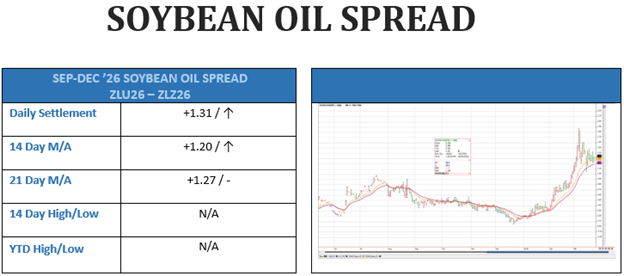
SEP-DEC ’26 SOYBEAN OIL SPREAD (ZLU26-ZLZ26)
I have recently written about my bullish thoughts on the Soybean Oil market and the Soybean Oil spreads. Nothing is always in commodity futures, but in general, Soybean Oil spreads will follow the direction of the out-right Soybean Oil market. The spreads did start to get away from us, but I believe we might be getting another chance to buy the SEP-DEC ’26 SOYBEAN OIL Spread (ZLU26-ZLZ26). Since January 8th this spread was on the rise floating just above the 14-day and 21-day moving averages the entire time. Then on February 26th it started to spike up way above these two moving averages from a price of 0.83 (83 one-hundredths of a cent) all the way up to 1.85 on March 6th. This took it .75 above both moving averages. It has now settled down somewhat and is back to just above the 14-day and 21-day, settling today at 1.31.
Soybean Oilshare is the value of the Soybean Oil versus the combined value of the Soybean Oil and Soybean Meal after crushing a bushel of soybeans. Historically Soybean Meal has usually been the more valuable part of the crush, but the Soybean Oil value has been on the rise to the point that the May Soybean Oilshare has surpassed 50%.
Soybean Oil was predominantly used as an edible oil. It is also used as a biofuel with recent environmental mandates and incentives increasing this use of Soybean Oil to help reduce one’s carbon footprint. Soybean Oil is regarded as a renewable energy with less greenhouse gas emissions, reducing potential global warming and climate change. The new biofuel mandate is coming out this Friday (3/27). I think this announcement could be bullish for Soybean-Oil. There are also other factors that may have contributed to the strength of Soybean-Oil. For example, in regard to edible oils, less Sunflower Oil has been coming out of Ukraine
I am suggesting that when the market opens this evening, try to buy ZLU26-ZLZ26 +1.31 (today’s settlement) or better. If you are unable to buy it at this price on the opening, I recommend leaving a bid in at 1.31.
If and when we are able to buy this spread, we will then choose our exit points. In any case, if we are able to get long this spread, look to exit the trade if it trades down to 0.98.
If you have any thoughts/questions on this article or any questions at all in regard to the commodities futures markets, please use this link Sign Up Now
Following up on still active past trade suggestions:
3/10/2026: ZSQ26-ZCK26 (Aug ’26 SOYBEANS – MAY ’26 CORN SPREAD)
****3/16/26: This spread opened at 743¾ and proceeded to trade down to and settle at 698¼ as August Soybeans settled limit down. This was 32 cents below the 14-day and 25 cents below the 21-day moving averages. As right as we were about this spread it is most probable that we missed our chance to get short. I still like selling Soybeans against Corn, so I will be looking for other opportunities.
I have recently written about the very disappointing cotton market. People have almost given up on even talking about trading cotton. As I had mentioned, The National Cotton Council (NCC) recently released its Annual Early Season Planting Intention Survey. According to the survey, at this point, U.S. growers intend on planting about 3.2% less acres of cotton this year. This is a result of the current low price of cotton and the fact that the current margins can be better for growers in other crops. Soybeans, for example, are simply less expensive to plant. I do believe that if cotton acreage is turned into soybean acreage, it may help the price of cotton. At the same time, this fall’s soybean harvest may end out being plentiful, possibly bringing down the price of soybeans. There are obviously other factors such as weather that come into play. For this reason, I like the idea of getting short this falls soybean market, more specifically August (ZSQ26) against getting long May corn (ZCK26), the current front month corn contract, so selling (ZSQ26-ZCK26).
ZSQ26-ZCK26 (AUG ’26 SOYBEAN – MAY ’26 CORN SPREAD) has been climbing from a price of about 660 in early February to its current 52-week high settlement of 748. It has been hovering above the 14-day and 21-day moving averages this entire time. I think we should be looking to get short, but not until it trades below and settles below these moving averages. When it does, I think it might be a good place to get short this spread with a stop to exit the trade just above the 52-week high.
1/23/2026: KCN26-KCU26 (JULY-SEPT ’26 COFFEE SPREAD)
WINNER **** On 3/12/25 (Thurs) – The spread traded up to 6.50, so we were able to sell the spread (on paper) at 6.45 (see below) for a $562.50 Profit Per Spread plus fees and commissions.
**** On 3/5/25 – This spread traded down to 4.85, so we are long at 4.95. I suggest when the market reopens sell the spread at 6.45 or better. If you do not get filled on the opening, leave a resting offer in at 6.45. If it goes back down to 4.95 before that, get out for a scratch at 4.95. I hate to turn a winner into a loser.
**** Today (3/4/25) – KCN26-KCU26 traded and settled above both the 14-day and 21-day moving averages (please see below). I am suggesting that when the market re-opens, try to buy this spread at 4.95 (today’s settlement) or better. We can pick our exact exit points when and if we are able to buy this spread, but if you are able to get long this spread, I suggest you exit the trade if it trades down to 3.50.
JULY-SEPT ’26 COFFEE SPREAD (KCN26-KCU26) has been hovering below the 14-day and 21-day moving averages since the start of its recent downward trend that began on 11/6/25. This spread started to stabilize at the beginning of this year at around 6.00. As this started to happen, the chart naturally began to flirt with both of these moving averages.
Brazilian coffee exports are down. This could help explain the recent halt in the bearish move in the spread. Also, drier weather in Brazil seems to be having the same effect on things.
I am suggesting that if KCN26-KCU26 trades above and settles above both the 14-day and the 21-day moving averages, we should try getting long this spread with a short stop just below the 52-week low. We can choose our exact exit points when and if we are able to put this trade on.
If you have any thoughts/questions on this article or any questions at all in regard to the commodities futures markets, please use this link Sign Up Now
Rich Moran
Senior Commodities Broker
Direct: (312)985-0298
Walsh Trading, Inc. is registered as a Guaranteed Introducing Broker with the Commodity Futures Trading Commission and an NFA Member.
Futures and options trading involve substantial risk and is not suitable for all investors. Therefore, individuals should carefully consider their financial condition in deciding whether to trade. Option traders should be aware that the exercise of a long option will result in a futures position. The valuation of futures and options may fluctuate, and as a result, clients may lose more than their original investment. The information contained on this site is the opinion of the writer or was obtained from sources cited within the commentary. The impact on market prices due to seasonal or market cycles and current news events may already be reflected in market prices. PAST PERFORMANCE IS NOT NECESSARILY INDICATIVE OF FUTURE RESULTS. All information, communications, publications, and reports, including this specific material, used and distributed by Walsh Trading, Inc. (“WTI”) shall be construed as a solicitation for entering into a derivatives transaction. WTI does not distribute research reports, employ research analysts, or maintain a research department as defined in CFTC Regulation 1.71.

/Microsoft%20Corporation%20logo%20on%20sign-by%20Jean-Luc%20Ichard%20via%20iStock.jpg)