As the Q4 earnings season comes to a close, it’s time to take stock of this quarter’s best and worst performers in the drug development inputs & services industry, including Azenta (NASDAQ:AZTA) and its peers.
Companies specializing in drug development inputs and services play a crucial role in the pharmaceutical and biotechnology value chain. Essential support for drug discovery, preclinical testing, and manufacturing means stable demand, as pharmaceutical companies often outsource non-core functions with medium to long-term contracts. However, the business model faces high capital requirements, customer concentration, and vulnerability to shifts in biopharma R&D budgets or regulatory frameworks. Looking ahead, the industry will likely enjoy tailwinds such as increasing investment in biologics, cell and gene therapies, and advancements in precision medicine, which drive demand for sophisticated tools and services. There is a growing trend of outsourcing in drug development for nimbleness and cost efficiency, which benefits the industry. On the flip side, potential headwinds include pricing pressures as efforts to contain healthcare costs are always top of mind. An evolving regulatory backdrop could also slow innovation or client activity.
The 8 drug development inputs & services stocks we track reported a mixed Q4. As a group, revenues beat analysts’ consensus estimates by 1.5%.
Amidst this news, share prices of the companies have had a rough stretch. On average, they are down 15.8% since the latest earnings results.
Azenta (NASDAQ:AZTA)
Serving as the guardian of some of medicine's most valuable materials, Azenta (NASDAQ:AZTA) provides biological sample management, storage, and genomic services that help pharmaceutical and biotechnology companies preserve and analyze critical research materials.
Azenta reported revenues of $148.6 million, flat year on year. This print exceeded analysts’ expectations by 1.1%. Despite the top-line beat, it was still a slower quarter for the company with a significant miss of analysts’ EPS estimates.
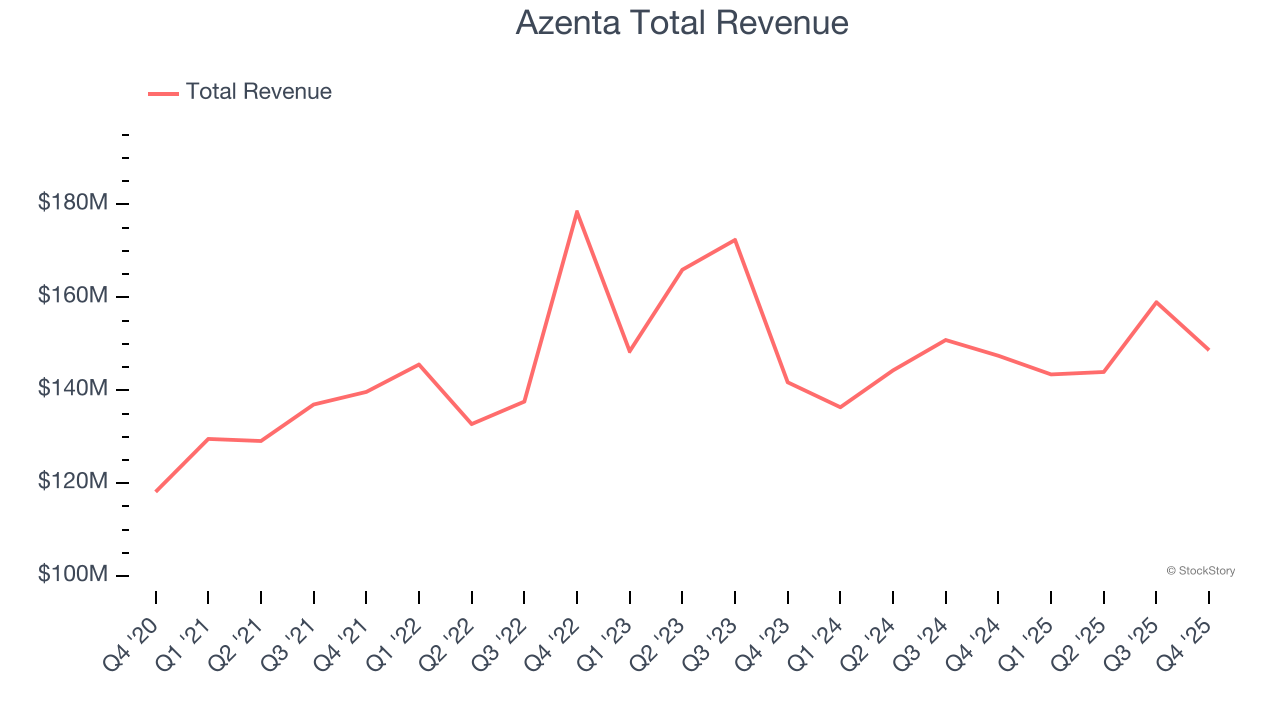
Unsurprisingly, the stock is down 45.3% since reporting and currently trades at $20.19.
Read our full report on Azenta here, it’s free.
Best Q4: Medpace (NASDAQ:MEDP)
Founded in 1992 as a scientifically-driven alternative to traditional contract research organizations, Medpace (NASDAQ:MEDP) provides outsourced clinical trial management and research services to help pharmaceutical, biotechnology, and medical device companies develop new treatments.
Medpace reported revenues of $708.5 million, up 32% year on year, outperforming analysts’ expectations by 3.3%. The business had a very strong quarter with an impressive beat of analysts’ organic revenue estimates and an impressive beat of analysts’ full-year EPS guidance estimates.
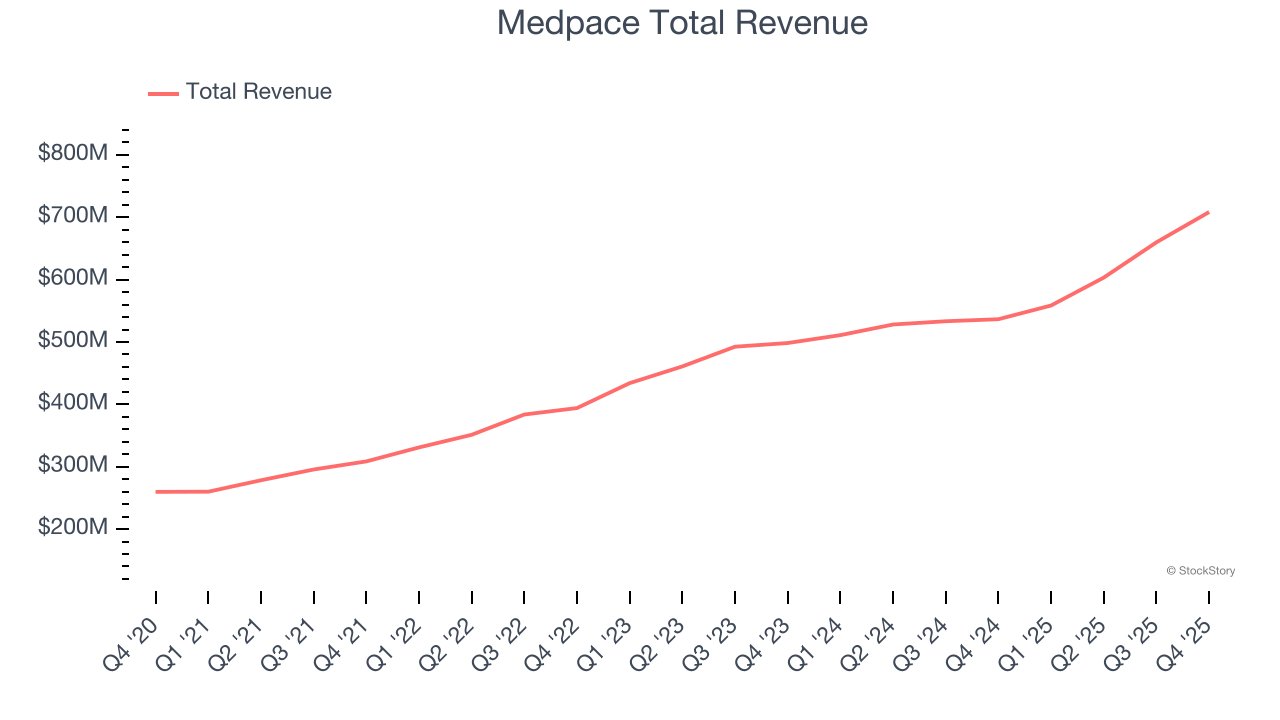
Medpace achieved the biggest analyst estimates beat and fastest revenue growth among its peers. Although it had a fine quarter compared its peers, the market seems unhappy with the results as the stock is down 14.5% since reporting. It currently trades at $453.42.
Is now the time to buy Medpace? Access our full analysis of the earnings results here, it’s free.
Slowest Q4: Fortrea (NASDAQ:FTRE)
Spun off from Labcorp in 2023 to focus exclusively on clinical research services, Fortrea (NASDAQ:FTRE) is a contract research organization that helps pharmaceutical, biotech, and medical device companies develop and bring their products to market through clinical trials and support services.
Fortrea reported revenues of $660.5 million, down 5.2% year on year, falling short of analysts’ expectations by 0.9%. It was a softer quarter as it posted full-year revenue guidance missing analysts’ expectations significantly and a significant miss of analysts’ EPS estimates.
Fortrea delivered the weakest performance against analyst estimates, slowest revenue growth, and weakest full-year guidance update in the group. As expected, the stock is down 5% since the results and currently trades at $9.83.
Read our full analysis of Fortrea’s results here.
West Pharmaceutical Services (NYSE:WST)
Founded in 1923 and serving as a critical link in the pharmaceutical supply chain, West Pharmaceutical Services (NYSE:WST) manufactures specialized packaging, containment systems, and delivery devices for injectable drugs and healthcare products.
West Pharmaceutical Services reported revenues of $805 million, up 7.5% year on year. This result beat analysts’ expectations by 1.5%. Overall, it was a strong quarter as it also recorded a solid beat of analysts’ full-year EPS guidance estimates and a beat of analysts’ EPS estimates.
The stock is down 3.9% since reporting and currently trades at $236.59.
Read our full, actionable report on West Pharmaceutical Services here, it’s free.
Charles River Laboratories (NYSE:CRL)
Named after the Massachusetts river where it was founded in 1947, Charles River Laboratories (NYSE:CRL) provides non-clinical drug development services, research models, and manufacturing support to pharmaceutical and biotechnology companies.
Charles River Laboratories reported revenues of $994.2 million, flat year on year. This number topped analysts’ expectations by 1.4%. Overall, it was a satisfactory quarter as it also produced a narrow beat of analysts’ revenue estimates.
The stock is down 3.1% since reporting and currently trades at $153.60.
Read our full, actionable report on Charles River Laboratories here, it’s free.
Market Update
Late in 2025 into early 2026, there was hand wringing around artificial intelligence. For software companies, the fear was that AI would erode pricing power and compress margins as new tools made it easier to replicate what once required expensive enterprise platforms. Crypto investors had their own version of the same anxiety: if AI agents could trade, allocate capital, and manage wallets autonomously, what exactly was the long-term value of today’s crypto infrastructure?
These concerns triggered a noticeable rotation away from these sectors and into safer havens. But markets rarely dwell on one narrative for long. Spring 2026 came, and the focus shifted abruptly from technological disruption to geopolitical risk. The US’ conflict with Iran became the dominant driver of market psychology, and when geopolitics takes center stage, the script changes quickly. Investors stop debating growth rates and start worrying about oil supply, inflation, and global stability.
Want to invest in winners with rock-solid fundamentals? Check out our Strong Momentum Stocks and add them to your watchlist. These companies are poised for growth regardless of the political or macroeconomic climate.
StockStory’s analyst team — all seasoned professional investors — uses quantitative analysis and automation to deliver market-beating insights faster and with higher quality.