




In 2021, the Fed blamed rising inflation on “transitory” factors, blaming higher prices on supply chain bottlenecks and other pandemic-related reasons. The US bond market has been ten steps ahead of the US central bank.
Last year, the bonds signaled that the Fed was wrong, and inflation was a structural issue. The trend in the bond market has been bearish since July 2021, and the path of least resistance for the US 30-Year Treasury bond futures remains bearish in June 2022 as the market prepares for another Fed Funds interest rate hike on June 15.
The Fed’s mandate- A mistake by the Fed and Treasury in 2021 but no admission
The Fed’s mandate is full employment and stable prices, and the Fed Funds Rate is the primary tool that can slow an overenthusiastic economy or stimulate a stagnant one. The Fed Funds Rate impacts the economy’s demand side. Meanwhile, the economy’s supply-side is a function of geopolitical and other macroeconomic forces above the central bank’s reach.
In early 2020, the Fed slashed and unleashed unprecedented liquidity as the global pandemic caused economic turmoil. Fiscal policy worked together with monetary policies as the governments released a tidal wave of stimulus. The necessary but haphazard policies planted inflationary seeds that sprouted during the second half of 2020. The seeds bloomed in 2021 and grew wild in 2022 as the war in Ukraine fertilized the inflationary pressures with supply-side economic woes.
While Treasury Secretary Janet Yellen and Fed Chairman Jerome Powell admitted that they were mistaken when characterizing inflation as “transitory” in 2021, they have yet to acknowledge that their policies were the root cause of the economic condition at the highest level in over four decades.
The long bond has been falling and is at a multi-year low
On Friday, June 10, the May consumer price index was 8.6% higher on a year-on-year basis, the highest increase since December 1981. Core inflation excluding food and energy rose 6%, with both above consensus expectations. Workers are losing the war with increasing prices as real wages fell 0.6% from April and were down 3% compared to May 2021.
Meanwhile, rising inflation in 2021 and 2022 has weighed on the bond market, pushing interest rates appreciably higher.
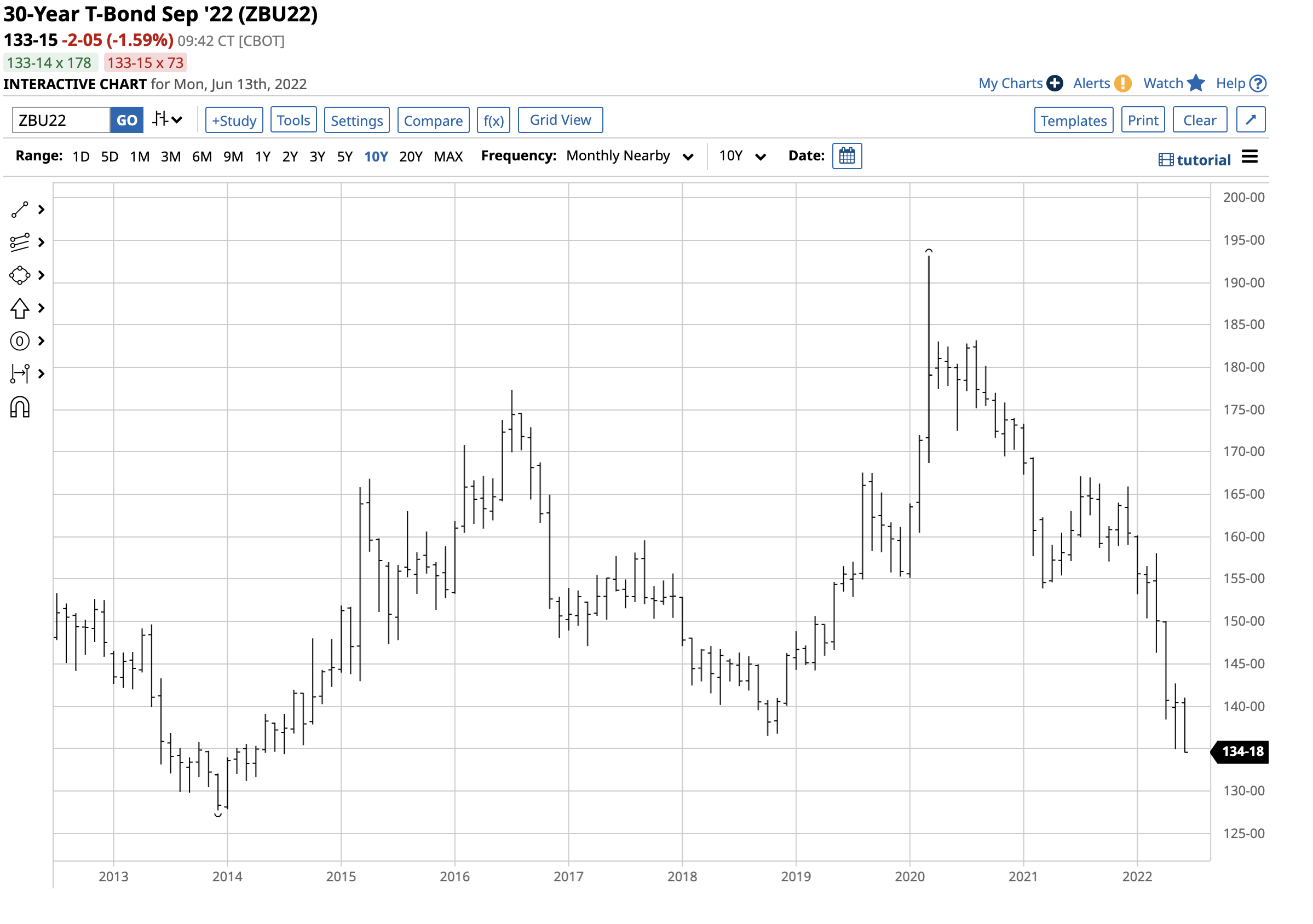
The chart of the nearby US 30-Year Treasury bond futures shows the decline to a 134-17 low on June 13, the lowest level since June 2014. At the 133-11 level on June 13, the September long bond futures contract was sitting at an eight-year low.
At the end of 2021, a thirty-year fixed-rate conventional mortgage was below the 3% level. In June 2022, it is over 2.5% higher at above the 5.50% level. The monthly payment on a $300,000 mortgage has increased by $625 in just under six months.
The Fed will speak on June 15, but it is nowhere near catching up with the bonds
The latest May CPI data removed any doubt that the Fed will hike the short-term Fed Funds Rate by a minimum of fifty basis points to 1.25%-1.50% on Wednesday, June 15. Some analysts are calling for a 75-point increase, while other economists believe that a full percentage point is necessary to address rising prices. Meanwhile, with inflation up 8.6% and the core reading 6% higher, a one percent hike that puts the Fed Funds Rate at 1.75%-2.00% would not approach the current inflation rate.
The Fed will likely remain on a path of fifty-basis point hikes as it monitors the impact of quantitative tightening on rates further out along the yield curve.
Inflation is a supply-side issue for at least three reasons
The latest inflation report showed what all consumers know all too well; prices are rising at an accelerated pace. Excluding food and energy prices may satisfy economists, but they have been influential factors pushing prices higher. The Fed tools can do little to push food and energy prices lower because they are supply-side issues. At least three factors make rising food and energy prices a challenge for the Fed:
- US energy policy addressing climate change supports alternative and renewable sources. It inhibits traditional fossil fuel production handing the oil market’s pricing power back to the international oil cartel and Russia.
- The war in Ukraine, sanctions on Russia, and Russian retaliation have caused embargos, trade issues, and price distortions in energy and food markets. Ukraine and Russia are Europe’s breadbasket, exporting around one-third of the world’s annual wheat requirements. The way has turned the fertile acres into minefields, and the Black Sea export hub is a war zone.
- The “no limits” cooperation between China and Russia create a geopolitical bifurcation between nuclear powers. The geopolitical risk leads to higher prices.
While supply chain issues continue to push prices higher and create shortages, the supply-side macroeconomic issues caused by US energy policy and the first major war in Europe fuel the current inflationary fire.
The Fed only has demand-side solutions- Two things can change the inflationary environment, and they are beyond the central bank’s reach
Increasing short-term interest rates can be highly effective on the economy’s demand side. However, the Fed and worldwide central banks have no solutions for the supply-side problems in their monetary policy toolboxes. The answers are with governments, with two clear paths to address the current economic landscape:
- A negotiated settlement between Russia and Ukraine and China/Russia and the US/Europe would cause food and other raw materials to flow and prices to decline.
- A realization that addressing climate change is a multi-decade, not a multi-month program with an increase in the US oil and gas output would cause prices to come down, pouring cold water on the inflationary fire.
The bottom line is markets reflect the economic and geopolitical landscapes. As the Fed moves to hike to short-term interest rate and offers the market an increase in hawkish squawks, realize the central bank is an impotent force as the answers to inflation are with the leadership that can address the underlying supply-side geopolitical issues.
The trend in the long bond futures remains lower, and technical and fundamental factors support the current path of least resistance.


/AI%20(artificial%20intelligence)/AI%20engineer%20working%20on%20laptop%20by%20ART%20STOCK%20CREATIVE%20via%20Shutterstock.jpg)
/Alphabet%20(Google)%20Image%20by%20Markus%20Mainka%20via%20Shutterstock.jpg)
/NVIDIA%20Corp%20logo%20on%20phone-by%20Evolf%20via%20Shutterstock.jpg)
/Carnival%20Corp_%20logo%20on%20ship%20by-%20Ihor%20Koptilin%20via%20Shutterstock.jpg)