Editor's note: Any and all references to time frames longer than one trading day are for purposes of market context only, and not recommendations of any holding time frame. Daily rebalancing ETFs are not meant to be held unmonitored for long periods. If you don't have the resources, time or inclination to constantly monitor and manage your positions, leveraged and inverse ETFs are not for you.
Investing in the funds involves a high degree of risk. Unlike traditional ETFs, or even other leveraged and/or inverse ETFs, these leveraged and/or inverse single-stock ETFs track the price of a single stock rather than an index, eliminating the benefits of diversification. Leveraged and inverse ETFs pursue daily leveraged investment objectives, which means they are riskier than alternatives which do not use leverage. They seek daily goals and should not be expected to track the underlying stock’s performance over periods longer than one day. They are not suitable for all investors and should be utilized only by investors who understand leverage risk and who actively manage their investments. The Funds will lose money if the underlying stock’s performance is flat, and it is possible that the Bull Fund will lose money even if the underlying stock’s performance increases, and the Bear Fund will lose money even if the underlying stock’s performance decreases, over a period longer than a single day. Investing in the Funds is not equivalent to investing directly in NVDA.
Key Takeaways
AI Fed policy is the swing factor for small caps. A pivot toward cuts could ignite a rotation into rate-sensitive names.
Nvidia fundamentals remain dominant. Record data center revenue and 75%+ gross margins show AI demand is real.
Good news isn’t moving NVDA. Sideways price action after blowout earnings raises “peak AI” debate.
March and May catalysts. The March 18 FOMC meeting and Nvidia’s next earnings call could reset momentum.
Two of the market’s most powerful forces may be coming to a boil: Federal Reserve policy expectations and artificial intelligence (AI) earnings momentum.
On one burner, small-cap stocks are waiting for rate relief. On the other, NVIDIA Corporation (NVDA) just delivered another earnings beat, yet the stock can’t break out.
So which trade has more upside from here: a rate-sensitive small-cap revival, or renewed AI leadership?
Small Caps: A Goldilocks Setup, or a Head Fake?
After three rate cuts in 2025 brought the federal funds rate to 3.50%–3.75%, the Federal Open Market Committee held steady in January 2026. Growth has cooled, inflation* has moderated to 2.4% year-over-year, and unemployment sits at 4.3%.
That backdrop creates a potential “Goldilocks” scenario:
Slower growth but no recession
Inflation easing but not collapsing
Labor markets stable but not overheating
Small-cap stocks, tracked by the Russell 2000 Index*, are especially sensitive to borrowing costs and domestic conditions. Lower rates reduce financing pressure, improve risk appetite, and often trigger rotation away from mega-cap tech.
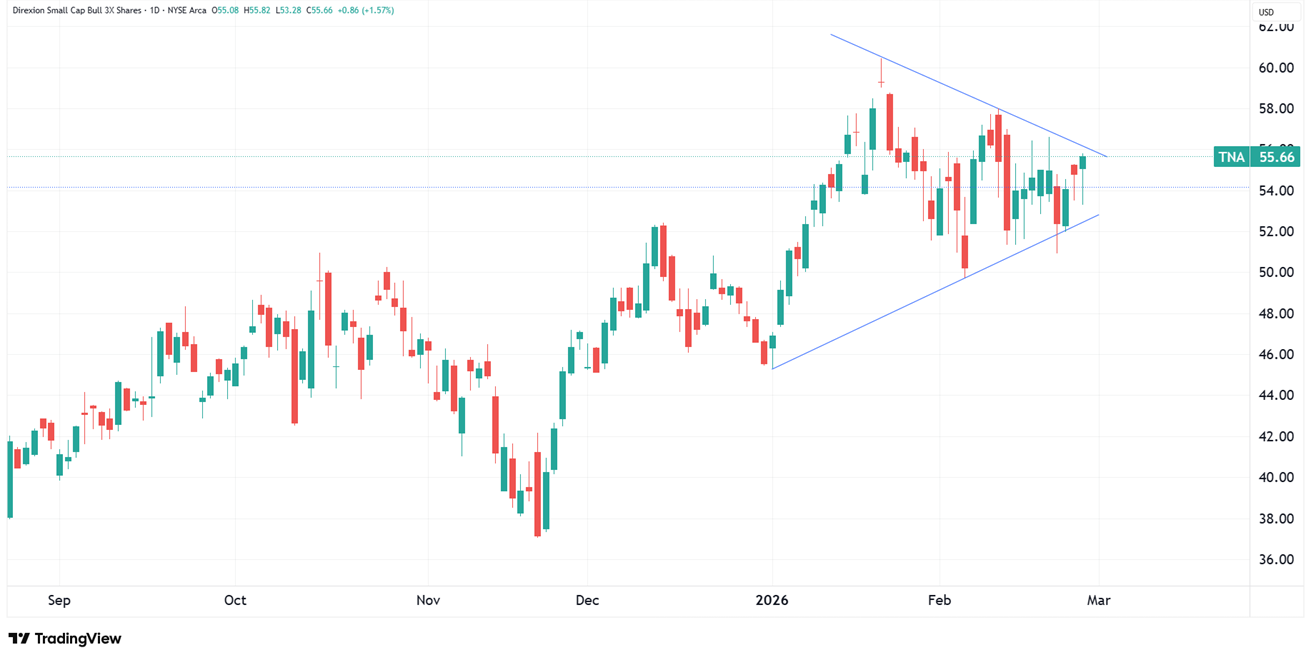
If the Fed signals easing later this year, leveraged exposure via Direxion’s Daily Small Cap Bull 3X ETF (TNA) could benefit from renewed momentum. TNA seeks daily investment results, before fees and expenses, of 300% of the performance of the Russell 2000 Index.
Below is a daily chart of TNA as of February 26, 2026.
Source: StockCharts.com
The performance data quoted represents past performance. Past performance does not guarantee future results. The investment return and principal value of an investment will fluctuate. An investor’s shares, when redeemed, may be worth more or less than their original cost. Current performance may be lower or higher than the performance quoted. Returns for performance under one year are cumulative, not annualized. For the most recent month-end performance please visit the funds’ website at direxion.com. For standardized performance, click here.
Candlestick charts display the high and low (the stick) and the open and close price (the body) of a security for a specific period. If the body is filled, it means the close was lower than the open. If the body is empty, it means the close was higher than the open.
What Could Go Wrong for Small Caps?
If inflation reaccelerates or the labor market proves too resilient, the Fed may stay restrictive longer. Small caps tend to feel higher-for-longer rates more acutely than large multinational peers.
The March 18 FOMC meeting becomes a pivotal moment. Hawkish tone could pressure small caps and benefit inverse exposure like TZA.
The Direxion Daily Small Caps Bear 3X ETF (TZA) seeks daily investment results, before fees and expenses, of 300% of the inverse (or opposite) of the performance of the Russell 2000 Index.
Nvidia: Earnings Beat… But No Breakout
Meanwhile, Nvidia just delivered another blockbuster quarter.
Data Center revenue: $62.3 billion in Q4
Growth: 75% year-over-year
Gross margins: Above 75%
Blackwell demand: Strong across hyperscalers
The company’s CUDA ecosystem, integrated networking (InfiniBand and Spectrum-X Ethernet), and end-to-end stack give it one of the strongest moats in tech.
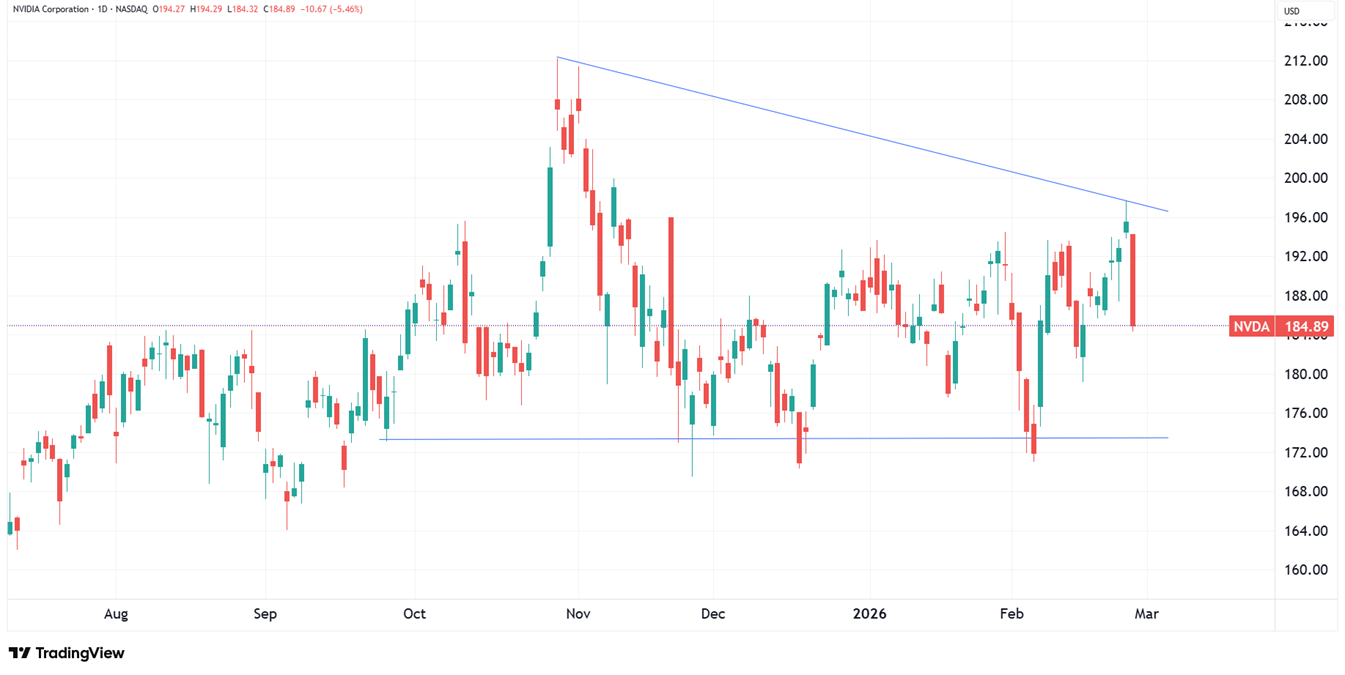
And yet the stock remains rangebound.
When strong earnings don’t produce upside follow-through, traders start asking whether expectations have simply become too high.
Below is a daily chart of NVDA as of February 26, 2026.
Source: TradingView.com
Candlestick charts display the high and low (the stick) and the open and close price (the body) of a security for a specific period. If the body is filled, it means the close was lower than the open. If the body is empty, it means the close was higher than the open.
The performance data quoted represents past performance. Past performance does not guarantee future results.
Bulls’ Case: AI Is Still Early
Data Center now drives over 90% of revenue.
Hyperscaler deployments remain massive.
Switching costs are extreme.
Upgrade cycles continue.
If AI spending continues compounding, Nvidia could break out of its consolidation pattern. Leveraged exposure via NVDU offers a way to express that view.
The Direxion Daily NVDA Bull 2X ETF (NVDU) seeks daily investment results, before fees and expenses, of 200% of the performance of the common shares of NVIDIA Corporation (Ticker: NVDA).
Bears’ Case: Peak AI or Capex Digestion?
Concerns include:
Hyperscaler spending moderation
Export restrictions
Competition from AMD or custom accelerators
“Good news fatigue” in valuation
If guidance softens or macro cracks appear, NVDA’s premium multiple could compress quickly. In that scenario, NVDD could attract tactical interest.
The Direxion Daily NVDA Bear 1X ETF (NVDD) seeks daily investment results, before fees and expenses, of 100% of the inverse (or opposite) of the performance of the common shares of NVIDIA Corporation (Ticker: NVDA).
The next earnings call in late May becomes critical.
The Bigger Question: Rotation or Concentration?
Markets may be setting up for a crossroads:
If the Fed eases, then small caps and cyclicals may lead.
If AI capex re-accelerates, Nvidia and mega-cap tech could retake dominance.
If both stall, volatility* likely increases.
This isn’t just about earnings. It’s about leadership. Small caps represent domestic economic confidence. Nvidia represents global AI infrastructure momentum.
What Traders Should Watch
March 18 FOMC tone and rate path signals
Inflation prints and labor data
Hyperscaler capex commentary
Nvidia’s May earnings guidance
The next leadership trade may hinge on whether capital rotates into rate-sensitive small caps, or doubles down on AI’s dominant franchise.
If the Fed opens the door to easing, small caps could finally get their moment.
If AI demand proves structurally durable and Blackwell momentum continues, Nvidia may break its range and reclaim momentum leadership.
Either way, the catalysts are pretty clear and the tape likely won’t stay quiet for long.
*Definitions and Index Descriptions
An investor should carefully consider a Fund’s investment objective, risks, charges, and expenses before investing. A Fund’s prospectus and summary prospectus contain this and other information about the Direxion Shares. To obtain a Fund’s prospectus and summary prospectus call 866-476-7523 or visit our website at direxion.com. A Fund’s prospectus and summary prospectus should be read carefully before investing.
The Russell 2000® Index (RU20INTR) measures the performance of approximately 2,000 small-capitalization companies in the Russell 3000® Index, based on a combination of their market capitalization. One cannot directly invest in an index.
The Russell 2000® Index is a trademark of Frank Russell Company (“Russell”) and has been licensed for use by the Trust. The Direxion Daily Small Cap Bull and Bear 3X ETFs are not sponsored, endorsed, sold or promoted by Russell. Russell makes no representation regarding the advisability of investing in the Direxion Daily Small Cap Bull and Bear 3X ETFs.
Direxion Shares Risks – An investment in a Fund involves risk, including the possible loss of principal. A Fund is non-diversified and includes risks associated with the Fund’s concentrating its investments in a particular industry, sector, or geography which can increase volatility. The use of derivatives such as futures contracts and swaps are subject to market risks that may cause prices to fluctuate over time.
Leverage Risk – Each Fund obtains investment exposure in excess of its net assets by utilizing leverage and may lose more money in market conditions that are adverse to its investment objective than a fund that does not utilize leverage. A total loss may occur in a single day. Leverage will also have the effect of magnifying any differences in the Fund’s correlation or inverse correlation with the Index and may increase the volatility of the Fund.
Daily Index Correlation Risk – A number of factors may affect the Bull Fund’s ability to achieve a high degree of correlation with the Index and therefore achieve its daily leveraged investment objective. The Bull Fund’s exposure to the Index is impacted by the Index’s movement. Because of this, it is unlikely that the Bull Fund will be perfectly exposed to the Index at the end of each day. The possibility of the Bull Fund being materially over- or under-exposed to the Index increases on days when the Index is volatile near the close of the trading day.
Daily Inverse Index Correlation Risk – A number of factors may affect the Bear Fund’s ability to achieve a high degree of inverse correlation with the Index and therefore achieve its daily inverse leveraged investment objective. The Bear Fund’s exposure to the Index is impacted by the Index’s movement. Because of this, it is unlikely that the Bear Fund will be perfectly exposed to the Index at the end of each day. The possibility of the Bear Fund being materially over- or under-exposed to the Index increases on days when the Index is volatile near the close of the trading day.
NVIDIA Corporation Investing Risk — NVIDIA Corporation faces risks associated with meeting the evolving needs of its large markets – gaming, data center, professional visualization and automotive – and identifying new products, services and technologies; competition in its current and target markets; changes in customer demand; supply chain issues; manufacturing delays; potential significant mismatches between supply and demand giving rise to product shortages or excessive inventory; the dependence on third-parties and their technology to manufacture, assemble, test, package or design its products which reduces control over product quantity and quality, manufacturing yields, development, enhancement and product delivery schedules; significant product defects; international operations, including adverse economic conditions; impacts from climate change, including water and energy availability; business investment and acquisitions; system security and data protection breaches, including cyberattacks; business disruptions; a limited number of customers; the ability to attract, retain and motivate executives and key employees; the proper function of its business processes and information systems; its intellectual property; and other regulatory and legal issues.
Semiconductor Industry Risk – Semiconductor companies may face intense competition, both domestically and internationally, may have limited product lines, markets, financial resources or personnel and may face risks related to the availability of materials.
Information Technology Sector Risk —The value of stocks of information technology companies and companies that rely heavily on technology is particularly vulnerable to rapid changes in technology product cycles, rapid product obsolescence, government regulation, and competition, both domestically and internationally, including competition from competitors with lower production cost.
Healthcare Sector Risk — Companies in the healthcare sector may be affected by extensive, costly and uncertain government regulation, rising costs of medical products and services, changes in the demand for medical products and services, an increased emphasis on outpatient services, limited product lines, industry innovation and/or consolidation, changes in technologies and other market developments.
Industrials Sector Risk — Stock prices of issuers in the industrials sector are affected by supply and demand both for their specific product or service and for industrials sector products in general.
Financials Sector Risk — Performance of companies in the financials sector may be materially impacted by many factors, including but not limited to, government regulations, economic conditions, credit rating downgrades, changes in interest rates and decreased liquidity in credit markets.
Additional risks of each Fund include Effects of Compounding and Market Volatility Risk, Market Risk, Counterparty Risk, Rebalancing Risk, Intra-Day Investment Risk, Other Investment Companies (including ETFs Risk), Cash Transaction Risk, Passive Investment and Index Performance Risk and for the Direxion Daily Small Cap Bear 3X ETF and Direxion Daily NVDA Bear 1X ETF, Shorting or Inverse Risk. Please see the summary and full prospectuses for a more complete description of these and other risks of a Fund.
Distributor: ALPS Distributors, Inc.



/A%20photo%20of%20a%20Sandisk%20Solid%20State%20Drive%20by%20Top%20Popular%20Vector%20by%20Shutterstock.jpg)