Editor's note: Any and all references to time frames longer than one trading day are for purposes of market context only, and not recommendations of any holding time frame. Daily rebalancing ETFs are not meant to be held unmonitored for long periods. If you don't have the resources, time or inclination to constantly monitor and manage your positions, leveraged and inverse ETFs are not for you.
Investing in the funds involves a high degree of risk. Unlike traditional ETFs, or even other leveraged and/or inverse ETFs, these leveraged and/or inverse single-stock ETFs track the price of a single stock rather than an index, eliminating the benefits of diversification. Leveraged and inverse ETFs pursue daily leveraged investment objectives, which means they are riskier than alternatives which do not use leverage. They seek daily goals and should not be expected to track the underlying stock’s performance over periods longer than one day. They are not suitable for all investors and should be utilized only by investors who understand leverage risk and who actively manage their investments. The Funds will lose money if the underlying stock’s performance is flat, and it is possible that the Bull Fund will lose money even if the underlying stock’s performance increases, and the Bear Fund will lose money even if the underlying stock’s performance decreases, over a period longer than a single day. Investing in the Funds is not equivalent to investing directly in MSFT, ORCL, PANW, and PLTR.
Key Takeaways
AI agent fears triggered a sharp software selloff (20%+ in key names).
Analysts argue disruption may be overstated—fundamentals remain intact.
Earnings and guidance will decide if this is a reset… or a regime shift.
Closely watched software stocks have received quite a jolt with many of the sector’s bellwethers down more than 20% in early 2026.
The primary culprit: the rise AI agents that complete tasks on their own with minimal prompting. The fear is these tools could revolutionize the nature of work and dramatically shrink the need for software across industries.
In particular, traders seemed to key on Anthropic's recent release of new AI tools for its "Claude Cowork" agent.
“AI agents—software tools that can take actions on behalf of a user—have long been talked about in the AI world. The market ructions are a sign that they may finally be at hand,” the Financial Times reports. “This presents a severe risk that established software companies will be usurped.”
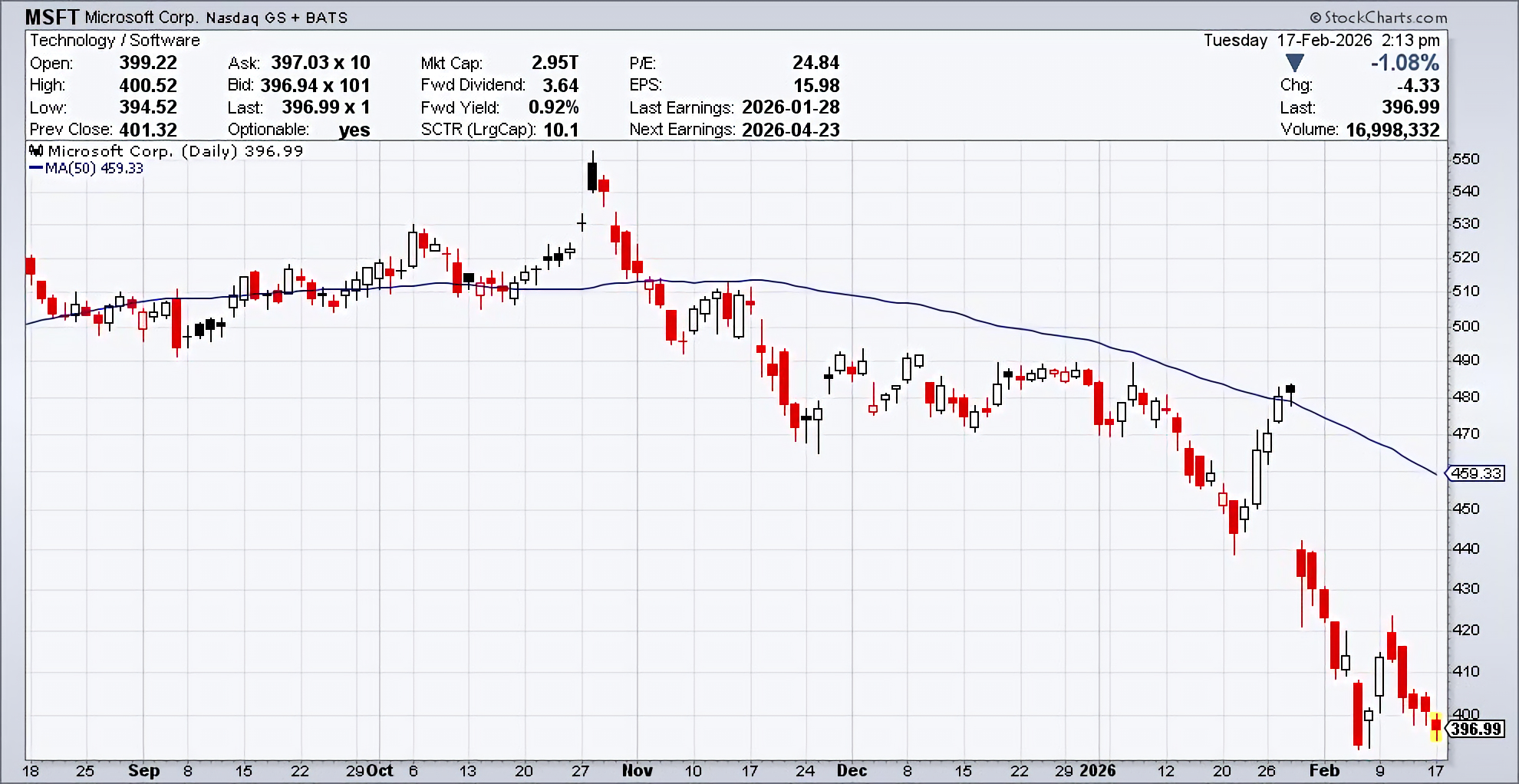
The roughly 25% wipeout in Microsoft Corporation (Ticker: MSFT) clearly shows the investor concerns around software companies.
Below is a daily chart of MSFT as of February 17, 2026.
Source: StockCharts.com
Candlestick charts display the high and low (the stick) and the open and close price (the body) of a security for a specific period. If the body is filled, it means the close was lower than the open. If the body is empty, it means the close was higher than the open.
The performance data quoted represents past performance. Past performance does not guarantee future results.
The question for traders following software is if this is just a temporary narrative-driven shakeout, or a long-term trend change for a sector known for fat profit margins and recurring business.
Analysts at J.P. Morgan have pushed back against the fears, arguing the market may be pricing “worst-case” disruption that’s unlikely to show up in the near term. They also point to washed-out positioning and still-supportive earnings and fundamentals as reasons the trade could snap back.
Here are some bullish catalysts traders may want to keep an eye on for a quartet of software leaders: Microsoft Corporation (Ticker: MSFT), Palantir Technologies Inc. (Ticker: PLTR), Oracle Corporation (Ticker: ORCL), and Palo Alto Networks, Inc. (Ticker: PANW).
Microsoft (MSFT)
Distribution Moat: If agents become the new interface, Microsoft can ship them inside products enterprises already pay for.
Sticky Workflows: Big organizations typically don’t rip and replace productivity stacks overnight—switching costs buy time.
“AI Fear” Rotation Candidate: J.P. Morgan highlighted higher-quality, more AI-resilient software names in the wake of the selloff.
Even in a disruption narrative, bulls see MSFT as a potential “toll booth”: whether AI agents help create, summarize, code, or automate tasks, Microsoft wants the work happening inside its ecosystem.
Direxion Daily MSFT Bull 2X ETF (Ticker: MSFU) seeks daily investment results, before fees and expenses, of 200% of the performance of the common shares of Microsoft Corporation (Ticker: MSFT).
For traders looking to take the other side, Direxion Daily MSFT Bear 1X ETF (Ticker: MSFD) seeks daily investment results, before fees and expenses, of 100% of the inverse (or opposite) of the performance of the common shares of Microsoft Corporation (Ticker: MSFT).
Palantir (PLTR)
“Operational AI” Angle: Bulls frame PLTR as a bridge from models to real workflows—less “replaceable app,” more implementation layer.
Sentiment: When the tape pivots from fear to relief, higher-beta* “AI-adjacent” names can move fast.
Narrative Offset: If the debate shifts from “agents replace software” to “enterprises need help deploying AI safely,” PLTR can benefit.
PLTR is also a useful barometer. If the market treats the AI scare as a tradeable overshoot, higher-volatility* software names often show it quickly.
Direxion Daily PLTR Bull 2X ETF (Ticker: PLTU) seeks daily investment results, before fees and expenses, of 200% of the performance of the common shares of Palantir Technologies Inc. (Ticker: PLTR).
For traders with a bearish view, Direxion Daily PLTR Bear 1X ETF (Ticker: PLTD) seeks daily investment results, before fees and expenses, of 100% of the inverse (or opposite) of the performance of the common shares of Palantir Technologies Inc. (Ticker: PLTR).
Why Bulls May Favor Oracle (ORCL)
Switching Costs: Core databases are “plumbing”—hard to replace quickly, even if the user interface changes.
AI Buildout Supports Infrastructure: If enterprises spend on AI, they still need data stored, governed, and served.
Selloff May be Sentiment-Driven: J.P. Morgan strategists argued valuations moved faster than fundamentals during the recent scare.
Bulls see ORCL as less about shiny demos and more about the boring work AI still requires: data, databases, and enterprise integration.
The Direxion Daily ORCL Bull 2X ETF (Ticker: ORCU) seeks daily investment results, before fees and expenses, of 200% of the performance of the common shares of Oracle Corporation (Ticker: ORCL).
For bearish traders, Direxion Daily ORCL Bear 1X ETF (Ticker: ORCS) seeks daily investment results, before fees and expenses, of 100% of the inverse (or opposite) of the performance of the common shares of Oracle Corporation (Ticker: ORCL).
Palo Alto Networks (PANW)
Security is Non-Optional: AI adoption can expand the attack surface, not shrink it.
Platform Consolidation: In uncertain budgets, some buyers consolidate vendors—scale can matter.
AI Resilience: J.P. Morgan named PANW among more AI-resilient software stocks in the selloff’s aftermath.
If agents automate more tasks, bears may argue for fewer seats—but bulls counter that more automation also means more things to secure (users, endpoints, apps, and AI-driven workflows).
The Direxion Daily PANW Bull 2X ETF (Ticker: PALU) seeks daily investment results, before fees and expenses, of 200% of the performance of the common shares of Palo Alto Networks, Inc. (Ticker: PANW).
If you’re in the bearish camp, Direxion Daily PANW Bear 1X ETF (Ticker: PALD) seeks daily investment results, before fees and expenses, of 100% of the inverse (or opposite) of the performance of the common shares of Palo Alto Networks, Inc. (Ticker: PANW).
What Traders Are Watching Next
The “AI disruption scare” isn’t just about the next demo—it’s about whether it shows up in numbers. J.P. Morgan analysts emphasized reasons the wipeout could be overdone, including worst-case disruption looking unlikely near term, extreme-low positioning, valuation resets, and earnings staying supportive.
Key variables to watch from here include: earnings and guidance language around renewals and pricing, customer commentary on agent experimentation, and whether the sector keeps trading as one block—or starts separating “AI-resilient” platforms from “AI-exposed” business models.
*Definitions and Index Descriptions
An investor should carefully consider a Fund’s investment objective, risks, charges, and expenses before investing. A Fund’s prospectus and summary prospectus contain this and other information about the Direxion Shares. To obtain a Fund’s prospectus and summary prospectus call 866-476-7523 or visit our website at direxion.com. A Fund’s prospectus and summary prospectus should be read carefully before investing.
Direxion Shares Risks – An investment in the Fund involves risk, including the possible loss of principal. The Fund is non-diversified and includes risks associated with the Fund concentrating its investments in a particular security, industry, sector, or geographic region which can result in increased volatility. The Fund’s investments in derivatives such as futures contracts and swaps may pose risks in addition to, and greater than, those associated with directly investing in securities or other investments, including imperfect correlations with underlying investments or the Fund’s other portfolio holdings, higher price volatility and lack of availability. As a result, the value of an investment in the Fund may change quickly and without warning.
Leverage Risk – The Bull Fund obtains investment exposure in excess of its net assets by utilizing leverage and may lose more money in market conditions that are adverse to its investment objective than a fund that does not utilize leverage. A total loss may occur in a single day. Leverage will also have the effect of magnifying any differences in the Fund’s correlation with PANW and may increase the volatility of the Bull Fund.
Daily Correlation Risk – A number of factors may affect the Fund’s ability to achieve a high degree of correlation with its underlying security and therefore achieve its daily leveraged investment objective. The Fund’s exposure to its underlying security is impacted by its underlying security's movement. Because of this, it is unlikely that the Fund will be perfectly exposed to its underlying security at the end of each day. The possibility of the Fund being materially over- or under-exposed to its underlying security increases on days when its underlying security is volatile near the close of the trading day.
Daily Inverse Correlation Risk – A number of factors may affect the Bear Fund’s ability to achieve a high degree of inverse correlation with its underlying security and therefore achieve its daily inverse investment objective. The Bear Fund’s exposure to its underlying security is impacted by its underlying security's movement. Because of this, it is unlikely that the Bear Fund will be perfectly exposed to its underlying security at the end of each day. The possibility of the Bear Fund being materially over- or under-exposed to its underlying security increases on days when its underlying security is volatile near the close of the trading day.
Microsoft Corporation Investing Risk — Microsoft Corporation faces risks associated with competition in the technology sector and among platform based ecosystems, including its cloud-based services; the evolution of its business, including the development of its new products and acquisitions, joint ventures and strategic alliances; cybersecurity, data privacy and platform abuses; significant investment may occur on products and services that do not achieve their expected results; operations, including excessive outages, data losses or disruptions of online services; quality or supply problems; legal, regulatory and litigation risks; and the ability to attract and retain talented employees.
Oracle Corporation Investing Risk— ORCL faces the risks of difficulties developing and selling new products; artificial intelligence may not operate as expected; inability to execute strategies, especially those related to the cloud structure; inability to secure data center capacity; products and services may not function properly; among other risks.
Palo Alto Networks, Inc. Investing Risk – Issuer-specific attributes may cause an investment held by the Fund to be more volatile than the market generally. Palo Alto Networks, Inc. faces risks associated with: development of new products and services may be difficult; may be unable to attract new customers; reliance on channel partners; credit and liquidity risk of customers; sales to government entities may be subject to greater scrutiny; intense competition; among other risks.
Palantir Technologies Inc. Investing Risk – Palantir Technologies Inc. faces risks associated with: a limited number of customer accounts for a substantial portion of its revenue; the development and deployment of new technologies; reliance on or capability with third-party products and services; the ability to hire, retain, train and motivate qualified personnel and senior management; sales and operations; intense competition; among other risks.
Information Technology Sector Risk — The value of stocks of information technology companies and companies that rely heavily on technology is particularly vulnerable to rapid changes in technology product cycles, rapid product obsolescence, government regulation, and competition, both domestically and internationally, including competition from competitors with lower production cost.
Software Industry Risk — Companies that develop and implement computer software can face risks associated with intense competition, especially in new product development, deployment and delivery, product obsolescence or saturation, cybersecurity risks as well as changes in regulation especially with respect to consumer or customer data, and risks associated with technology.
Technology Sector Risk — The market prices of technology-related securities tend to exhibit a greater degree of market risk and sharp price fluctuations than other types of securities. These securities may fall in and out of favor with investors rapidly, which may cause sudden selling and dramatically lower market prices.
Additional risks of each Fund include Effects of Compounding and Market Volatility Risk, Derivatives Risk, Counterparty Risk, Rebalancing Risk, Intra-Day Investment Risk, Industry Concentration Risk, Market Risk, Indirect Investment Risk, and Cash Transaction Risk. Additionally, for the Direxion Daily MSFT Bear 1X ETF, Direxion Daily ORCL Bear 1X ETF, Direxion Daily PANW Bear 1X ETF, and Direxion Daily PLTR Bear 1X ETF, Shorting or Inverse Risk. Please see the summary and full prospectuses for a more complete description of these and other risks of a Fund.
Distributor: ALPS Distributors, Inc.



/A%20photo%20of%20a%20Sandisk%20Solid%20State%20Drive%20by%20Top%20Popular%20Vector%20by%20Shutterstock.jpg)