




Dollar Dominance Meets the Intervention Ceiling: What Is Driving USDJPY Right Now
USDJPY remains one of the most macro-sensitive pairs in the currency markets, and in the current environment it is essentially a real-time expression of the interest rate divergence between the United States and Japan. The Federal Reserve concluded 2025 with three consecutive 25 basis point cuts, bringing its funds rate to 3.50 to 3.75 percent, while the Bank of Japan raised its policy rate to 0.75 percent on December 19, 2025, its highest level since 1995. Despite that hike, the yen paradoxically weakened in the immediate aftermath, as the move had been priced in with near-100 percent probability by overnight index swap markets and Governor Kazuo Ueda offered no clear forward guidance on the pace of future hikes. The classic "buy the rumor, sell the news" dynamic played out in full.
Japan's domestic political backdrop has added further complexity. Prime Minister Sanae Takaichi's administration has signaled a preference for fiscal expansion, reigniting comparisons to Abenomics-era stimulus spending, which put both the yen and Japanese government bond yields under pressure simultaneously. The 40-year JGB yield briefly broke above 4 percent in January 2026 for the first time since 1995, while the 2s10s yield curve steepened to its widest levels since 2011, reflecting market concerns about Japan's long-term fiscal trajectory. These developments have made USDJPY acutely sensitive to BoJ communication, US labor market data, JGB yield moves, and the growing threat of official FX intervention near the psychologically significant 160 level.
What the Market Has Done
- USDJPY entered an uptrend from the second quarter of 2025, supported by the persistent US-Japan interest rate differential, renewed carry trade activity, and expectations that the BoJ would remain cautious in its normalization path. The pair gained approximately 8.46 percent in the second half of 2025 alone.
- In December 2025, buyers were able to step up bids and compress prices towards the 159.2 area (daily level 2). The 158 to 160 zone is widely regarded as intervention territory by Japanese authorities, with the last confirmed FX intervention occurring on July 12, 2024 when USDJPY hit an intraday high of 159.45. Following the December 19, 2025 BoJ rate hike, Finance Ministry officials issued verbal warnings about excessive yen weakness as prices approached 157.77, though no confirmed physical intervention occurred at the 159.2 level. The area nonetheless carries significant historical weight as a trigger zone for official activity.
- The macro backdrop underpinning the broader uptrend was anchored by the wide US-Japan rate differential, yen-funded carry trade flows, and a classic "buy the rumor, sell the news" reaction to the December BoJ rate hike that pushed USDJPY back toward yearly highs rather than sparking sustained yen strength. Prime Minister Takaichi's fiscal expansion signals added further yen headwinds by pressuring Japanese government bonds simultaneously.
- In the last week of January 2026, buyers attempted a break above 157.5 (near term level) but failed to sustain higher. On January 23, 2026, USDJPY briefly spiked above 159 following a BoJ meeting where the central bank held rates steady with a more hawkish tone. The pair reversed within hours after reports emerged that the New York Federal Reserve had conducted rate checks, asking dealer banks for USDJPY position sizes. Markets interpreted this as a precursor to coordinated US-Japan intervention, and the resulting long liquidation flushed prices down to approximately 152.10, with the pair settling around the 152.5 area in subsequent sessions.
- Subsequently, the market auctioned two-way between 152.5 and 157.5 with greater volatility. The choppy, range-bound price action was likely driven by lingering uncertainty over whether physical intervention had occurred, mixed US economic data keeping Fed cut expectations in flux at roughly 45 basis points priced for 2026, political uncertainty surrounding Japan's snap election in February 2026, and rising JGB yields complicating the BoJ's room to tighten further.
- More recently, buyers seem to have taken over some control and have steadily bid up prices back to the 159.2 area. The rebound has been supported by rising US 10-year Treasury yields and firmer crude oil prices, both of which structurally weaken the yen given Japan's position as a net energy importer. The market is now pressing against the same 159.2 resistance that capped December's advance and triggered the January reversal.
What to Expect in the Coming Weeks
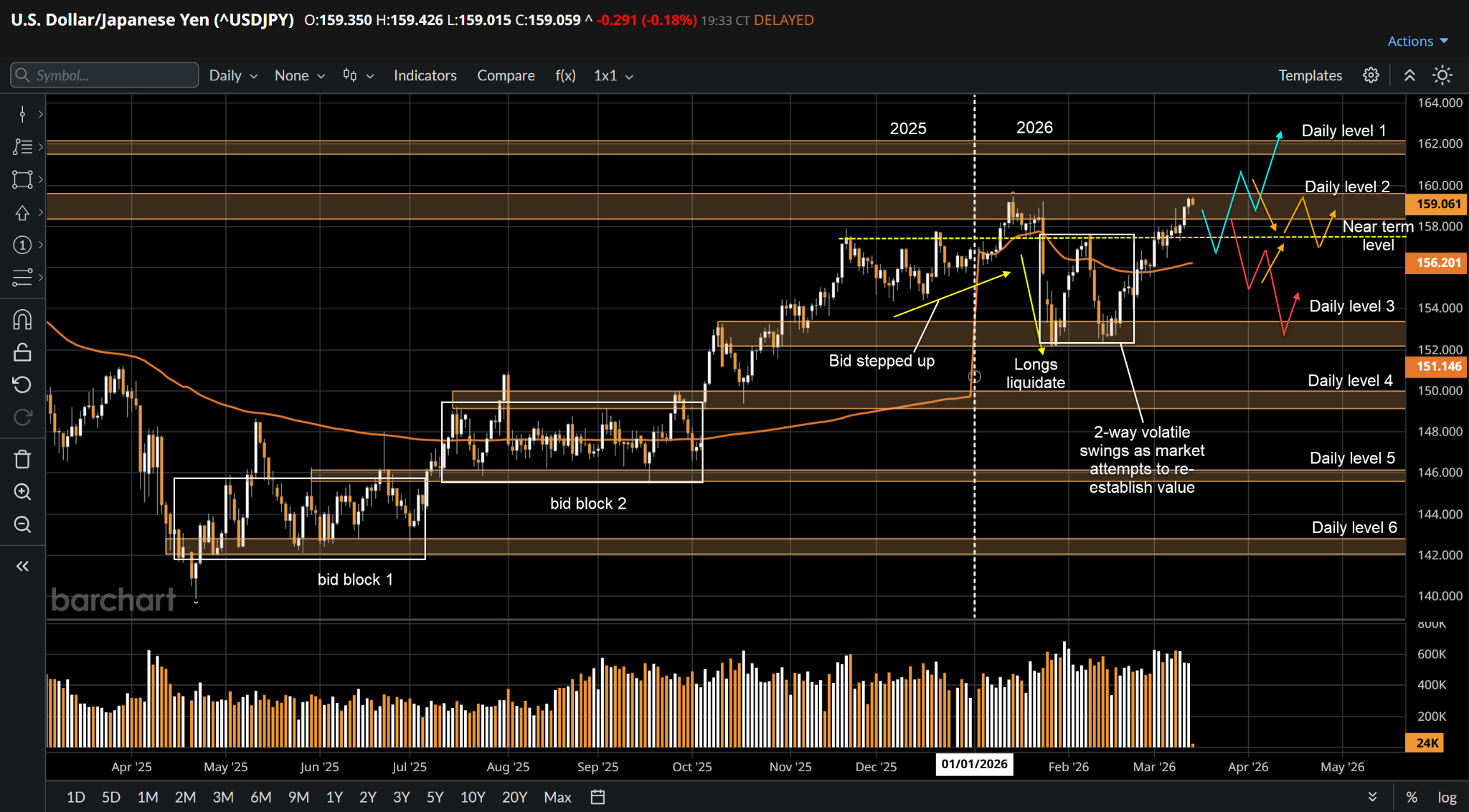
Bullish Scenario
- If the market is able to hold above 157.5 and the 2026 yearly VWAP, the path of least resistance remains higher. Buyers defending this level would signal that the recent pullback from 159.2 is being treated as a retracement rather than a reversal, consistent with the broader uptrend structure.
- A sustained hold above 157.5 would open the door for a move up towards 162 (daily level 1), where sellers are expected to respond. Major bank forecasts including J.P. Morgan's year-end target of 164 would provide fundamental backing for such a move, particularly if US labor market data remains resilient and the BoJ signals no urgency to hike again before October 2026 as ING currently expects.
- The bullish case is additionally supported by the structural carry trade argument. With the Fed's terminal rate still well above Japan's policy rate, and with the BoJ constrained by political pressure from the Takaichi administration, the yield differential continues to favor dollar longs on pullbacks.
Bearish Scenario
- If buyers fail to defend 157.5 or the 2026 yearly VWAP, expect rotation back down through the 157.5 to 152.5 range towards 152.5 (daily support), where buyers are expected to respond. A failure at VWAP would shift the short-term narrative from "buy the dip" to "selling into strength," particularly as intervention risk remains elevated at the 159 to 160 zone.
- The bearish case is reinforced by the fact that the January spike above 159 and subsequent collapse was not random noise. It was a policy message aimed at leveraged carry longs. Should USDJPY approach 159 to 160 again with speed, the Ministry of Finance and potentially the New York Fed could act again, as the January rate check demonstrated that US tolerance for excessive yen weakness tied to JGB yield instability is not unlimited.
- A softer US CPI print or a materially weaker Non-Farm Payrolls report could accelerate pricing of additional Fed cuts in 2026, narrowing the rate differential and removing one of the primary structural pillars supporting USDJPY at elevated levels.
Neutral Scenario
- If there is a false break higher at 159.2 (daily level 2) and buyers subsequently step up bids to defend at the 2026 yearly VWAP, expect a tight consolidation as the market establishes value higher for the next directional move. This scenario reflects a market that is digesting the intervention risk premium while waiting for a fundamental catalyst, whether from a BoJ rate decision, a US payrolls report, or fresh geopolitical developments, to determine the next leg.
- In this environment, the 157.5 to 159.2 range becomes the value area, and traders should watch for expanding volume on either side of this band as confirmation of a directional resolution.
Conclusion
USDJPY sits at a genuinely pivotal technical and macro junction. Technically, the pair is pressing against the 159.2 daily resistance level that capped the December 2025 advance and triggered the January 2026 reversal. The uptrend structure from the April 2025 lows remains intact above 157.5 and the yearly VWAP, but intervention risk is a real and demonstrated constraint that carries heavy weight at these levels. On the macro side, the Fed-BoJ policy divergence continues to provide a structural dollar tailwind, but the BoJ's gradual normalization path, rising JGB yields, Japan's fiscal expansion risks under the Takaichi government, and the demonstrated willingness of both Tokyo and potentially Washington to defend against excessive yen weakness all add meaningful complexity to a straightforward long thesis. Whether this is another opportunity to buy the dip or the beginning of a larger rotation lower will likely depend on the next round of US labor data and the BoJ's communication into its next meeting. How are you positioning as USDJPY tests this critical ceiling again?
Want to express a directional view on USDJPY with precision and transparency? Consider trading the 6J Japanese Yen futures contract rather than a CFD offered by a retail forex broker. The 6J futures contract, traded on the CME Group exchange, offers centralized pricing, deep liquidity, and regulated execution that CFD products simply cannot match. Unlike OTC forex CFDs where the broker may be the counterparty to your trade, futures are exchange-cleared with full pre-trade price transparency. EdgeClear provides direct access to global futures markets with reliable execution and trader-focused platforms built for serious market participation and traders who want to take their trading to the next level. Check out EdgeClear at edgeclear.com.
Disclaimer:
This article is provided for informational and educational purposes only and does not constitute financial, investment, or trading advice. The analysis presented reflects the author’s market observations and opinions at the time of writing and is not a recommendation to buy or sell any futures contract, security, or financial instrument. Futures trading involves significant risk and is not suitable for all market participants. Losses may exceed initial margin deposits, and market conditions can change rapidly.
Any scenarios, levels, or market expectations discussed are hypothetical in nature and are intended solely to illustrate potential market behavior. They do not represent actual trading results and should not be interpreted as guarantees of future performance. Past performance, market behavior, or historical price action are not indicative of future outcomes.
Readers are solely responsible for their own trading decisions and risk management. Always conduct independent research, consider your financial situation and risk tolerance, and consult with a qualified financial professional, if necessary, before engaging in futures or derivatives trading.


/A%20corporate%20sign%20for%20SK%20Hynix%20by%20Tada%20Images%20via%20Adobe%20Stock.jpeg)

/2d%20illustration%20of%20Cloud%20computing%20by%20Blackboard%20via%20Shutterstock.jpg)
/Server%20racks%20by%20dotshock%20via%20Shutterstock.jpg)