Howdy market watchers!
We start off this week praying for our farmer and rancher neighbors impacted by the severe thunderstorms and tornados in northern Oklahoma. Severe weather and hail were forecast, but the tornados were a surprise, especially in March, and also came after dark. Our thoughts and prayers are with these families.
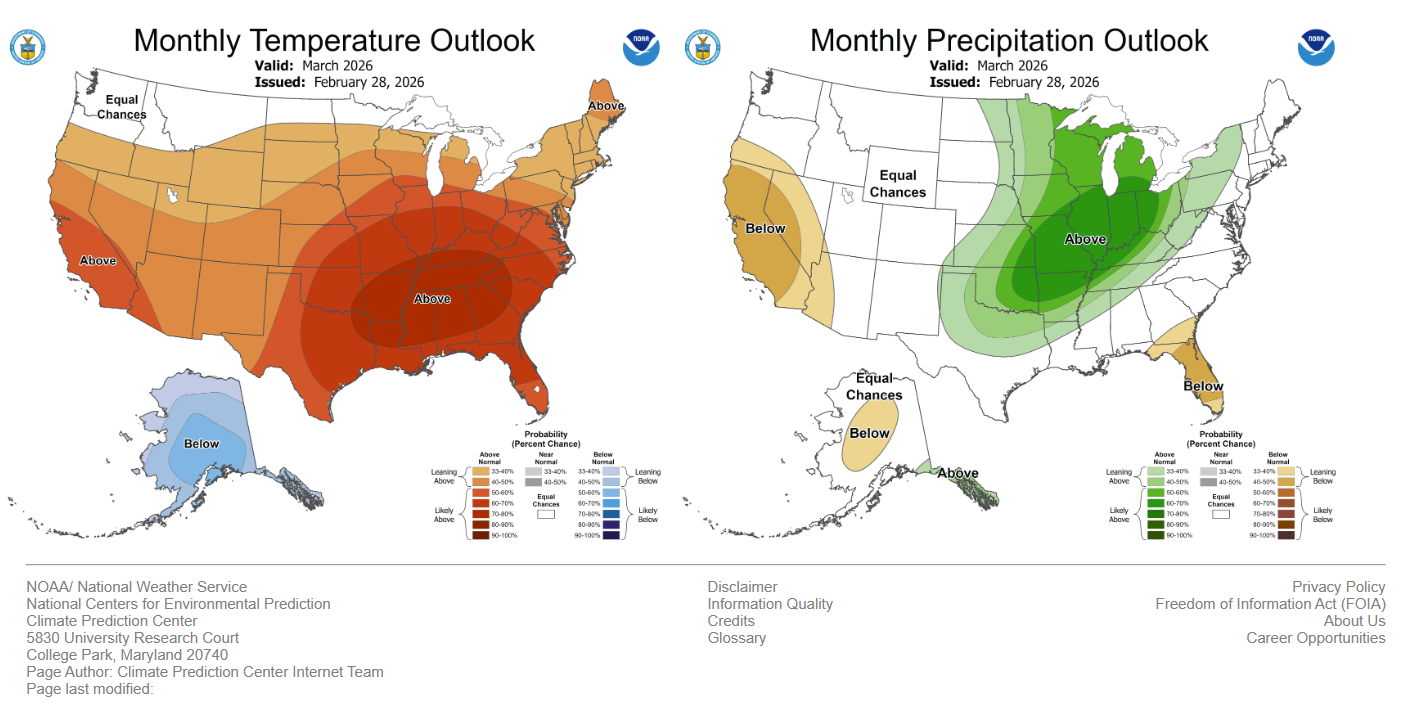
We could be in for a spring of severe weather with warmer than usual temperatures and shifting weather patterns.
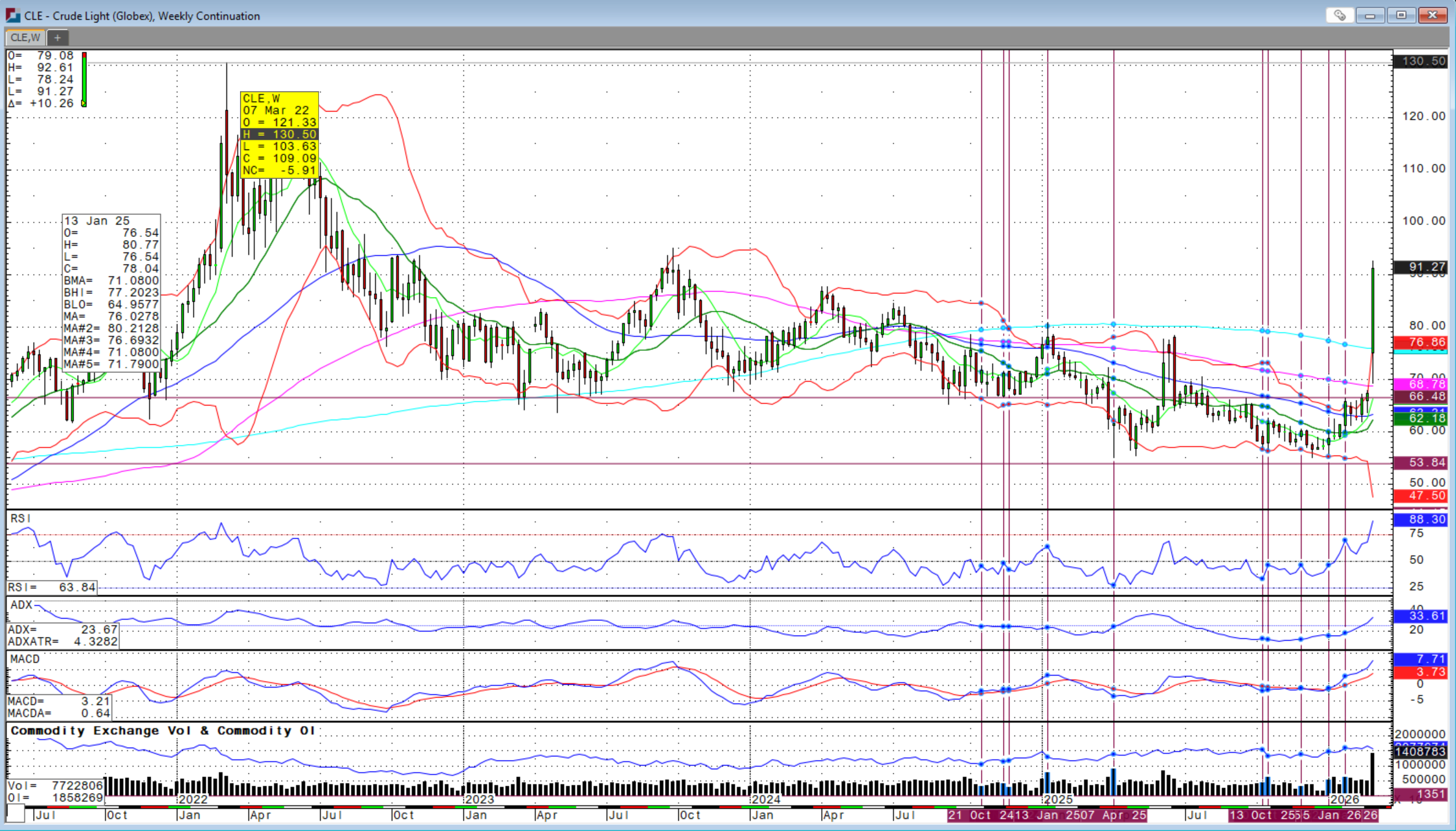
What a week in the markets! We all woke up last Saturday morning to find a recorded video of President Trump saying that Iran had been attacked overnight. Crude oil markets, metals and grains spiked on the Sunday night open, but quickly sold off, finishing Monday’s session lower. With the brute force and breadth of the attacks and selloff in the markets after the immediate spike, many were beginning to think that the war premium had come and gone. However, the week ended on a very different note.
As the week lingered on, Iran began lobbing drones and missiles across the Middle East attacking civilian sites and doing everything they could to wreak havoc to pressure US forces to reconsider the extent of the blundering. Instead, it has brought President Trump to proceed to the next wave of attacks and double-down in destroying all of Iran’s ability to shoot back. That plan continues to play out and will until Iran “unconditionally surrenders,” as President Trump says now is the only thing that will end the fighting.
Iran began threatening closure of as well as ships passing through the Strait of Hormuz throughout the week to increase oil prices to apply additional pressure to President Trump’s plan to lower inflation as well as aggravate regional oil and natural gas producing allies. Crude oil prices began rallying on Tuesday, but in a measured pace and then spiked on Friday as tensions escalated and uncertainties peaked into the weekend.
Neighboring countries had to begin cutting oil production given export shipping channels were impacted and slowed, backing up production and exacerbating the deficit, hence the market’s excitement. Front-month crude oil spiked over 12 percent and despite some intraday softness, it finished near the high.
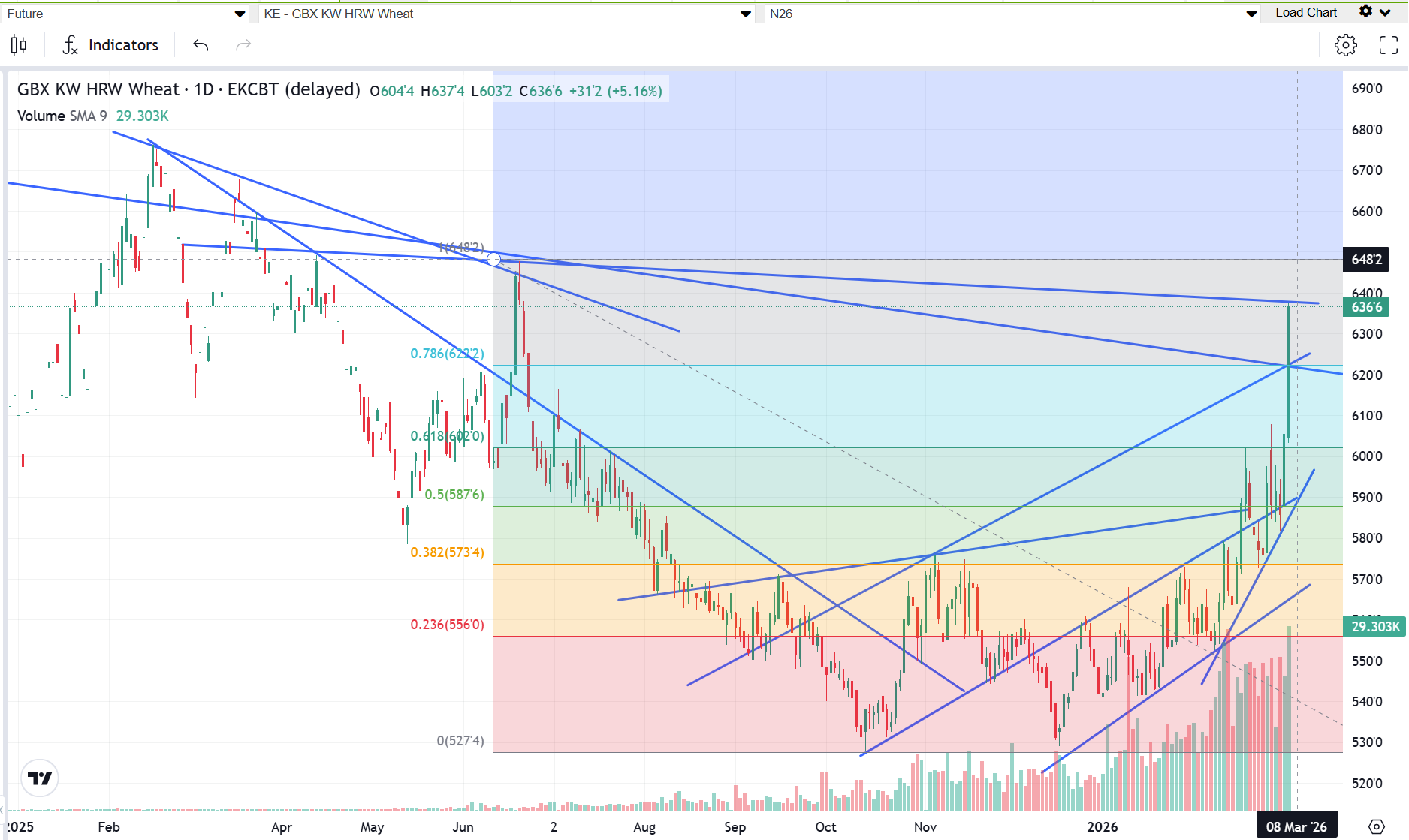
While there are plenty of fundamental reasons to try and explain this week’s grain rally, I believe it is all driven by the crude oil market. Wheat, in particular, has another push as being the commodity in greatest import demand by countries in the region due to flour-based products in the diet and deficiency, but crude oil remains the biggest driver, in my opinion. Therefore, monitor crude oil closely for expectations in the wheat, corn and soybean futures. If the blockage and conflict in the Strait of Hormuz continues, expect grains to go higher.
The Trump Administration announced insurance protections on Friday for ships passing through the Strait to incentivize ships to continue flowing given that global insurance companies have withdrawn from coverage. From the handful of conflicts I’ve traded through in my career, I know that markets spike and linger for a few sessions more than expected, but then crumble and correct more than expected.
This is an opportunity for producers to lock in new crop wheat, corn, milo and soybeans. It is very difficult to hit the top and it is also very difficult to lock in a price and then see the markets go higher for one or two or three or five days after. However, as we say in the trade, it is escalator up and elevator down. We were on an escalator until Friday when the market took the elevator up. Markets get impulsive near the top and spike. I’m not saying Friday was that spike, but markets can be very fickle when markets are at extreme levels.
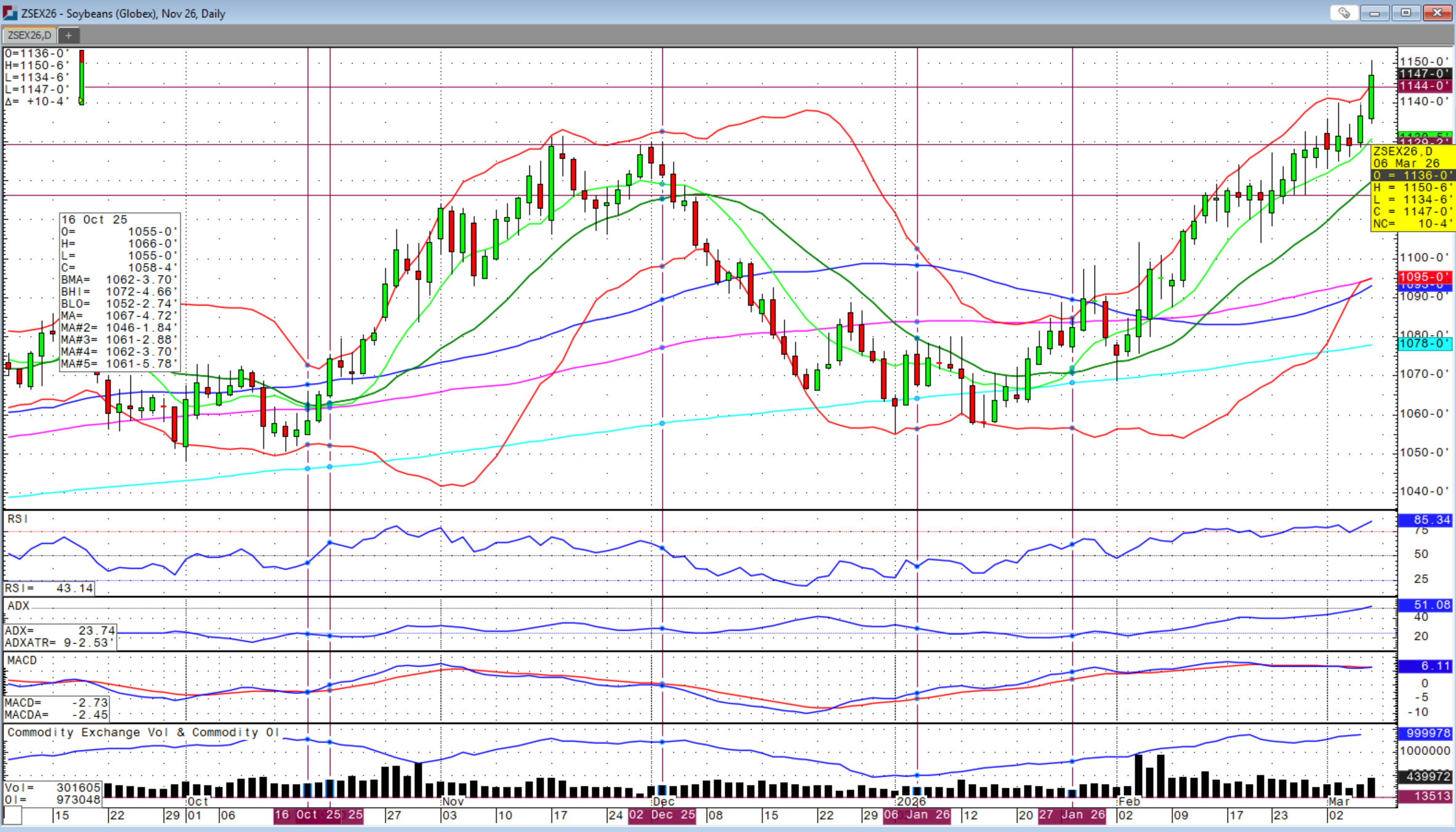
New crop July KC wheat futures closed at $6.35. December corn/milo new crop futures closed at $4.84. November new crop soybeans closed at $11.47. All of these closes were near session highs. The market will be closely watching activity over the weekend and crude oil’s open at 5 PM CDT on Sunday will be foresight to the 7 PM grain market opening. The USDA will release its monthly WASDE and Crop Production reports on March 10th and we will see where the latest production forecasts for South America land as well as exports.
As I mentioned many times during our recent roadshow with Sidwell Insurance, know your breakeven and know the futures price that gives you desirable and acceptable margin. Then, consider locking in physical forward contracts in with your desired delivery point on your crop insurance guarantee bushels and then protect any bushels over that yield with put options or spreads or futures contracts that can be rolled to next year if you don’t produce this year.
If you need help in calculating any of this or coming up with a marketing plan, give us a call as this is what we do and we have all the experience to assist with any crop in both the futures as well as cash markets even if you’re not delivering to our elevator, Enterprise Grain. We are agnostic to where you do business. We want to see farmers across the United States succeed with marketing and already work in many states across the country with grain, livestock, energy marketing and hedging as well as investments in these agriculture commodities as well as precious metals and stock indices.
The equity markets have been taking the new military conflict in stride, somewhat surprisingly. If you had told the markets a year ago that we were about to bomb Iranian nuclear sites in June 2025, it would have been a huge shock. If you then would have told the market that we would be in an all-out “war” with Iran in March 2026, you would have been told you were CRAZY and yet, here we are!
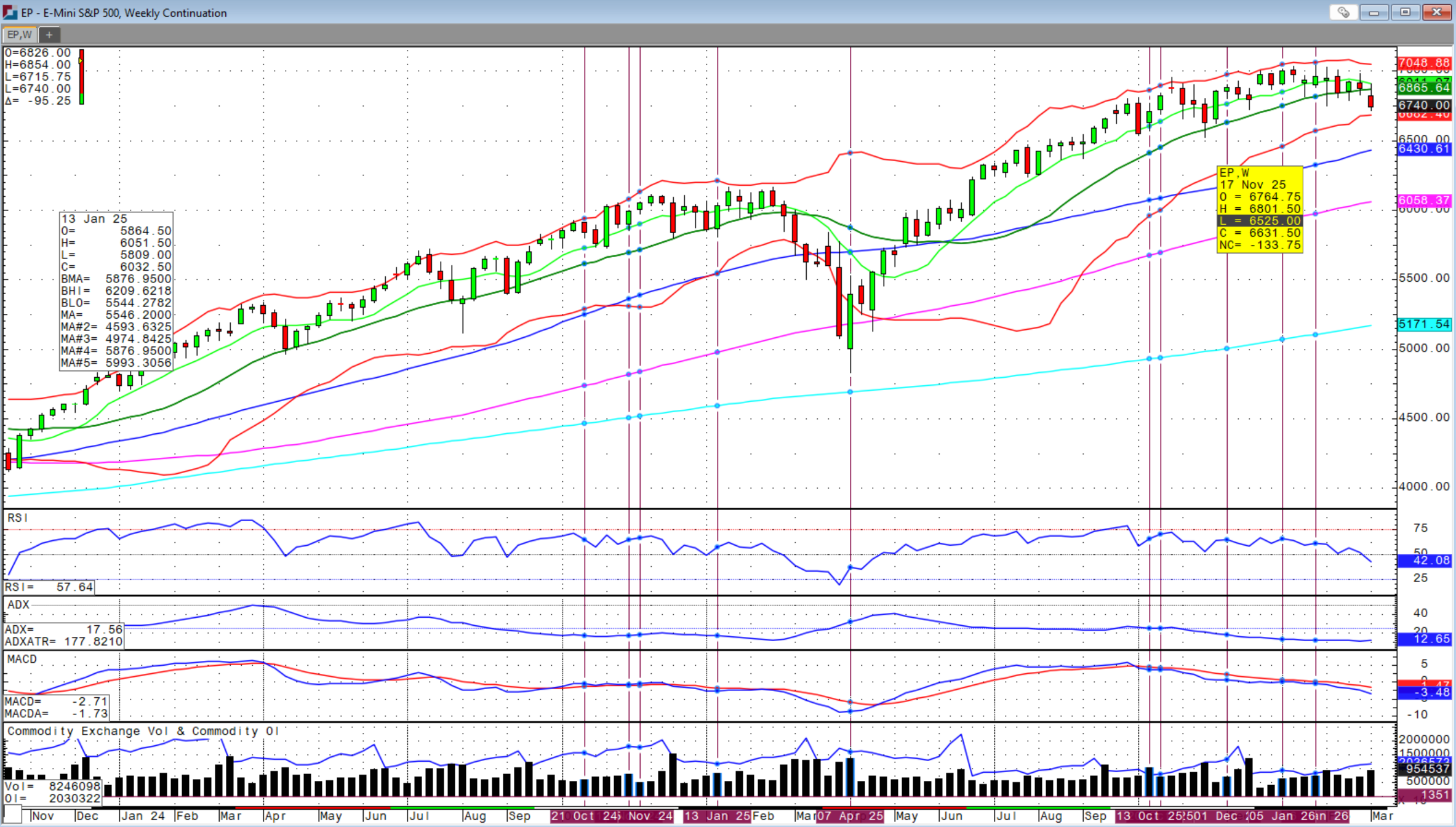
The boundaries become the middle and there are so many considerations to factor into the agenda for the Mid-Term election cycle that has already started. The intensity of the election battle could not be more amplified with all that’s going on, especially with the latest fodder of international conflict and commodity inflation. The US jobs report for February released Friday showed disappointing news with 92,000 jobs lost that also increased the unemployment rate to 4.4 percent from the prior month's 4.3 percent. Combined with the shock of higher energy prices, this is not a trend that we want to see starting.
The translation of uncertainty into stock market weakness has also spilled over into the cattle complex. However, the cattle market has held up relatively well all-considering.
The fed cash cattle market has gone from $249 two-weeks in a row to $244-245 last week to $238-242 this week. With record low slaughter numbers and heavy weight cattle beginning to back up somewhat in the feedyard, I believe we will see heavy slaughter in the weeks ahead, which should bode well for fed cash cattle prices and the cattle complex overall.
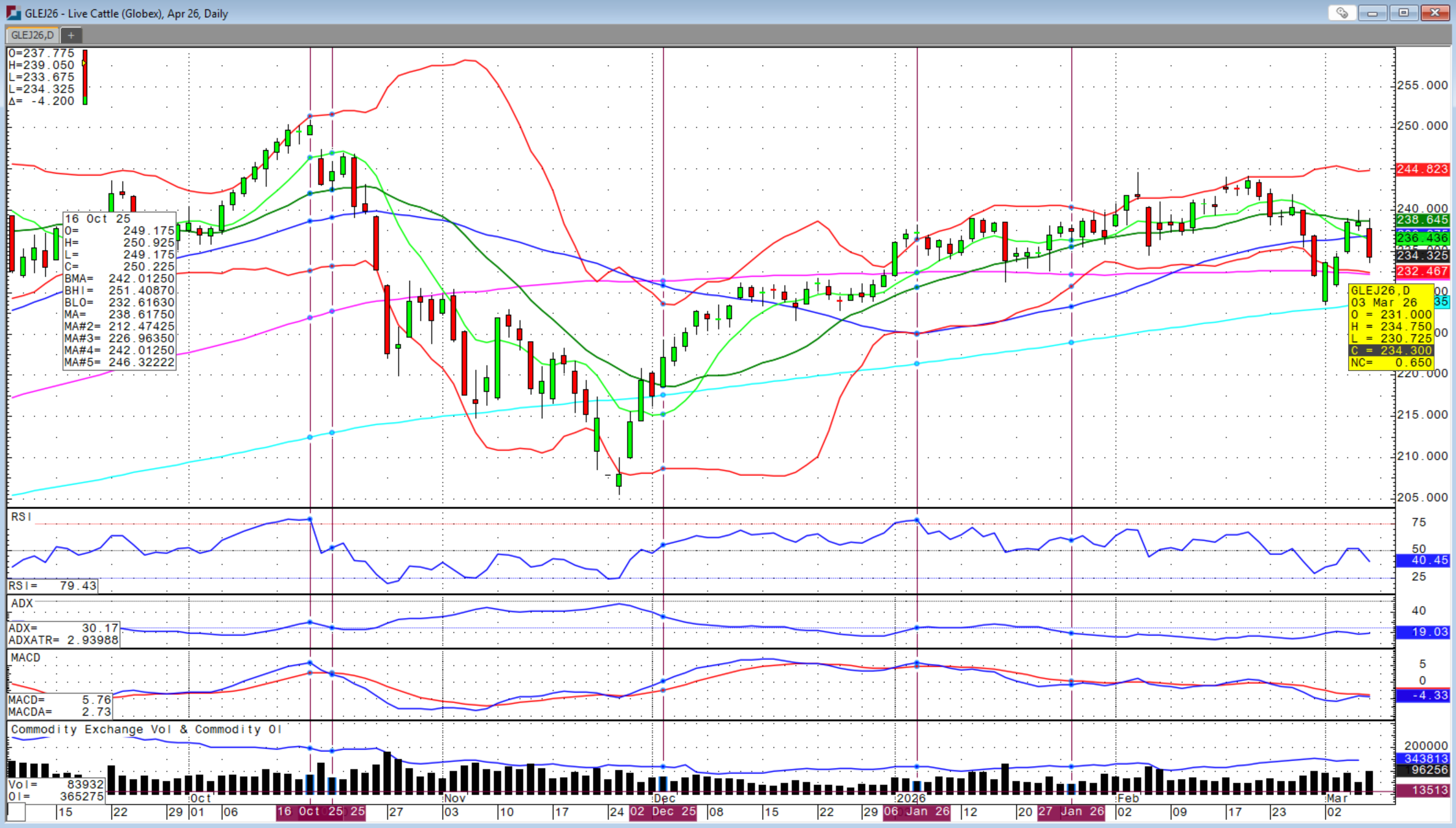
Having said that, should this war escalate and prolong, we could see more downside. Friday’s trade was weak, but I think it was some risk-off into the weekend with uncertainty at a high level. Put options are cheap for March, April and May relative to having price protected last fall and so consider this if you’re concerned about short-term weakness while taking cattle to market. If the war de-escalates, crude oil drops and equities rally strongly, I believe we could be headed towards that last chart gap from back in October and perhaps new, all-time highs driven by demand and the fundamental supply shortage.
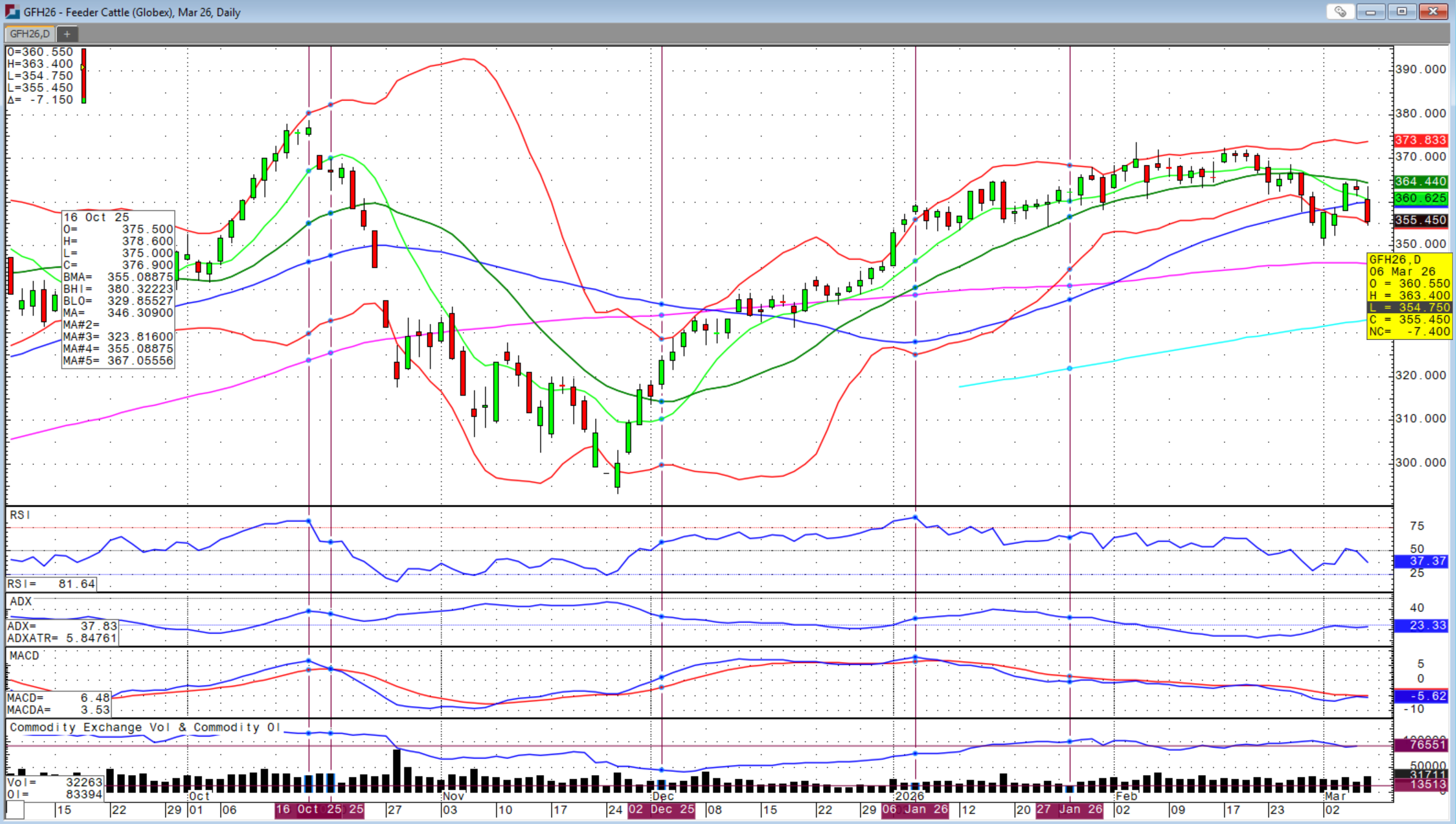
Have faith but protect your equity especially if you’ve been able to ride this market from historic highs, back down to sub-$3.00 and back near the peak. The only thing that matters for your bottomline is what the price is when you sell the cattle and not what the high is for the year. Play it smart and realize that insurance is a cost of doing business, especially in this environment of extremes.
Sidwell Strategies is the one-stop shop to protect cattle with futures, puts, LRP or a combination of all, which is probably the best strategy overall. If you’re ready to trade commodity markets, give me a call at (580) 232-2272 or stop by my office to get your account set up and discuss risk management and marketing solutions to pursue your objectives. Self-trading accounts are also available. It is never too late to start and there is no operation too small to get a risk management and marketing plan in place.
Wishing everyone a successful trading week! Let us know if you'd like to join our daily market price and commentary text messages to stay informed!
Brady Sidwell is a Series 3 Licensed Commodity Futures Broker and Principal of Sidwell Strategies. He can be reached at (580) 232-2272 or at brady@sidwellstrategies.com. Futures and Options trading involves the risk of loss and may not be suitable for all investors. Review full disclaimer at https://www.sidwellstrategies.com/fccp-disclaimer-21951.

/Amazon_com%20Inc_%20storefront%20by-%20%20Markus%20Mainka%20via%20Shutterstock.jpg)