Chart of the Day
The information and opinions expressed below are based on my analysis of price behavior and chart activity
Sign Up to receive Walsh Trading’s 1st Half of 2026 Market Outlook First Half of 2026 Outlook for the Livestock and Grain markets.
Thursday, February 26, 2026
If you like this article and would like to receive more information on the commodity markets from Walsh Trading, please use the link to join our daily email list -Click here
April Live Cattle (Daily)
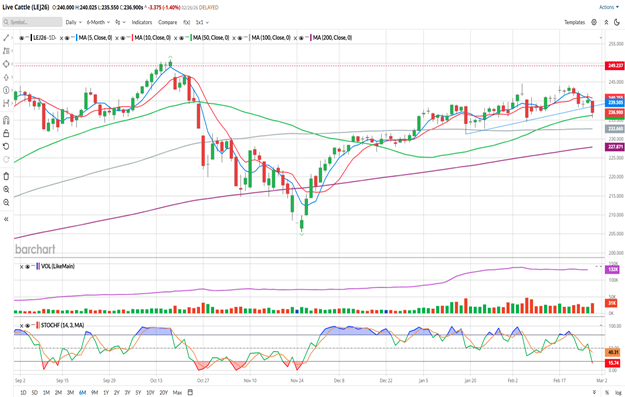
April Live Cattle closed at 236.900 today, dropping 3.375 on the day. This marks the lowest close since February 5th and is the 2nd lowest close of the month. The 50-day moving average (green, 236.200) held as support today. However, yesterday’s trade saw the 5- and 10-day averages make a bearish crossover and the 5-day (blue, 239.500) seemed to act as resistance today and the 10-day (red, 240.755) was never tested on Thursday. There’s a blue trendline drawn on the chart above, connecting the lows in January and February, and today’s trade broke through that. The 100-day moving average (grey, 232.660) has basically been a flat line since before Christmas, which indicates to me that this market is need of directional momentum. The 200-day average (purple, 227.871) is well below the market and is still inclined higher. Stochastics (bottom sub-graph) are just starting to tick into oversold territory, but they haven’t been “oversold” since just before Thanksgiving. Technically, this market is showing some signs of short-term weakness, I think. But I’ve been saying that for a while, now, and the market remains in a sideways pattern. The first day of 2026 the market closed at 235.975…two months in and we’ve moved less than 1.000.
From my perspective, not much has changed on the supply/demand side of the Cattle markets. Last Friday’s Cattle On Feed report confirmed that the US herd continues it’s decline, as 11.5 million head are on feed, a 2% decline from the numbers of a year ago. Marketings declined by 13% to 1.63 million head and Placements are at 1.74 million head, a decline of 5%. The percentage of heifers on feed remained steady at 39%, showing no signs of heifer retention or herd expansion. Tuesday’s Cold Storage data also showed a decline in frozen beef by about 4% from this time last year. We have less cattle, less beef in the freezer and more people to feed. Fundamentals remain bullish, in my opinion.
There’s lots of uncertainty and fear, I think, in the cattle markets today. The uncertainty will always be present, I think, in every market and on some level, so that’s not too unusual. Livestock producers will recall a seemingly random statement from the President in October putting prices in a tailspin for about a month. They also recall the way the market dropped from its peak in 2015-16 and prices stayed low until 2020. This 5-6 year rally has been great for them, but they’re waiting for the proverbial shoe to drop. And not everything that they’re hearing is all bullish and good. The border with Mexico remains closed to Livestock imports due to the New World Screwworm. It will re-open at some point, but nobody seems to know when that might be. As a result of that, news is circulating this week about a 50,000 head feedlot closing in TX, after 70 years of operation. I’m starting to think that even when the border re-opens, the number of cattle coming across will take a long time to rebuild to the roughly 100k/month that were coming across before the closure in 2024. Those animals still exist, but they’re getting fed out and fattened for slaughter in MX now. I doubt very much that those operations will just willingly close up shop when the border does open. There’s labor unrest within the packing industry, as a major processing plant in CO is under imminent threat of strike. With packer margins as far in the red as they are, I don’t think they can afford a plant closure and they may seek to ward that off.
On the bullish side, Sale Barns from KY to WY continue to set records for the prices folks are paying for the lighter cattle. Retail prices for consumers are still high, but demand doesn’t seem to be slowing.
For what it’s worth, I don’t think the market is going to head significantly lower and turn into a bearish market anytime soon. Although, we may have different definitions of significant.
When I last wrote in this space, I advocated for Cattle producers to look at either 235 April Put Options or the April 235/225 Put Spread. The outright Put settled at 4.30 today, down from the 4.75 it was at two weeks ago, and the Put Spread settled at 2.625, also down from the 2.925 level 2 weeks ago. I still recommend those positions for the producers out there, or those that need to manage their downside risk.
April Live Cattle (Weekly)
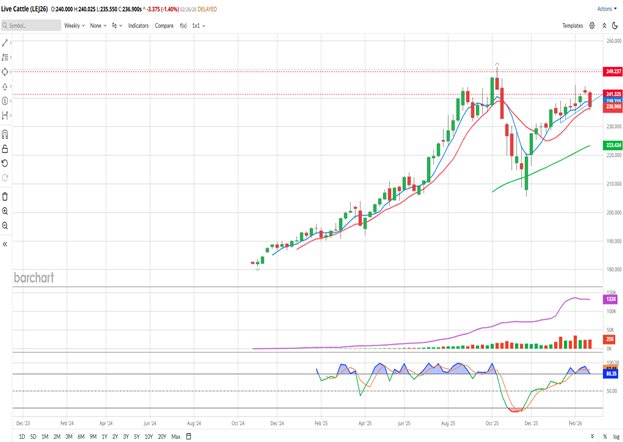
So far this week, April Cattle are down 5.100 from last Friday’s close. This appears to be the biggest bearish bar we’ve seen since the first week of November. The 10-week average (red, 236.900) has held as support, so far, while the 5-week average is at 238.715, offering potential resistance. Both of those averages are still in a bullish configuration and pointing higher. The 50-week (green, 233.425) is offering potential support there. Stochastics are overbought, but the reading has been declining this week and the two averages in that indicator are making a bear cross now. I also think it’s interesting that this week’s trade has engulfed, not last week’s activity, but the first two weeks of the month. That certainly doesn’t seem bullish to me.
My seasonal charts (not pictured) point toward weakness through the first week or two of March. You can view Barchart’s seasonal data here. Their analysis seems to show a 50/50 proposition for March to be up or down, while April leans almost 70/40 to the downside. They do show small gains in each of those months, on average, over the past 15 years.
Sign Up to receive Walsh Trading’s 1st Half of 2026 Market Outlook First Half of 2026 Outlook for the Livestock and Grain markets.
If you like what you’ve read here and would like to see more like this from Walsh Trading, please Click here and sign up for our daily futures market email.
Jefferson Fosse Walsh Trading
Direct 312 957 8248 Toll Free 800 556 9411
jfosse@walshtrading.com www.walshtrading.com
Walsh Trading, Inc. is registered as a Guaranteed Introducing Broker with the Commodity Futures Trading Commission and an NFA Member.
Futures and options trading involves substantial risk and is not suitable for all investors. Therefore, individuals should carefully consider their financial condition in deciding whether to trade. Option traders should be aware that the exercise of a long option will result in a futures position. The valuation of futures and options may fluctuate, and as a result, clients may lose more than their original investment. The information contained on this site is the opinion of the writer or was obtained from sources cited within the commentary. The impact on market prices due to seasonal or market cycles and current news events may already be reflected in market prices. PAST PERFORMANCE IS NOT NECESSARILY INDICATIVE OF FUTURE RESULTS. All information, communications, publications, and reports, including this specific material, used and distributed by Walsh Trading, Inc. (“WTI”) shall be construed as a solicitation for entering into a derivatives transaction. WTI does not distribute research reports, employ research analysts, or maintain a research department as defined in CFTC Regulation 1.71.


/Nvidia%20logo%20on%20phone%20screen%20with%20stock%20chart%20by%20xalien%20via%20Shutterstock.jpg)

/Quantum%20Computing/A%20concept%20image%20of%20a%20green%20and%20yellow%20motherboard_%20Image%20by%20Gorodenkoff%20via%20Shutterstock_.jpg)